Glass House, Hakgala Botanic Gardens
Hakgala, Nuwara Eliya
No freely licensed photo of this greenhouse yet. Do you have one? Suggest it for this page →
Sources checked October 2026
- Style
- Display house for indoor plants (the 'glass house')
- Status
- Open with the garden (365 days a year according to the official site); garden reopened on 25 December 2025 after Cyclone Ditwah, with some areas temporarily closed
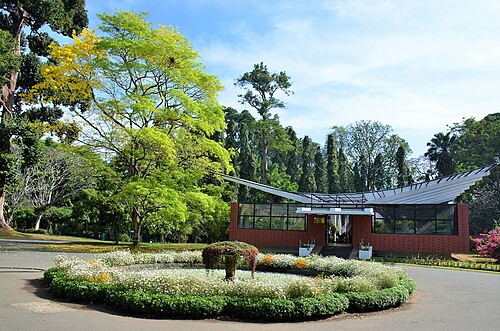
Hakgala Botanic Gardens, founded in 1861 to trial cinchona cultivation, at about 1,745 m above sea level near Nuwara Eliya, hold a 'glass house' that the official site of the Department of National Botanic Gardens describes as newly established, meant for indoor plants and standing beside the exit drive. It displays begonias, peperomias, African violets, primulas, gloxinias, streptocarpus and pelargoniums, as well as many cacti and succulents. The official plan places it near the herbarium and the nursery.
Affiliate links — booking through Verrière helps fund our research, at no extra cost to you.
History
Hakgala Botanic Gardens were founded in 1861 to experiment with and promote cinchona cultivation in Sri Lanka, according to the official site of the Department of National Botanic Gardens. English Wikipedia credits the foundation to George Henry Kendrick Thwaites, explains that tea later replaced cinchona and that the site became a garden in 1884. The official site mentions a summer house built in 1910 in memory of J. K. Nock, one of the garden's first curators, and a bulb garden opened in 1924: the place was laid out in stages.
The 'glass house' belongs to a more recent phase. The official page (its images were uploaded in 2021) calls it 'newly established' and describes it as a repository for indoor plants; the Jetwing guide (undated) also speaks of 'a new addition'.
The garden was interrupted at the end of 2025: closed because of the disaster conditions caused by Cyclone Ditwah, it reopened to visitors on 25 December 2025 according to Ada Derana, with areas judged dangerous signposted, among them the pond area near the entrance. According to the Department, 522,450 visitors came in 2025, against 749,257 in 2024, and the fall in 2025 revenue is attributed to a full closure of about a month.
Architecture and engineering
The official site, Jetwing (undated) and TravelTriangle (2024) speak of a 'glass house' or 'greenhouse'. The garden's official plan draws the glass house as a small building with a glazed front, in the lower left of the plan, close to the herbarium, the nursery, the office and the rose garden. Jetwing places it across from the entrance, on the lower left edge, with the herbarium and the nurseries, and the official site 'alongside the exit drive'.
A photograph in the official site's gallery (uncaptioned, uploaded in October 2021) shows the interior of a greenhouse whose lattice metal frame carries a roof and walls of translucent panels, with a gravel path, planted borders and flowering pots on a stepped bed. It matches the written description, but nothing expressly identifies it as the glass house, and the panel material cannot be established from the image. The garden itself forms several terraces on the lower slope of Hakgala Rock, and the official site gives it a cool climate, with temperatures of 3 to 15 °C.
Plant collections
For the glass house, the official site lists flowering specimens of begonias, peperomias, African violets, primulas, gloxinias, streptocarpus and pelargoniums, as well as many kinds of cacti and succulents. Jetwing (undated) repeats the begonias, African violets, cacti and succulents; TravelTriangle (2024) sees a recent glass structure serving as a store for indoor plants. It is a collection of pot plants, closer to a display house than to a tropical conservatory.
Around it, the official site describes a rose garden on two terraces with modern varieties imported from England and America, a bulb garden (lilies, gladioli, agapanthus) many of whose plants came from Holland and Japan, a fernery whose character comes from Sri Lanka's woolly tree fern, an arboretum of native, endemic and exotic trees, and the native rhododendron with scarlet blooms.
Visiting
The glass house stands on the garden's route, beside the exit drive according to the official site. The official site advises walking round this 'very compact' garden to explore its many corners, and Jetwing describes terraces rising from the flower, bulb and rose beds at the bottom to the fernery, the rockeries and then the arboretum, at the foot of Hakgala Rock.
The best season is, according to the official site, mid-March to the end of April, the 'Nuwara Eliya season', when temperate annuals, roses and orchids are at their best. The garden lies about 9.5 km south-east of Nuwara Eliya on the Badulla road (other sources give 6 or 16 km) and adjoins the Hakgala Strict Nature Reserve. After the cyclone at the end of 2025, some areas were temporarily closed: it is wise to check conditions before coming.
6.93° N, 80.82° E
Greenhouses nearby
Do you have a good photo of this greenhouse? Suggest it for this page →
Sources (6)
- botanicgardens.gov.lk/service/botanic-gardens-hakgala/
- jetwinghotels.com/islandinsider/how-to-spend-a-day-at-hakgala-botanical-garden-your-ultima
- en.wikipedia.org/wiki/Hakgala_Botanical_Garden
- traveltriangle.com/blog/hakgala-botanical-garden/
- sinhala.adaderana.lk/news/218871
- ada.lk/breaking_news/%E0%B7%84%E0%B6%9C%E0%B7%8A%E0%B6%9C%E0%B6%BD-%E0%B6%86%E0%B6%AF%E0%B
Affiliate links — booking through Verrière helps fund our research, at no extra cost to you.