Selva Subtropical Glasshouse, Córdoba Municipal Botanical Garden
Córdoba (Quebrada de las Rosas district), Córdoba Province
No freely licensed photo of this greenhouse yet. Do you have one? Suggest it for this page →
Sources checked October 2026
- Style
- Large glasshouse described as a "glass cube", subtropical forest under glass
- Dimensions
- 40 m long, 11 m high, 10 to 11 m wide
- Status
- Open to the public with the municipal garden; renovated in 2023
In Córdoba's municipal botanical garden, in Argentina, the Selva Subtropical is a large glasshouse 40 m long, 10 to 11 m wide and 11 m high. It recreates a forest from Misiones Province with trees, palms, orchids and bromeliads, set up from soil and plants brought from Misiones, and must stay above 21 °C all year. Put back in order in 2020 and renovated in 2023, it is equipped with a fogging system that simulates tropical rain, RGB lighting and a sound system.
Affiliate links — booking through Verrière helps fund our research, at no extra cost to you.
History
Córdoba's municipal botanical garden stands on a former dump, plagued by recurring fires, beside the Suquía river, in the Quebrada del Infiernillo (Quebrada de las Rosas district). The city, then led by Rubén Américo Martí, cleared it and laid out three hectares in the late 1990s; it opened on 14 April 1999 according to the municipal press, whereas Wikipedia speaks of a creation in 1997 and an inauguration in 1999. It later grew to six hectares, an extension that Wikipedia dates to 23 May 2005. Its main building is the work of the architects Mónica Bertolino and Carlos Barrado, according to Wikipedia.
According to the same source, the Selva Subtropical was built jointly with the educational room and the aquarium, without precise dates. In May 2023, La Voz wrote that its collection was assembled about twenty-three years earlier, with soil and plants brought from Misiones Province, and had matured into a formation typical of the Argentine subtropical forest.
The whole had deteriorated. A first stage of work, in 2020, put the fountain back in operation, installed new irrigation, pruned the central bed, removed the soil that covered the paths and damaged metal structures, and replaced broken panes; the garden reopened in early January 2021 after its pandemic closure. A second stage began on 2 May 2023, as part of the future Rubén Américo Martí environmental hub: rebuilding the interior paths, finishing the electrical work, repairing ground undermined by water seeping in from outside, and a new fogging system. The garden reopened on 3 June 2023.
Architecture and engineering
The glasshouse is 40 m long, 11 m high and 10 m wide according to the city; La Voz gives 11 m for the width. The newspaper sees a large glass structure, "a kind of glass cube", and Perfil calls it a vast glazed greenhouse. The 2020 works mention metal structures and the replacement of broken panes. On OpenStreetMap it is drawn as a glass building of about 43 m by 13 m, next to the educational room and the aquarium.
The Misiones forest requires a temperature kept above 21 °C all year, to avoid damage and disease, along with stable humidity. The 2023 renovation added an automatic fogging system that simulates storms, tropical rain and mist, RGB lighting and a sound system that accompany the atmosphere wanted for guided visits. The glasshouse's perimeter canal has been turned into a dry patio, to contrast with the interior. For this route each visitor is given a rain cape, a pilotín, according to Perfil.
Plant collections
The glasshouse holds the only subtropical forest in the city: a patch of Misiones forest under glass. According to La Voz, it has 60 orchid species out of the 100 found in Argentina, 30 species of trees and palms, and 60 hybrid or exotic orchids; most of the orchids and bromeliads are epiphytes, meaning they live on another plant without parasitising it. The city's website describes the walk as a display of forest plants and animals of various origins, representing a small part of the diversity of tropical forests.
The garden has ten walks over six hectares: organic vegetable garden, flowers, cacti and succulents, palms, conifers, grasses, native flora of the Espinal, urban trees, aromatic plants and this Selva Subtropical. Another glasshouse, the Invernadero El Infiernillo, is devoted to producing native species.
Visiting
The glasshouse stands in the municipal botanical garden, near the educational room and the aquarium according to OpenStreetMap; the address is Francisco Yunyent 5491, in the Quebrada de las Rosas district (a municipal page of December 2025 gives Avenida Chancay 800). In 2023 the city announced guided visits with limited places, in order of arrival, and entering the large glazed glasshouse was part of the route. Allow an hour with the glasshouse, the artificial lagoon (carp, turtles, aquatic plants) and the Flora Cordobesa walk, 1.5 hectares reopened in 2023 after twenty years of closure, which has a viewpoint over the Suquía.
Not to be confused with the Real Jardín Botánico de Córdoba in Spain, which is a different garden.
31.39° S, 64.25° W
More greenhouses — Argentina
All greenhouses — Argentina →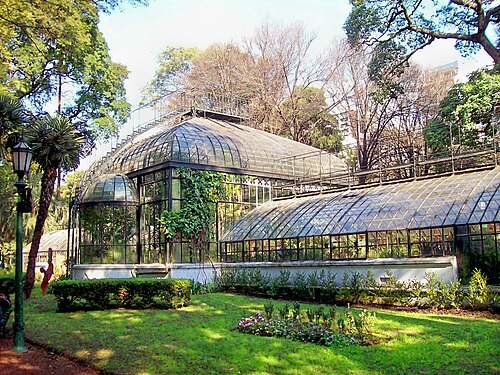
Do you have a good photo of this greenhouse? Suggest it for this page →
Sources (8)
- cordoba.gob.ar/el-jardin-botanico-reabrio-sus-puertas/
- lavoz.com.ar/ciudadanos/ponen-en-valor-la-unica-selva-subtropical-que-hay-en-la-ciudad-de-
- perfil.com/noticias/cordoba/con-una-selva-tropical-en-su-interior-reabre-un-renovado-jardi
- es.wikipedia.org/wiki/Jard%C3%ADn_bot%C3%A1nico_de_la_municipalidad_de_C%C3%B3rdoba
- ambiente.cordoba.gob.ar/botanico/
- infonegocios.info/ciudad-informa/de-basural-a-espacio-educativo-y-de-conservacion-vegetal-
- cordoba.gob.ar/en-verano-cordoba-capital-familia/
- lavoz.com.ar/ciudadanos/jardin-botanico-cuales-son-los-paseos-y-visitas-guiadas-que-se-pue
Affiliate links — booking through Verrière helps fund our research, at no extra cost to you.