Glass House, Quranic Park
Al Khawaneej, Dubai
No freely licensed photo of this greenhouse yet. Do you have one? Suggest it for this page →
Sources checked October 2026
- Year
- 2019
- Architect
- Dubai Municipality project
- Style
- Climate-controlled glasshouse with a glazed roof and an indoor observation walkway
- Dimensions
- 64-hectare park
- Status
- Open to the public (separate ticket; park entry free)
At the heart of Al Khawaneej's Quranic Park, opened to the public in 2019 by Dubai Municipality on 64 hectares, the Glass House is a greenhouse growing plants named in the Quran and the Sunnah. Announced in 2016 together with the Cave of Miracles as a 100-million-dirham project, it stands, according to a municipality architect, on the highest point of the park. A building management system sets the temperature for the needs of each species, and a misting system keeps the humidity up. Labels in Arabic and English link each plant to its uses and to the verses that mention it.
Affiliate links — booking through Verrière helps fund our research, at no extra cost to you.
History
The Quranic Park is a Dubai Municipality project in the Al Khawaneej district, in the east of the emirate. On 25 September 2016 the press reported that Sheikh Hamdan bin Rashid, Deputy Ruler of Dubai and chairman of the municipality, had approved a 100-million-dirham project covering the Cave of Miracles and the Glass House, presented as two major elements of the park. The municipality's director general then described the greenhouse as a place bringing together the plants named in the Quran and the Sunnah, which grow within particular temperatures and environmental conditions, alongside shops selling herbs and plants.
The park opened to the public in spring 2019: a Gulf News article updated on 30 March mentions its first weekend, and the daily Emarat Al Youm reported on 8 April 2019 that 100,000 people had visited in a week, for a total cost close to 200 million dirhams. A municipality architect named the Glass House among the key elements and placed it on the highest point of the park, so that visitors could see all its elements. According to the Arabic Wikipedia article on the municipality, the park received more than five million visitors between 2019 and 2024.
Architecture and engineering
The municipality's official page describes the Glass House as the building reserved for plants that need a controlled environment. A smart electromechanical system sets its temperature through a building management system (BMS), programmed for the needs of each type of plant, via a high-efficiency air-conditioning system linked to the plantings. A smart irrigation and misting system maintains the required humidity; the Arabic version of the page adds that mist is released in different zones of the house at set times for visitors throughout the day.
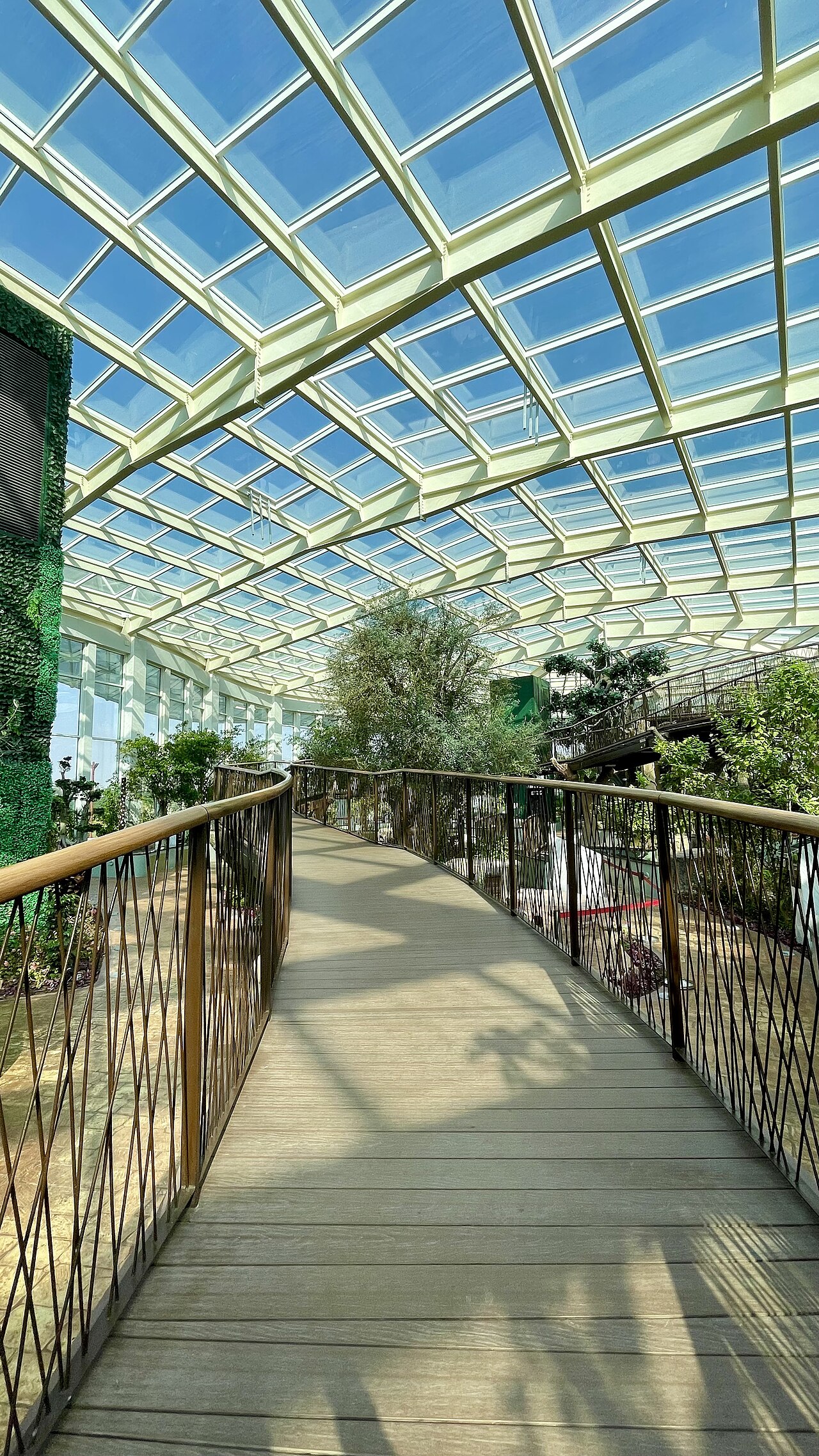
Inside, according to the Dubai Online guide, stairs lead up to a raised observation deck giving a view over the plants and the building, and a municipality architect mentions a café surrounded by trees and plants. Photographs taken in December 2023 and published on Wikimedia Commons show a roof of glass panels set on a lattice of light-coloured members, a raised walkway above the planting beds and a green wall.
Plant collections
The Glass House brings together the plants named in the Quran and the Sunnah that need a controlled environment, while twelve themed orchards (grape, palm, olive and others) occupy the rest of the park. The municipality's official page cites 51 types of plants for the project as a whole, including banana, pomegranate, olive, watermelon, grape, fig, garlic, leek, onion, corn, lentil, wheat, cumin, ginger, date, basil, pumpkin and cucumber. Dubai Online lists, inside the house, corn, olive, citron, lemongrass, saffron, barley, basil, wheat, banana, garlic, sesame, grape, pumpkin, ginger, onion, aloe vera, mustard and leek.
The plants carry labels in Arabic and English giving their uses, their health benefits and the Islamic text that mentions them; a photograph taken in 2023 shows an olive tree labelled in this way. The number of plant types is given as 29 (Arabic Wikipedia, for the park), 43 (Gulf News, 2019), 45 (Emarat Al Youm, 2019) or 51 (the municipality; Gulf News, 2024, in its section on the glasshouse).
Visiting
The Glass House stands in the Quranic Park in Al Khawaneej, in eastern Dubai, close to the Sharjah border. The park is free to enter; the greenhouse and the neighbouring Cave of Miracles, a multimedia exhibition on seven Quranic miracles, are two attractions with separate tickets. No metro station is within easy walking distance: car or taxi are the simplest ways to get there, according to Dubai Online.
The greenhouse's air-conditioning makes it a workable stop in any season, whereas the rest of the park (Moses Lake and its sunken walkway, jogging and cycling tracks, play areas, solar trees) is better walked in the cooler hours. Within about 500 m, according to Dubai Online, are the Last Exit Al Khawaneej food-truck park and the Al Khawaneej Walk shopping centre.
25.24° N, 55.47° E
Greenhouses nearby
Do you have a good photo of this greenhouse? Suggest it for this page →
Sources (8)
- dm.gov.ae/projects/quranic-park/
- thenationalnews.com/uae/dh100-million-project-approved-for-quran-park-1.194303
- gulfnews.com/uae/inside-the-just-opened-quranic-park-in-dubai-1.63013584
- emaratalyoum.com/local-section/other/2019-04-08-1.1200572
- gulfnews.com/amp/living-in-uae/ask-us/dubais-quranic-park-unveiling-islamic-heritage-throu
- dubai-online.com/sights/quranic-park/
- ar.wikipedia.org/wiki/%D8%A8%D9%84%D8%AF%D9%8A%D8%A9_%D8%AF%D8%A8%D9%8A
- commons.wikimedia.org/wiki/File:Inside_Glass_House_at_Quranic_Park.jpg
Affiliate links — booking through Verrière helps fund our research, at no extra cost to you.