Central Park Conservatory
Malvern East, Melbourne, Victoria
No freely licensed photo of this greenhouse yet. Do you have one? Suggest it for this page →
Sources checked October 2026
- Year
- 1927
- Style
- Interwar public conservatory, steel frame and wire-reinforced glass on a concrete base
- Dimensions
- 10 m × 7 m according to the Victorian Heritage Register
- Status
- Open to the public on two days a week, according to the City of Stonnington
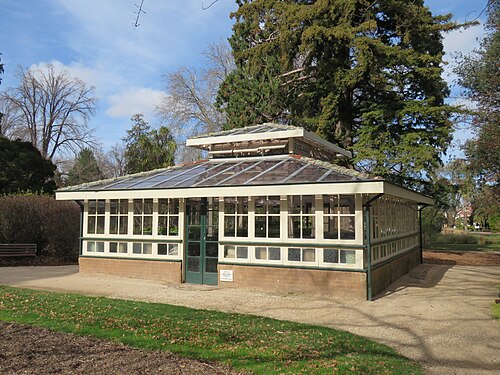
Set on the highest point of Central Park, an Edwardian park of almost eight hectares in Malvern East, a suburb of Melbourne, this conservatory was built in 1927 by Malvern City Council. A steel frame carries clear wire-reinforced glass walls on a concrete base, and the building is divided into three zones, the central one housing tropical plants. Restored, it is on the state heritage register, which ranks it among the oldest and largest public conservatories still standing in Victoria.
Affiliate links — booking through Verrière helps fund our research, at no extra cost to you.
History
The conservatory dates from 1927: the plaque on site says it was built by Malvern City Council.
The Victorian Heritage Register sees in the building evidence of the interwar growth of interest in exotic plants and in their public display. The adjacent boiler house, essential to how such conservatories worked at the time, is protected with it. The place is registered under number H0908.
The conservatory was kept at the council's wish. RBA Architects repaired the corroded steel sections in place instead of replacing them, in a project the firm dates to 1994. A plaque dated 2 March 1997 marks the restoration and recognises the contribution of the Friends of Central Park.
Architecture and engineering
According to the Victorian Heritage Register, the conservatory measures 10 metres in length by 7 metres in width. It stands on a concrete base, with a structural steel frame and walls of clear wire-reinforced glass. It is divided into three areas: the central one is set aside for tropical plants, while display shelves, including tiered shelving, run along both sides. The building's outline as mapped in OpenStreetMap, roughly 18 by 14 metres, is larger than these dimensions.
RBA Architects notes that the curved steel framing was imported from Europe and ties this steel-framed glazing to the innovations of its period; the firm describes the building as both functional and elegant, with roots in the Modern movement. The register stresses the large size, the tiered shelves and the expansive glass walls, which put the display function first, and notes that the conservatory keeps its original form on the park's initial central axis. There it serves as a focal point and marks a visual and geographical break between the park's active and passive areas. The adjoining boiler house is part of the protected place.
Plant collections
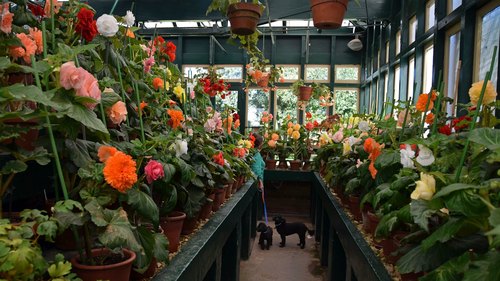
The register states that the central zone of the conservatory is used for tropical plants and that the side shelves, tiered, are for displaying plants. Victoria Walks, which describes the walk linking Central Park to Hedgeley Dene Gardens, writes that the conservatory houses exotic plants that have pleased visitors for almost a century.
The City of Stonnington says that guided tours can be arranged with a gardener or a member of the Orchid Club.
Visiting
The conservatory stands in the upper part of Central Park, a park at the corner of Burke Road and Wattletree Road. The City of Stonnington opens it only on certain days of the week, at set times; staff are not always present, but visitors are welcome to enter and explore. Guided tours can be requested through the City's customer service. It is best to check the opening days before making the trip.
The park also has two playgrounds, John Landy Oval and a small living installation, Lost Lands Found, which brings together more than 60 native Victorian species. A walk of about 3.5 km there and back, described by Victoria Walks, links it to Hedgeley Dene Gardens. Tram route 5 runs along Wattletree Road and bus route 624 along Burke Road.
37.87° S, 145.05° E
Greenhouses nearby
More greenhouses — Australia
Do you have a good photo of this greenhouse? Suggest it for this page →
Sources (8)
- vhd.heritagecouncil.vic.gov.au/places/684
- vhd.heritagecouncil.vic.gov.au/places/684/download-report
- stonnington.vic.gov.au/Community/Parks-and-sporting-facilities/Central-Park
- rbaarchitects.com.au/projects-1/central-park-conservatory
- monumentaustralia.org/themes/culture/community/display/111190-restoration-of-central-park-
- walkingmaps.com.au/walk/5871
- geocaching.com/geocache/GCQ150
- api.openstreetmap.org/api/0.6/way/58199618/full.json
Affiliate links — booking through Verrière helps fund our research, at no extra cost to you.