Parque Bicentenario Greenhouses and Orquidario
Mexico City, Parque Bicentenario (Miguel Hidalgo / Azcapotzalco)

Entry updated on October 5, 2026
- Year
- 2010
- Architect
- Team led by Mario Schjetnan (park landscape design)
- Style
- Contemporary modular glass cubes and an orchid house under a translucent roof
- Dimensions
- 15 × 15 × 15 m cubic modules; orchid house in a 100 × 15 m cistern, 5 m deep
- Status
- Open to the public
Opened on 7 November 2010 for the bicentennial of Mexican independence, Parque Bicentenario covers 55 hectares on the site of the former Pemex refinery at Azcapotzalco, closed in 1991 on health and environmental grounds. Its Natura garden brings together nine Mexican biomes: four in the open air, three inside large cubic glasshouses built on a 15-metre module, and the last in an orchid house set into one of the refinery's cisterns. More than 7,000 orchids, including 35 Mexican species, grow there under a translucent roof.
Affiliate links — booking through Verrière helps fund our research, at no extra cost to you.
History
1 min
The park stands on the grounds of the former Azcapotzalco refinery, in operation from 1933 in the west of the capital and run by Pemex. Shut down for good in 1991 for public-health and environmental-safety reasons, it left behind heavily polluted soil, and the site lay abandoned for about a decade. In 2007 Pemex handed the land over to the federal government, which made it one of the flagship projects of the bicentennial of Mexican independence.
The clean-up, put at more than 800 million pesos, involved excavating, treating and encapsulating thousands of tonnes of contaminated earth, backed by drainage systems, geotechnical barriers and monitoring of toxic vapours. The landscape scheme was entrusted to a team led by the landscape architect Mario Schjetnan.
President Felipe Calderón opened the park on 7 November 2010. The cubic greenhouses and the orchid house were part of the original scheme, forming the core of the Natura garden, conceived as a showcase for the country's plant diversity. In 2017 management of the park passed from Pemex to the federal Ministry of Environment and Natural Resources (SEMARNAT).


Architecture and engineering
1 min
The 55-hectare park is divided into five themed zones: Natura, Agua, Viento, Tierra and Sol. Natura, the most botanical of them, gathers nine Mexican biomes. Four are planted in the open, three are housed in cubic greenhouses that stand out as landmarks in the urban landscape, and the last occupies the orchid house.
The greenhouses are built by repeating a cubic module measuring 15 metres on each side, which incorporates a funnel-like element designed to collect rainwater. In 2013 the press described them as enormous glass buildings; one of them rises less than a hundred metres from the orchid house.
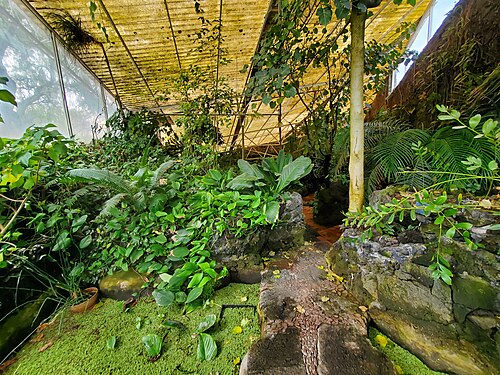
The orchid house itself reuses a relic of the refinery: a cistern 100 metres long, 15 metres wide and 5 metres deep. The designers fitted it with a system of suspended ramps running its full length, then closed it with side walls and a translucent roof chosen to capture as much natural light as possible. Humidity and temperature are kept within the narrow range that orchids require.

Plant collections
1 min
The Natura garden sets out to sum up the plant diversity of Mexico. The habitats on show include montane cloud forest (bosque mesófilo), tropical rainforest, oak woodland, conifer forest, xerophytic scrub and desert. Some are planted outdoors and others under glass: one greenhouse is devoted to the desert, another to the cloud forest.
The orchid house holds the park's most specialised collection. In 2023 it counted more than 7,000 orchid plants, divided between 35 Mexican species and over 120 hybrids from around the world, together with ferns, palms and a few oaks. Figures vary between sources and years: another description of the park mentions more than 75 species. As early as 2013, the orchid house was being presented as the jewel of the park.
Visiting
1 min
The park lies at 290 Avenida 5 de Mayo, in the colonia of San Lorenzo Tlaltenango, on the boundary between the Miguel Hidalgo and Azcapotzalco boroughs, and is served by Refinería station on Metro Line 7. The greenhouses and the orchid house are grouped together in the Natura zone and are easily seen in a single round.
Half a day leaves time to add the outdoor gardens, the artificial lake and the experimental chinampa, which borrows the raised-bed farming technique of Xochimilco. On a rainy day the covered orchid house makes a welcome shelter in the middle of the visit.
19.47° N, 99.19° W
Greenhouses nearby
Do you have a good photo of this greenhouse? Suggest it for this page →
Sources (8)
- es.wikipedia.org/wiki/Parque_Bicentenario_(Ciudad_de_M%C3%A9xico)
- umffaac.org.mx/arquitectura-para-plantas-invernaderos-y-espacios-de-cultivo-en-latinoameri
- mxc.com.mx/2023/01/09/el-precioso-e-intrigante-orquideario-del-parque-bicentenario/
- excelsior.com.mx/expresiones/historia-del-parque-bicentenario-cdmx-de-refineria-contaminad
- archivo.eluniversal.com.mx/ciudad/116069.html
- mexicodesconocido.com.mx/el-parque-bicentenario-de-la-cdmx-un-sofisticado-y-exotico-espaci
- parquesalegres.org/biblioteca/blog/parque-bicentenario-cdmx-conocelo
- openstreetmap.org/way/1150690918