Tropical Plants Orangery, National Botanical Garden of Georgia
Tbilisi
No freely licensed photo of this greenhouse yet. Do you have one? Suggest it for this page →
Sources checked October 2026
- Style
- Glazed gabled-roof greenhouse in a botanical garden officially founded in 1845
- Status
- Open to garden visitors (supplement on the entrance ticket)
In the Tsavkisis-tskali gorge, at the foot of Narikala Fortress, the National Botanical Garden of Georgia keeps an orangery of tropical plants open to visitors. The garden, given botanical status in 1845, received two French orangeries with iron arches between 1871 and 1873, built near the former museum. Today's tropical orangery is a building with a glazed roof. Power cuts in the 1990s decimated its collections, and restoration began in 2000. In August 2026 the garden was again inviting visitors to see it.
Affiliate links — booking through Verrière helps fund our research, at no extra cost to you.
History
The garden occupies former royal gardens; it received the official status of Tiflis botanical garden on 1 May 1845, by order of the Viceroy of the Caucasus. Sputnik Georgia recalls that it was then run for over a century by German scientists, and that the gardener Scharer, appointed director in 1861, left behind a so-called French orangery, named for the fact that all its material came from France. According to Tbilisi Post, the orangery parts were brought from France in 1872 and two small arched orangeries went up in 1873; by 1875 the garden counted 1,238 open-ground and orangery species, pineapple among them. In a July 2026 post relayed by Paper Kartuli, the garden places the two French orangeries with round iron arches between 1871 and 1873, beside the historic museum building, with some elements ordered from Paris; the smaller one housed an exhibition pond for the Victoria water lily, whose leaves reach 2 m across. The Georgian cultural heritage portal lists an "iron orangery" (no. 26716).
The tropical plants orangery open today is mentioned separately. The television channel Mir 24 said in 2018 that it was created in 1872 and held over 1,500 plants; it reported that the energy crisis of the early 1990s killed many plants, that restoration began in 2000 and that the complex was now open. An older Facebook post from the garden, of unspecified date, said it was closed to visitors and would reopen soon. Tbilisi Post mentions, without a date, a Soviet-era orangery with a laboratory.
Architecture and engineering
The historic orangeries, called French, combine round iron arches; part of the elements were reportedly ordered from Paris, according to the garden itself, and Sputnik noted in 2016 that the construction had proved remarkably sturdy, flowers no longer being grown there although the building is kept clean. The Georgian heritage portal lists them as the "iron orangery". The tropical plants orangery visited today is a separate building: the OpenStreetMap outline, to be treated with caution, gives it a single level, a gabled roof and a footprint of about 1,100 m².
A 2017 freely licensed photograph, filed in the Commons category devoted to this orangery, shows a gabled roof of rectangular glass panels behind a metal fence, beside a low building with a green roof, its façade covered in climbing foliage turned red by autumn. A 2026 travel guide calls the tropical plants orangery "modest" in size.
Plant collections
The garden presents its collection as gathering plants from every part of the world. The Georgian Wikipedia says that many tropical and subtropical plants grow in the garden's orangery. A garden post, of unspecified date, counts 90 families and 300 genera, up to 900 named plants including 600 cultivars; Mir 24 spoke in 2018 of over 1,500 plants. The two figures are not comparable, and none of the texts read names a species.
The historic orangeries already sheltered exotic plants: in 1875 the garden counted pineapples among its orangery plants, and the smaller of the 1871-1873 orangeries held a pond for the Victoria water lily. The present condition is debated: a travel guide updated in August 2026 judges the orangery modest in size and says the collection has not recovered from the power cuts, whereas the garden itself, in August 2026, presents the orangery as one of the greenest and most distinctive spaces in the garden.
Visiting
The tropical orangery lies in the lower part of the garden, not far from the former museum and its historic orangeries, according to OpenStreetMap mapping. The garden covers 128 hectares in the Tsavkisis-tskali gorge; the main entrance opens on Botanikuri Street, at the foot of Narikala Fortress, and a gate in the fortress's south wall lets visitors descend into the garden. The stop is short, the orangery being judged modest in size by a 2026 guide, and access to the orangery carries a supplement on the garden ticket (price to be checked on site); an older garden post is a reminder that its opening has been suspended before.
The visit combines with the waterfall, about 22 m high and the main reason to visit the garden according to a 2026 travel guide, with Narikala Fortress, reached by the cable car from Rike Park, and with the Abanotubani sulphur baths, a few minutes' walk from the lower exit.
41.69° N, 44.81° E
Greenhouses nearby
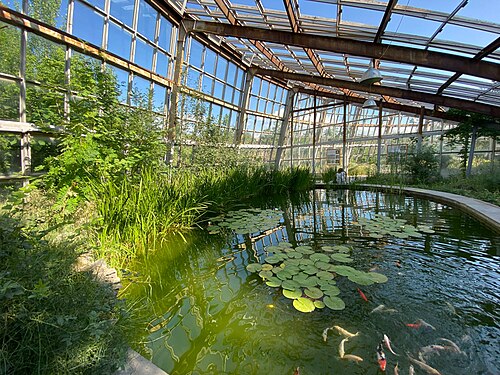
Do you have a good photo of this greenhouse? Suggest it for this page →
Sources (8)
- ka.wikipedia.org/wiki/თბილისის_ბოტანიკური_ბაღი
- commons.wikimedia.org/wiki/Category:Botanical_Garden,_Tbilisi_-_Orangery_of_tropical_plant
- tbilisipost.ge/news/tbilisis-botanikuri-baghis-istoria/7008
- paperpaper.io/papernews/2026/7/10/ob-istorii-kollekcii-vodnyh-rastenij/
- sputnik-georgia.ru/20160719/232731132.html
- instagram.com/p/DcTV-zcjulF/
- mydrive.club/ka/georgia/blog/tbilisi-botanical-garden
- sakhva-travel.com/en/blog/botanical-garden-tbilisi/
Affiliate links — booking through Verrière helps fund our research, at no extra cost to you.