Taipei Botanical Garden Glasshouses (台北植物園溫室)
Taipei (Zhongzheng District)
Entry updated on October 5, 2026
- Year
- 1964 (rebuilt glasshouses) · new glasshouse 2020s
- Architect
- Unknown (historic glasshouses); Huang Sheng-yuan / Fieldoffice Architects (new glasshouse)
- Style
- Rebuilt Japanese-era glasshouses; low, geometric contemporary glasshouse
- Dimensions
- New glasshouse under 10 m high; garden ≈8 ha
- Status
- Open to the public
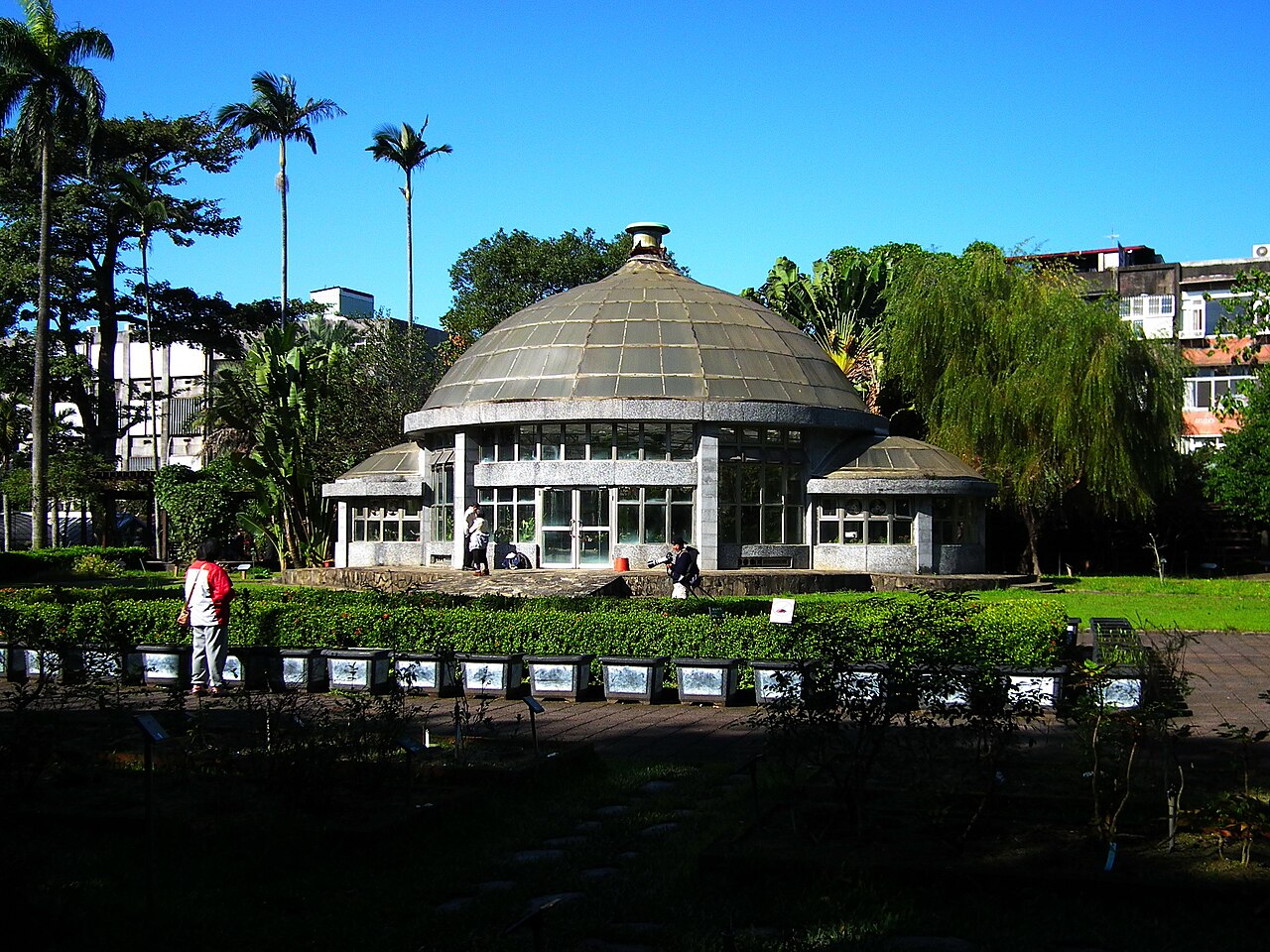
Founded as a nursery in 1896 under Japanese rule and designated a botanical garden in 1921, Taipei Botanical Garden had three glasshouses standing on foundations from that era: a central rotunda, a hexagonal house and a long orchid house, whose glazing and frames were rebuilt in 1964. By then structurally unsafe, the rotunda was demolished in 2020 under the national Botanical Garden Ark project, and Huang Sheng-yuan's practice Fieldoffice Architects designed a low, geometric replacement devoted to Taiwan's threatened plants.
Affiliate links — booking through Verrière helps fund our research, at no extra cost to you.
History
1 min
Taipei Botanical Garden is one of the oldest scientific grounds in the city. Soon after Japanese rule began, a nursery was laid out in 1896 on government land outside the Little South Gate, and on 22 January 1921 the headquarters site of the forestry experiment station was formally designated a botanical garden. The grounds, about 8 hectares, are run today by the Taiwan Forestry Research Institute (TFRI). Some sources date the nursery to 1895.
Three glasshouses were built during the Japanese period: a central round house, a hexagonal house and a long orchid house. Their foundations are original, but the glazing and frames were badly damaged in the aftermath of the Second World War and rebuilt in 1964.
On 4 September 2019 the institute launched the National Botanical Garden Ark project, which spreads the ex situ conservation of Taiwan's 989 threatened plant species across several gardens and partners. The ageing round house, by then considered unsafe, was demolished in 2020 to make way for a new glasshouse. The commission, budgeted at around NT$80 million, went to Fieldoffice Architects, the practice of Huang Sheng-yuan, and the Taiwanese press presented it as the garden's first 'plant art museum'. The hexagonal house and the orchid house remain in place.
Architecture and engineering
1 min
The two surviving historic houses keep a feature shared by all three original buildings: a long channel runs beneath the central planting bench, collecting surplus irrigation water and keeping it moving. The water steadies the humidity, gives frogs a habitat and keeps pests down, an arrangement now cited as an early example of ecological, energy-saving design.
Fieldoffice's new glasshouse takes a deliberately geometric line. It stays below 10 metres, slightly lower than the surrounding trees, and its alternating white and grey members lighten its bulk. Two small temperature-controlled glasshouses flank a rectangular lotus pond; above them a trapezoidal canopy shelters circular open spaces used for shade, gatherings and teaching. A round platform that seems to float recalls the vanished dome, and a lookout at the highest level brings visitors up to canopy height. The design team also had to deal with the water that used to pool in the old round house.
Plant collections
1 min
The garden holds more than 2,000 plant species, and its glasshouses now serve conservation first. Under the Ark project, the new glasshouse is intended to display several hundred threatened native species, drawn from the plants that TFRI and its partners safeguard away from their natural habitats.
Another glasshouse in the garden is devoted to plants whose names refer to places in Taiwan: around a hundred rare species are gathered there, among them Taiwania (台灣杉), the Taoyuan marshweed (桃園石龍尾) and the Longtan floating heart (龍潭莕菜). In the older houses, the frogs living in the underground channels help keep pests in check, while in the new glasshouse an augmented-reality public artwork conjures up imaginary plants of the future.
Visiting
1 min
The glasshouses stand within Taipei Botanical Garden in Zhongzheng District, a compact garden of about 8 hectares that is easily explored in one or two hours. A visit can take in the site's other landmarks: the brick herbarium of 1924, built to store dried plant specimens, the Qincha administrative building (欽差行臺) and the lotus pond. The lookout on the new glasshouse gives a view across the tree canopy, and the place-name glasshouse makes a good introduction to Taiwan's flora before walking on through the outdoor collections.
25.03° N, 121.51° E
Greenhouses nearby
Do you have a good photo of this greenhouse? Suggest it for this page →