Exhibition Greenhouses, Shanghai Chenshan Botanical Garden
Songjiang, Shanghai
No freely licensed photo of this greenhouse yet. Do you have one? Suggest it for this page →
Sources checked September 2026
- Year
- 2011
- Architect
- Planungsgruppe Valentien (Valentien + Valentien, Straub + Thurmayr, Auer + Weber)
- Style
- Three contemporary glasshouses in a garden enclosed by a landscaped ring
- Dimensions
- 12,608 m² of exhibition space (three houses)
- Status
- Open to the public
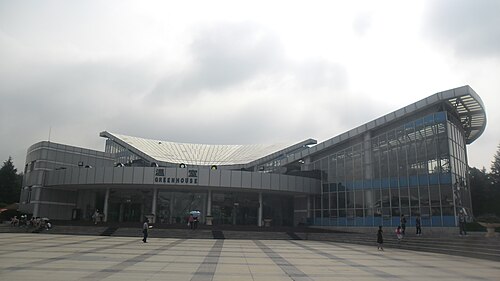
The glasshouse complex of Chenshan Botanical Garden occupies the north-east corner of a 207-hectare garden in Songjiang district, some 30 km from central Shanghai, laid out to plans by the German consortium Planungsgruppe Valentien, which brought together landscape architects and the architects Auer + Weber. Three free-standing houses, devoted to tropical flowers and fruit, to plants of sandy and arid ground and to rare plants, provide 12,608 m² of exhibition space. When the garden opened in full in January 2011, Shanghai's official press presented them as Asia's largest greenhouse. In 2026 the site became a national botanical garden.
Affiliate links — booking through Verrière helps fund our research, at no extra cost to you.
History
Chenshan Botanical Garden grew out of an international competition held for the garden's project team. The consortium Planungsgruppe Valentien, made up of the landscape architects Valentien + Valentien and Straub + Thurmayr together with the architects Auer + Weber, won third prize and was then ranked first after reworking its scheme; the Valentien practice dates the commission to 2005-2010. Construction began on 22 April 2007 on land in Sheshan town, Songjiang district, bounded by Chenhua Road to the south, Qianxin Road to the west and Shenzhuan Road to the north, amid intensively farmed countryside.
The garden opened on a trial basis on 26 April 2010, during the Shanghai World Expo, and according to its landscape architects drew more than 300,000 visitors in its first six months. It opened in full on 24 January 2011, when Shanghai's official press announced the completion of Asia's largest greenhouse and a collection of 9,000 plant species.
The site was later rated a national 4A tourist attraction (October 2012) and a Shanghai "five-star" park (January 2013). In 2026 the State Council approved the creation of Shanghai Chenshan National Botanical Garden, the country's third national botanical garden, in a decision made public in early July. Commentators described the change as a shift from a municipal leisure amenity to an institution responsible for conserving the plant resources of eastern China.
Architecture and engineering
The greenhouses sit within a strongly drawn landscape plan. To give legibility to a flat and disjointed site, the designers enclosed the inner garden and one of the hills within a great sculpted earth ring, up to 14 metres high and conceived as an image of the globe; a route along it passes through laurel forests representing the continents. At the centre lies a lake landscape, about 18 hectares according to the Valentien practice.
According to the official website, the exhibition complex stands in the north-east corner of the garden, inside Gate 2. It consists of three free-standing houses, the Tropical Flowers and Fruits Hall, the Sand-Land (desert) Plants Hall and the Rare Plants Hall, which together provide 12,608 m² of exhibition space. The three houses decrease in size, the largest to the west and the smallest to the south-east.
Auer + Weber lists the garden's buildings, completed in 2010, among its works.
Plant collections
Each house follows a theme. The Tropical Flowers and Fruits Hall is, as its name suggests, about flowers and fruit; the Rare Plants Hall takes "survival and evolution" as its theme; the Sand-Land Plants Hall is given over to plants of dry ground.
Across the garden, the collections exceed 10,000 species and cultivars. They include magnolias, orchids, bromeliads, roses, cherries, apples and irises, along with aquatic and dryland plants, medicinal and economic plants, rare and endangered species and greenhouse plants. In 2026 the press reported more than 18,000 living plant accessions and a cold seed store holding over 100 million seeds.
Visiting
The greenhouses are part of a 207-hectare garden organised into four main zones: a central display area, a conservation area, a five-continents plant area and a peripheral buffer belt. The central area holds 26 specialist gardens according to the garden itself, or about thirty island-like themed gardens according to its landscape architects.
The glasshouse complex occupies the north-east corner, near Gate 2. A visit can continue along the ring planted with laurel forests, around the central lake and towards Chenshan hill. The rose garden, surrounded by water, flowers at the turn of spring and summer. According to the press, the garden welcomes visitors on the scale of a million a year.
31.08° N, 121.18° E
Greenhouses nearby
Architecture nearby
More greenhouses — China
Do you have a good photo of this greenhouse? Suggest it for this page →
Affiliate links — booking through Verrière helps fund our research, at no extra cost to you.