Tropical Rainforest Indoor Hall (Pangolin House), Taipei Zoo (熱帶雨林室內館/穿山甲館)
Taipei (Wenshan District)
Entry updated on October 5, 2026
- Year
- 2019
- Architect
- Yeh Shih-tsung Architects (葉世宗建築師事務所)
- Style
- Contemporary steel-truss arched hall inspired by the pangolin
- Dimensions
- ≈60 m span, ≈42 m wide, 24 m high
- Status
- Open to the public
Opened in July 2019 in the tropical rainforest zone of Taipei Zoo, this 24-metre-high hall recreates an ecosystem of the Amazon basin. Designed by Yeh Shih-tsung Architects, it turns the arched body and overlapping scales of the Taiwanese pangolin into a structure of steel-tube truss arches spanning about 60 metres. Certified as a gold-level green building, it incorporates solar panels and rainwater recycling. A single route leads from the forest floor up to the canopy, past sloths, tamarins, night monkeys and fish.
Affiliate links — booking through Verrière helps fund our research, at no extra cost to you.
History
1 min
The Tropical Rainforest Indoor Hall is the outcome of a long redevelopment of the tropical rainforest zone at the municipal Taipei Zoo. According to the journal Taiwan Architect, design work by the practice of architect Yeh Shih-tsung ran from March 2009 to May 2013, followed by construction from November 2013 to June 2019; press reports speak of thirteen years of planning in all. The practice handled design and site supervision, while Tong Shun Construction (同順營造) built it.
The budget was revised along the way: the press reported an original allocation of 600 million Taiwan dollars, later cut to under 400 million. The zoo's press release gives a cost of close to 390 million for a site of about 1.5 hectares that includes six outdoor enclosures as well as this building, whereas the architecture journal quotes 430 million, so the sources disagree on this point.
The zoo announced the opening of the hall on 9 July 2019. Despite its nickname, the Pangolin House displayed no pangolins at first: the zoo had set aside care areas for them out of public view and wanted to observe visitor behaviour before letting them roam the hall. A 2023 report noted that putting them on show was still being planned.
Architecture and engineering
1 min
The building's form derives from the pangolin, a protected animal that stands for Taiwan's tropical forest: its arched body became a series of steel-tube truss arches and its scales an outer shell. According to Taiwan Architect, the egg-shaped hall spans about 60 metres, with a maximum width of about 42 metres and a clear internal height of about 28 metres; the zoo itself gives a height of 24 metres above ground. The outer walls imitate fair-faced concrete, and artificial rock faces in glass-fibre-reinforced concrete (GRC) add to the scenery. The project reused the structure of an existing basement to limit excavation.
The Ministry of the Interior awarded it gold-level green building certification. The scales of the shell were conceived as energy-saving devices, combining solar panels, rainwater recycling and efficient air conditioning. A 2023 report blames the daylighting for the strong summer heat inside, although the exact proportion of glazing in the roof is not documented.
Plant collections
1 min
The hall recreates an Amazon basin habitat by layering water, forest and canopy: fish pools, a short tunnel, fallen trunks, vines, leaf litter and tropical trees, with viewpoints at treetop level.
The zoo's page lists nine animal species, among them the two-toed sloth, the cotton-top tamarin, the aye-aye, toucans, the slow loris and night monkeys, together with two fish species. The opening press release also mentions poison dart frogs and macaws. Press coverage in 2019 described cotton-top tamarins donated by Singapore Zoo, brown spider monkeys from Frankfurt Zoo, Malayan tapirs and arapaima, and a 2023 report mentions capybaras, so the line-up has changed over the years. The pangolins themselves are cared for behind the scenes.
Visiting
1 min
The hall stands in the tropical rainforest zone of Taipei Zoo, in Wenshan District; this outdoor area evokes the forests of Southeast Asia, with buttress roots, aerial roots and stilt roots. The indoor visit follows a single one-way route that climbs from the ground to the canopy, and the interior can be very warm in summer.
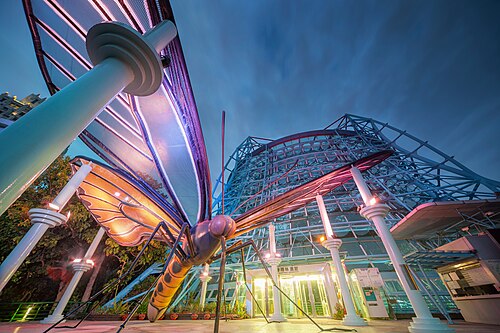
It combines well with the zoo's Insectarium, a former butterfly house turned insect museum whose greenhouse and netted flight room immerse visitors among butterflies, and with the Bug Exploration Valley, some ten hectares in size, where more than 125 butterfly species can be seen throughout the year.
25.00° N, 121.58° E
Greenhouses nearby
Do you have a good photo of this greenhouse? Suggest it for this page →
Sources (7)
- zoo.gov.taipei/News_Content.aspx?n=BD065B2FA7782989&sms=72544237BBE4C5F6&s=416B6590555A9A7
- zoo.gov.taipei/News_Content.aspx?n=0E2F1BDD15CF608D&sms=4B48AE9F06DCAA6F&s=A0E78E5E74C0C58
- ta-mag.net/ta/News.php?id=1608
- storm.mg/article/1544355
- travel.yam.com/article/113912
- zoo.gov.taipei/News_Content.aspx?n=0E2F1BDD15CF608D&sms=4B48AE9F06DCAA6F&s=FD31DA7EA875EF4
- openstreetmap.org/way/478380211