Glass House and lean-to vinery, Turlough Park
Turlough, near Castlebar (County Mayo)
No freely licensed photo of this greenhouse yet. Do you have one? Suggest it for this page →
Sources checked October 2026
- Year
- 1874–1875 (glasshouse rebuilt in 2000)
- Architect
- Vinery attributed to Richard Turner
- Style
- Rebuilt Victorian glasshouse, and an iron lean-to vinery against the stables
- Status
- Open to the public: gardens open all year, free admission
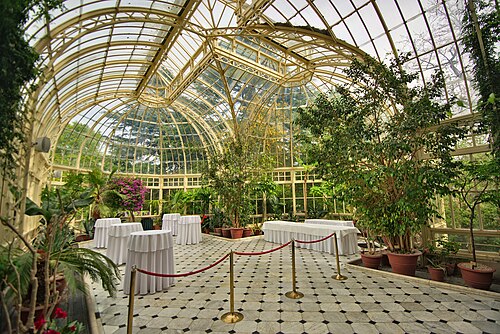
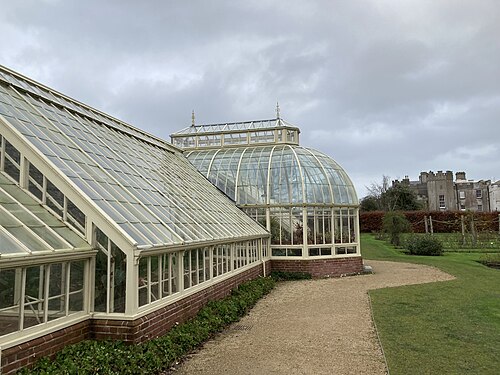
In the gardens of Turlough Park, home to the National Museum of Ireland - Country Life near Castlebar, the Glass House was built between 1874 and 1875 and heated by a saddleback boiler still visible through a grille. Destroyed by a violent storm in the 1930s, it was rebuilt in 2000 by Mayo County Council using the original hand-fired floor tiles and iron roof cresting. It is the focal point of the Victorian flower beds and holds hothouse flowers. Against the stable wall, an iron lean-to vinery is attributed, depending on the page, to the Dublin ironmaster Richard Turner. Admission is free.
Affiliate links — booking through Verrière helps fund our research, at no extra cost to you.
History
The Turlough Park estate belonged to the Fitzgerald family for almost 350 years and covered 8,500 acres at its largest. A first house was built there in 1722 by Thomas Fitzgerald; its ruins can be seen near the entrance. The present Victorian Gothic house, designed by Thomas Newenham Deane, is dated 1865 by the museum (Wikipedia gives works from 1863 to 1867). The gardens were redesigned at the time: terraces, flower beds, a croquet lawn and a tennis court, and a lake dug in 1865 by damming the Castlebar River, with three 'picnic islands'. The Mayo tourism page adds that a glasshouse and a vinery were among the additions of 1863, whereas the museum dates the present glasshouse to 1874-1875, with its saddleback boiler.
A violent storm destroyed this glasshouse in the 1930s. The estate was bought and redistributed by the Congested Districts Board in 1915, but the house stayed in the family until 1991, when Mayo County Council bought it. In 1995 it was decided to locate part of the National Museum of Ireland at Turlough, which opened in September 2001 according to Wikipedia. Mayo County Council rebuilt the glasshouse in 2000; Fáilte Ireland and the Great Gardens of Ireland Restoration Programme supported an extensive restoration of the gardens and parkland, now maintained by Mayo County Council and the Office of Public Works. In 2025 Storm Éowyn uprooted over thirty trees on the site without touching the glasshouse, according to the Connaught Telegraph.
Architecture and engineering
The Glass House is the focal point of the Victorian garden: the formal bedding on the lawn in front of it is an original feature, kept up today by the site's groundskeeper. It replaces a glasshouse of 1874-1875 which the museum says was heated by a saddleback boiler, still visible through a safety grille. The 2000 rebuilding reuses the hand-fired floor tiles and the iron roof cresting of the original.
The vinery is an iron structure leaning against the stables, heated by a cast-iron boiler. The museum calls it contemporary with the house. Attributions vary: one museum page suggests it may have been designed by Richard Turner, the Dublin ironmaster behind the Curvilinear Range at the National Botanic Gardens in Dublin; another says it was probably built by Richard Turner Engineers; the Mayo tourism site states this without reservation, and Discover Ireland describes a curvilinear lean-to on the stable wall that could be a Turner. The sources therefore differ on how certain the attribution is.
Plant collections
According to the museum, the Glass House holds hothouse flowers today, and the Mayo tourism page notes a wide variety of plants there, without listing them. In the vinery, the Fitzgeralds would have grown grapes and other fruit, thanks to the cast-iron boiler that heated it. Around the glasshouses, the formal beds on the lawn belong to the original Victorian garden, and the grounds have fine mature trees: beech, oak, chestnut, holly and sycamore, some planted in the 18th century by George Robert Fitzgerald and others by Charles Lionel Fitzgerald. The museum also mentions a 'veteran' tree, believed to date from the mid-18th century, behind the exhibition galleries. The gardens have received a Green Flag Award.
Visiting
The glasshouses stand in the gardens of the National Museum of Ireland - Country Life, at Turlough Park, just outside Castlebar. Admission is free and the gardens stay open all year, with a different appeal each season. Discover Ireland suggests allowing three to four hours for the whole site, which includes the museum, a café, paths along the river and the lake, a sunken garden with a woodland playground, and a round tower that can be seen from the museum grounds. The museum also presents the National Folklife Collection. The site is part of the Wild Atlantic Way.
53.88° N, 9.21° W
Greenhouses nearby
More greenhouses — Ireland
Do you have a good photo of this greenhouse? Suggest it for this page →
Sources (6)
- museum.ie/en-IE/Museums/Country-Life/Visitor-Information/The-Gardens
- museum.ie/en-IE/Museums/Country-Life/Visitor-Information/The-gardens-of-Turlough-Park
- mayo-ireland.ie/en/towns-villages/turlough/history/turlough-park-gardens.html
- discoverireland.ie/mayo/turlough-park
- con-telegraph.ie/2025/02/27/victorian-greenhouse-escaped-wrath-of-storm-that-uprooted-over
- en.wikipedia.org/wiki/National_Museum_of_Ireland_%E2%80%93_Country_Life
Affiliate links — booking through Verrière helps fund our research, at no extra cost to you.