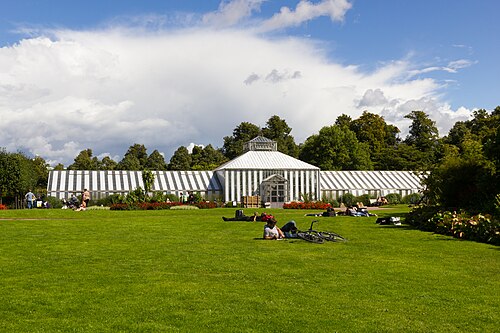
Plantehuset, the Muséhagen glasshouse (University of Bergen)
Bergen, Vestland

Entry updated on October 5, 2026
- Year
- 1901
- Architect
- Gustav Bild
- Style
- Iron-and-glass glasshouse bought from Breslau, central pavilion with two wings
- Dimensions
- Central pavilion 8 × 8 m, 10 m high; two wings of 9.5 × 6 m
- Status
- Open to the public (limited hours); protected since 2013
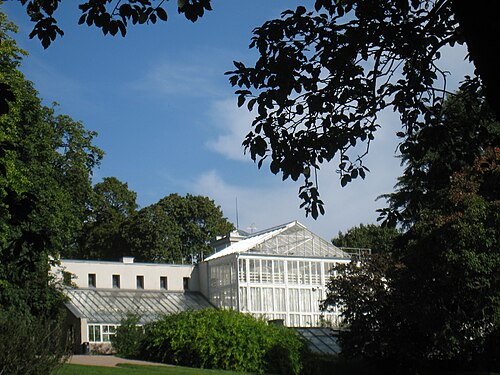
Opened in October 1901 in the Muséhagen, the botanical garden laid out in the late 1890s beside the university museum in Bergen, this glasshouse was bought ready-made in Breslau and paid for by Conrad Mohr, with Gustav Bild as architect. It still keeps its original three climates: a warm, humid wing to the south, the 10-metre palm house in the middle and a cooler wing to the north. The building has been legally protected since 2013.
Affiliate links — booking through Verrière helps fund our research, at no extra cost to you.
History
1 min
The Muséhagen was created between 1897 and 1899 on the initiative of the botanist Jørgen Brunchorst, then curator and later director of the Bergen Museum. The garden opened in May 1898, its first beds holding some 400 Norwegian and 300 foreign plants in addition to trees and shrubs. Only three years later, in October 1901, the glasshouse was inaugurated: the building had been bought complete in Breslau (now Wrocław) and funded by Conrad Mohr, with the architect Gustav Bild in charge of its erection. Brunchorst himself planned and ran the interior layout and the plant displays.
While Jens Holmboe was in charge of the garden (1906–1925) the glasshouse was remodelled and refitted, and a guidebook of some sixty pages was published in 1913. His successors Rolf Nordhagen and Knut Fægri went on developing the garden, the former with the garden architect Georg Rosenkilde, the latter through post-war seed exchanges. Around the middle of the twentieth century a renovation markedly changed the building's outline, replacing its pointed glass roof with an ordinary pitched roof. In 2013 the garden and its glasshouse were protected by regulation, while remaining in use for research and teaching.

Architecture and engineering
1 min
The glasshouse consists of a central pavilion measuring 8 by 8 metres and rising to 10 metres, flanked by two wings of 9.5 by 6 metres each. Visitors enter through the pavilion, which holds the palm house.
As first built, the structure carried Gothic-inspired cast-iron ornament and a pointed glass roof, and a gallery ran round the central section at mid-height, in line with the glasshouse conventions of the period. The mid-twentieth-century renovation swapped the pointed roof for a more conventional pitched one.
From 1901 the building was split into three climate sections that are still in place: to the south, the warm wing, tropical and humid, kept at about 26 °C all year with humidity close to 100%; in the middle, the palm house, humid but slightly cooler at around 22 °C; and to the north, the cold wing, at roughly 8 to 18 °C, frost-free in winter and warmer in summer.
Plant collections
1 min
Each of the three sections shows plants suited to its climate. The warm wing gathers tropical crop plants and many flowering tropical species, among them a large collection of orchids, both terrestrial and epiphytic.
In the 10-metre central pavilion stand the big palms and banana plants, surrounded by other trees and a wide range of tropical forest plants.
The cooler north wing brings together plants from subtropical regions and from areas with a Mediterranean climate, including cultivated species and further orchids. The university presents the whole as a way of experiencing the tropics and the Mediterranean without leaving Bergen. Around the glasshouse, the Muséhagen holds roughly 3,000 different plant species.
Visiting
1 min
The glasshouse stands in the Muséhagen at Muséplass 3, on the Nygårdshøyden hill, right next to the natural history collections of the University Museum of Bergen. It opens only on certain days and for short periods, so it is worth checking the university's website before going.
The glasshouse itself takes little time to see; a walk through the botanical garden, planted according to plant classification, and a visit to the neighbouring natural history museum make a natural extension. The garden also keeps a bronze bust of Armauer Hansen by Jo Visdal, unveiled near the glasshouse in 1901 and moved several times since.
60.39° N, 5.32° E
Greenhouses nearby
Do you have a good photo of this greenhouse? Suggest it for this page →