Victoria House (Victoriahuset, Tøyen Botanical Garden)
Oslo
Entry updated on October 5, 2026
- Year
- 1874-1876
- Architect
- Georg Andreas Bull (attributed)
- Style
- Late Empire style: masonry block with three glazed wings on cast-iron frames
- Status
- Temporarily closed to the public after plant thefts
Built between 1874 and 1876 for the university in Christiania, this glasshouse in Tøyen's botanical garden, Norway's oldest, was designed to show the giant Victoria water lily, which arrived in 1879 and flowered the same year. Its original drawings are lost, and the architect Georg Andreas Bull is now regarded as its probable designer. A plastered-brick entrance block leads into three glazed wings framed in cast iron. Restored in 2008-2009 and statutorily protected in 2014, it turned 150 in 2026 but remains closed to the public following plant thefts.
Affiliate links — booking through Verrière helps fund our research, at no extra cost to you.
History
1 min
Tøyen's botanical garden, founded on 1 June 1814 on the estate King Frederik VI had handed to the university, had its first glasshouses in 1816-1819 and 1825. Partly built of timber, they were so decayed by 1865 that visitors were feared to be at risk of falling through the floors. The director Frederik Christian Schübeler and head gardener Carl Theodor Schulz then planned two replacements, the Palm House (1868) and the Victoria House. Work on the latter began in 1874 and it came into use in the autumn of 1876. Because the grant was cut, both houses were built on a reduced scale and were later regretted as too small and too low. The drawings are lost: the management plan for the listed building attributes the design to Georg Andreas Bull, Christiania's city architect, probably working closely with Schübeler and Schulz, while a 2026 university article still calls the architect unknown.
The Victoria water lily, the building's reason for being, arrived in 1879 and first flowered on 25 August that year; attendance rose to more than 2,000 a day, and in 1931 some 12,000 people queued over two days to see it bloom. The wings were rebuilt in 1891-1893 after the render began to fall away, and director Jens Holmboe had the house repaired in 1927. A propagation house added in 1933 was demolished during the 2008-2009 restoration, carried out with the national heritage directorate, Riksantikvaren. Protected by law in 2014, interior included, the house celebrated its 150th anniversary on 12 June 2026.
Architecture and engineering
1 min
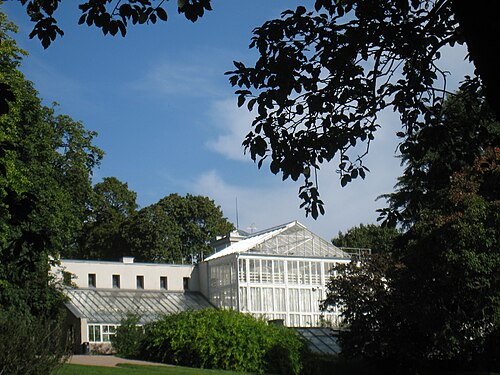
The management plan for the listed building describes it as late Empire in style. To the north, a plastered-brick entrance block on a high granite base has a projecting doorway under a stepped gable, roofs of black glazed tiles and a tall plastered-brick chimney at the south-west corner. Behind it open three glazed wings. Their cast-iron-framed glass roofs sit on a plinth of dressed granite blocks, with metal columns carrying the roof inside; the east and west gables are of granite, while the south wing ends in a glass gable.
The south wing holds a large circular masonry pool capped with slate slabs, circled by a narrow path; the east wing is the epiphyte room and the west wing the Africa room. The building has changed a great deal: double windows and earth floors at first, steam boilers in 1897, larger panes in 1927, plastic sheeting replaced by glass in timber frames in 1996, district heating in 2012. The clash between humid air inside and Norwegian winter cold outside cracks the masonry and rots the joinery; by 2026 the foundations were settling and ice was forming indoors in hard frosts.
Plant collections
1 min
The central room is given over to the Victoria pool. Depending on the year the garden grows Victoria cruziana, Victoria amazonica or the so-called Longwood hybrid; in 2026 it was Victoria cruziana, whose flowers open on two successive nights, white on the first and pink on the second. Around it grow lotus and tropical aquatic plants, along with tropical crops: ginger, coffee, cinnamon, cacao, papaya, papyrus, sugarcane, cotton, rice and vanilla. An Aristolochia vine produces large, foul-smelling flowers in August.
The epiphyte room gathers orchids, bromeliads and carnivorous plants, epiphytes being plants that grow on the branches of others to reach the light. The Africa room, created during the 2008-2009 restoration, shows plants of savanna and dry forest, some of them threatened with extinction or able to survive on underground tubers, together with useful species such as the marula tree.
Visiting
1 min
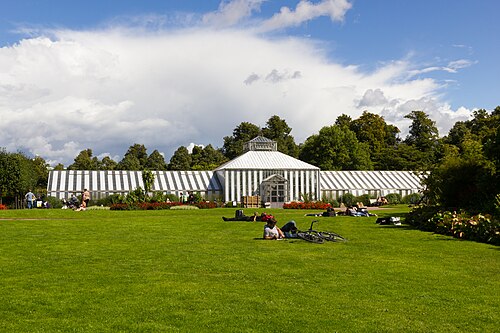
The Victoria House stands at the centre of Tøyen's botanical garden, at the foot of the slope below the Palm House, among lawns, perennial beds and the red-list and black-list beds. Both glasshouses are temporarily closed after plant thefts; for the 150th anniversary, private guided tours were offered from September to December 2026, so it is worth checking whether they have reopened before making the trip. The garden itself can be explored freely and combined with the buildings of the Natural History Museum and the old Tøyen manor. The museum is also preparing a large new 5,000 m² exhibition glasshouse.
59.92° N, 10.77° E
Greenhouses nearby
Do you have a good photo of this greenhouse? Suggest it for this page →
Sources (7)
- nhm.uio.no/utstillinger/botanisk-hage/avdelinger/victoriahuset/
- nhm.uio.no/english/botanical-garden/thematic-gardens/victoria-house/
- uio.no/tjenester/eiendom/utfore-arbeid-pa-uios-eiendom/forvaltningsplaner/toyen/forvaltnin
- uniforum.uio.no/nyheter/2026/06/sjarmerende-og-slitt-150-ars-jubilant.html
- uniforum.uio.no/nyheter/2009/08/gjenapning-av-veksthusene.html
- nhm.uio.no/utstillinger/veksthuset/
- openstreetmap.org/way/33208940