Conservatory and Orangery, Glenveagh Castle Walled Garden
Glenveagh National Park, County Donegal

Sources checked October 2026
- Year
- 1957
- Architect
- Philippe Jullian (design)
- Style
- Gothic Revival; timber-framed octagonal conservatory and lean-to orangery
- Status
- Open to the public (castle gardens open all year)
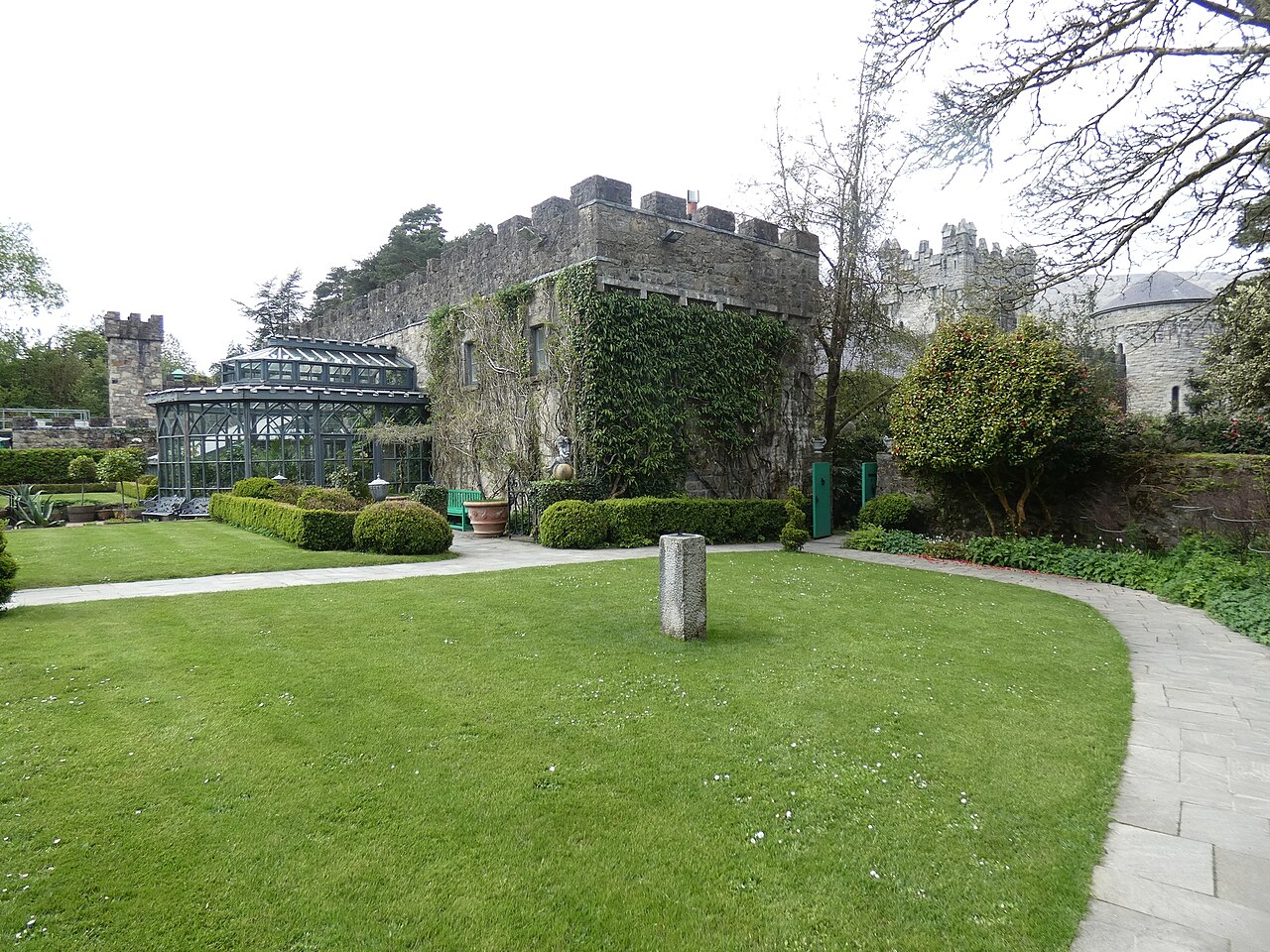
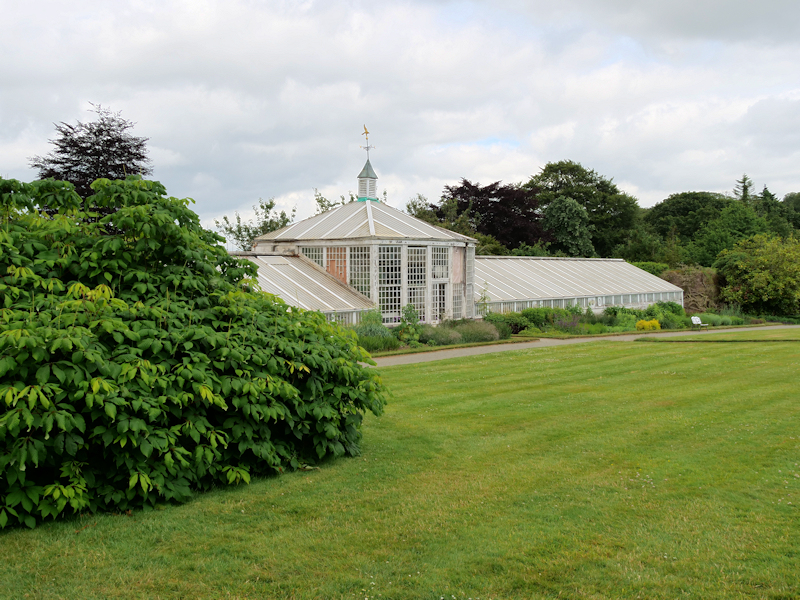
At the north-west corner of the walled garden behind Glenveagh Castle, an eight-sided timber conservatory with a raised glazed roof stands beside a rectangular orangery with a glazed lean-to roof. Both Gothic Revival glasshouses were designed around 1957 by the French cultural historian Philippe Jullian for the estate's owner, the Philadelphia art collector Henry P. McIlhenny; Ireland's national inventory adds that they were reportedly rebuilt in 1989. They still shelter potted lemons and other tender plants, and they serve as the main way into the walled garden in the heart of the national park.
Affiliate links — booking through Verrière helps fund our research, at no extra cost to you.
History
The glasshouses belong to the second life of the walled garden. The garden was laid out for Cornelia Adair, widow of the castle's builder John George Adair, as a kitchen garden to feed the household. Ireland's National Inventory of Architectural Heritage (NIAH) dates the layout to about 1885, while the park's own guide gives 1888 for the six-plot pattern; it fills the hollow left by a quarry opened in the late 1860s to supply granite for the castle walls.
The orangery and conservatory came some seven decades later. Henry P. McIlhenny, a Philadelphia collector who acquired Glenveagh in the late 1930s, began reshaping the garden from 1947 according to the guide, adding walls, gates, box hedging, lead statuary and ornamental 'jardin potager' planting; the heritage register dates the stone boundary wall instead to about 1957. According to the park's head gardener, the Gothic-style orangery was added in 1957 to a design by Philippe Jullian, a French cultural historian and friend of McIlhenny, who wanted lemons and oranges grown in pots. The NIAH, which recorded the ensemble in 2014, also gives about 1957 and adds that the buildings were reportedly rebuilt in 1989.
McIlhenny gave the castle, its gardens and much of its contents to the Irish nation in 1983; the national park opened to the public in 1984 and the castle in 1986. The glasshouses are now cared for by the National Parks and Wildlife Service. Sources spell the designer's name both Julian and Jullian.
Architecture and engineering
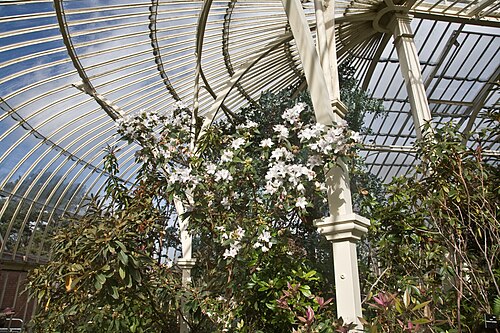
The NIAH, which rates the ensemble of regional importance, describes two adjoining buildings at the north-west corner of the walled garden. The conservatory is a single-storey octagon with a timber frame and decorative glazing, braced by internal metal supports. Its hipped glazed roof carries a raised glazed centre section topped by a decorative timber ridge and a metal weather vane. The walls have decorative timber windows and crenellated parapets on a concrete plinth, and the rainwater goods are cast iron.
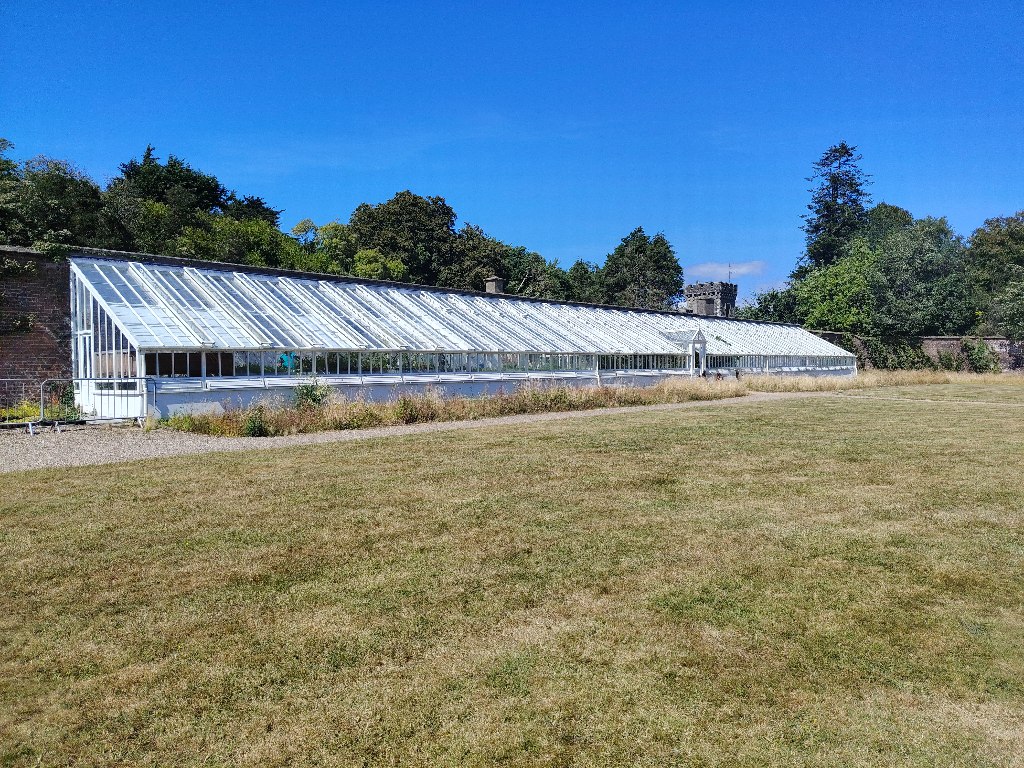
The orangery is rectangular, also timber-framed, with glazed walls, a glazed lean-to roof, a crenellated parapet and a rubble stone plinth. The register sees the pair as an attractive Gothic Revival group that has kept its original form and character, and bases its importance on the group value it shares with the castle.
The walled garden itself is rectangular and faces west, divided into six plots by herbaceous borders and gravel paths.
Plant collections
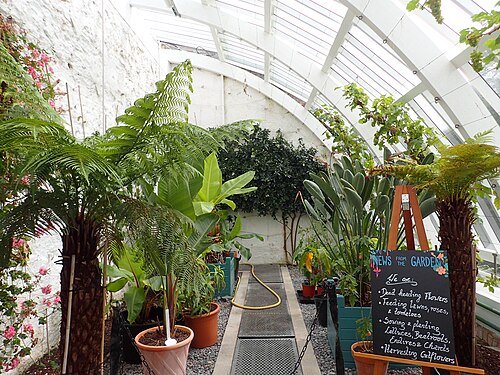
The park's guide says McIlhenny wanted lemons and oranges cultivated in pots, and the houses still grow several lemon varieties alongside Brugmansia, Ficus pumila, jasmine, Strelitzia, Sparmannia, Puya and Agave. The NIAH adds that the buildings continue to produce plants and flowers.
Outside, the walled garden is managed organically in an ornamental potager style. Vegetables, herbs and annual flowers, from kale and purple cabbage to calendula and fennel, are planted as 'floral art'. The perennial borders hold geraniums, phlox, peonies, delphiniums, monkshood, lupins and climbing roses, and Irish apple varieties have been trained as standards and espaliers since 2000. The single red Dahlia 'Matt Armour', raised in 1930 by the gardener Matt Armour, later head gardener, from seed given by Lucy Porter, is the garden's summer emblem and has carried his name since 1996. Snowdrops flower in front of the gardener's cottage in January and February, followed by narcissi in March and April.
Visiting
The walled garden lies behind the castle, at the heart of the castle gardens, which cover about 11 hectares of Glenveagh National Park. The orangery is reached from the Stable Yard, through a gallery in the former stable building, and acts as the doorway into the walled garden.
The park's guide suggests about an hour for the gardens, which a signposted one-kilometre trail runs through. The borders peak in July and August, the narcissi in March and April. The castle tour is ticketed separately and, in 2026, does not run every day. The Pleasure Grounds, the Belgian Walk and the tea rooms are close by, and a shuttle bus links the visitor centre to the castle.
55.04° N, 7.97° W
Greenhouses nearby
More greenhouses — Ireland
Do you have a good photo of this greenhouse? Suggest it for this page →
Sources (8)
- buildingsofireland.ie/niah/search.jsp?type=record&county=DG®no=40904308
- buildingsofireland.ie/buildings-search/building/40904305/glenveagh-castle-gartan-mountain-
- nationalparks.ie/app/uploads/2025/10/123057-Glenveagh-Guide-to-Castle-Gardens.pdf
- nationalparks.ie/glenveagh/
- nationalparks.ie/glenveagh/things-to-do/
- nationalparks.ie/glenveagh/learn/
- donegalgardentrail.com/gardens/glenveaghnp
- irishhistorichouses.com/2024/08/01/glenveagh-castle-county-donegal-a-castle-and-garden-ope
Affiliate links — booking through Verrière helps fund our research, at no extra cost to you.