Friðheimar tomato greenhouses and greenhouse restaurant
Reykholt (Bláskógabyggð), Southern Region

Sources checked October 2026
- Year
- 1946 (present greenhouses 1995–2020)
- Style
- Glazed production greenhouses with geothermal heating and artificial lighting
- Dimensions
- Greenhouses of 1,174 m² (1995–2001), 1,000 m² (2002–2006) and 5,600 m² (2020)
- Status
- Open to the public: restaurant inside the greenhouse daily; guided greenhouse visits for pre-booked groups
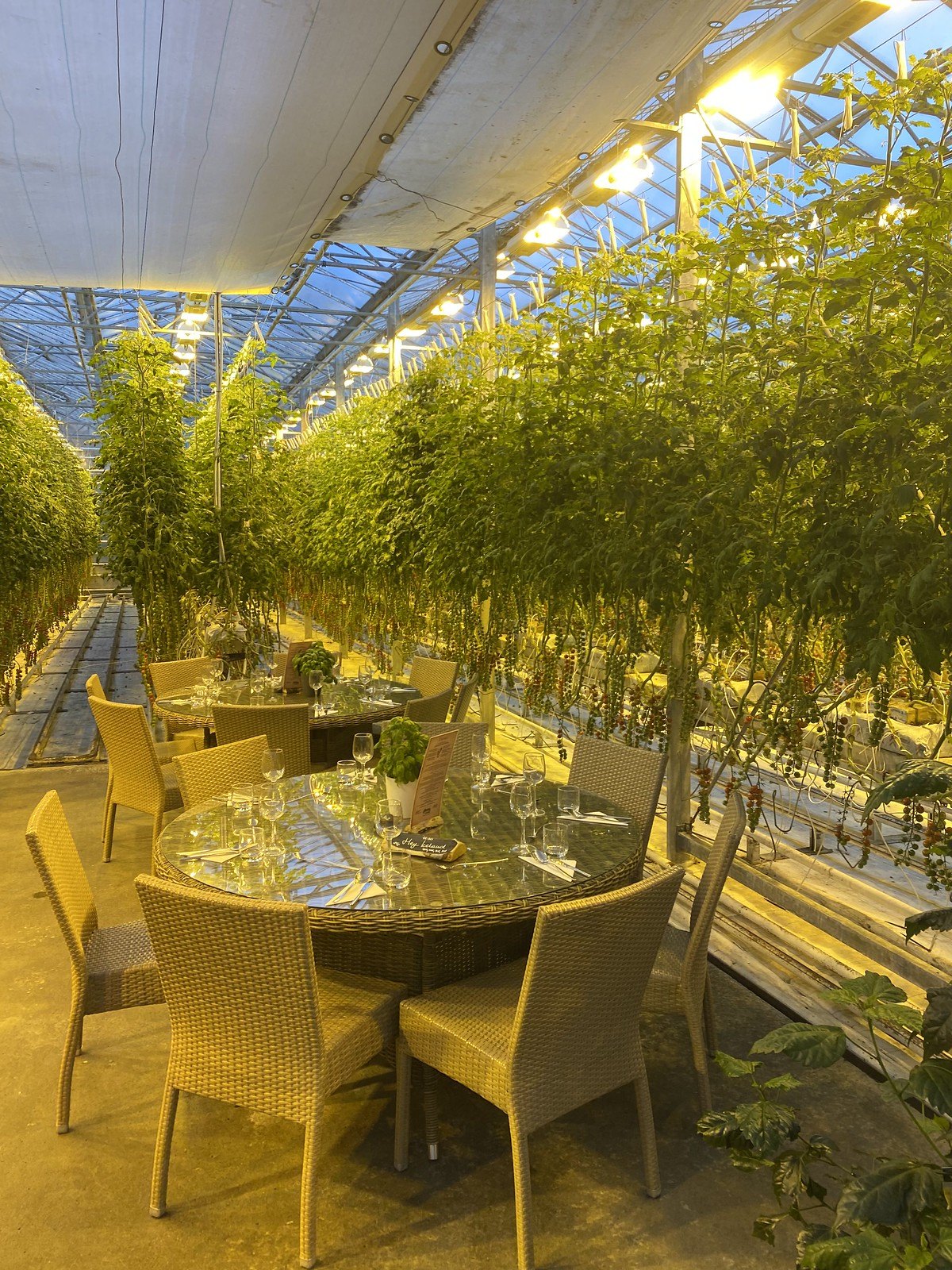
At Reykholt in southern Iceland, Friðheimar grows tomatoes all year round under artificial light, in greenhouses heated by geothermal water drawn from a borehole 200 metres away. Greenhouse growing began on the site in 1946; Knútur Rafn Ármann and Helena Hermundardóttir took over the farm in 1995 and built the present greenhouses in stages between 1995 and 2020. The restaurant serves its tomato soup among the plants, the Vínstofa wine bar has occupied one of the oldest greenhouses since 2023, and guided visits with a talk on greenhouse growing are offered to pre-booked groups.
Affiliate links — booking through Verrière helps fund our research, at no extra cost to you.
History
Greenhouse growing began at Friðheimar in 1946, drawing on the natural hot water of Reykholt, a village of about a hundred inhabitants in the municipality of Bláskógabyggð. When Knútur Rafn Ármann, an agronomist trained at Hólar, and Helena Hermundardóttir, a horticulturist trained at Reykir, bought the property in 1995, nobody had lived there for several years and the business had a single employee. The couple set out to combine their two trades, horses and growing. Between 1995 and 2001 they built a greenhouse of 1,174 m²; between 2002 and 2006 they moved to year-round tomato production under artificial light and added a fully lit greenhouse of 1,000 m².
The years 2007 to 2013 brought the riding centre and the tourist side of the business: a stable for twenty horses, an outdoor arena with seating for 120, a horse show, then the Little Tomato Shop in 2013 and an online shop in 2014. The growing area increased by 60 per cent over the same period. In 2016 the oldest greenhouses were raised by 1.5 metres. In 2020 a 5,600 m² greenhouse with packing facility and nursery was built, and three older 400 m² greenhouses at Birkilundur were acquired. In 2023 one of the oldest greenhouses became the Vínstofa, a wine bar and restaurant, which received a new kitchen in 2024. The company, which had one employee in 1995, had about sixty in 2021 and more than a hundred in 2025, the year it took over the Jarðarberjaland strawberry farm. In 2024 the President of Iceland awarded Knútur Rafn Ármann the Order of the Falcon for the development of the business.
Architecture and engineering
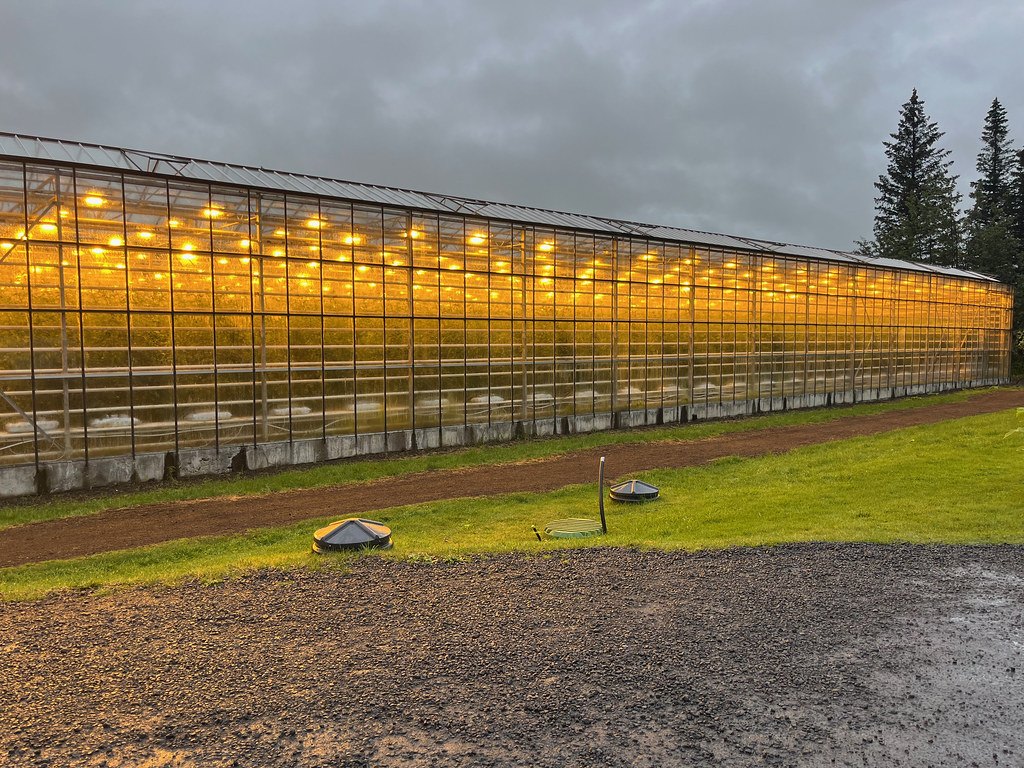
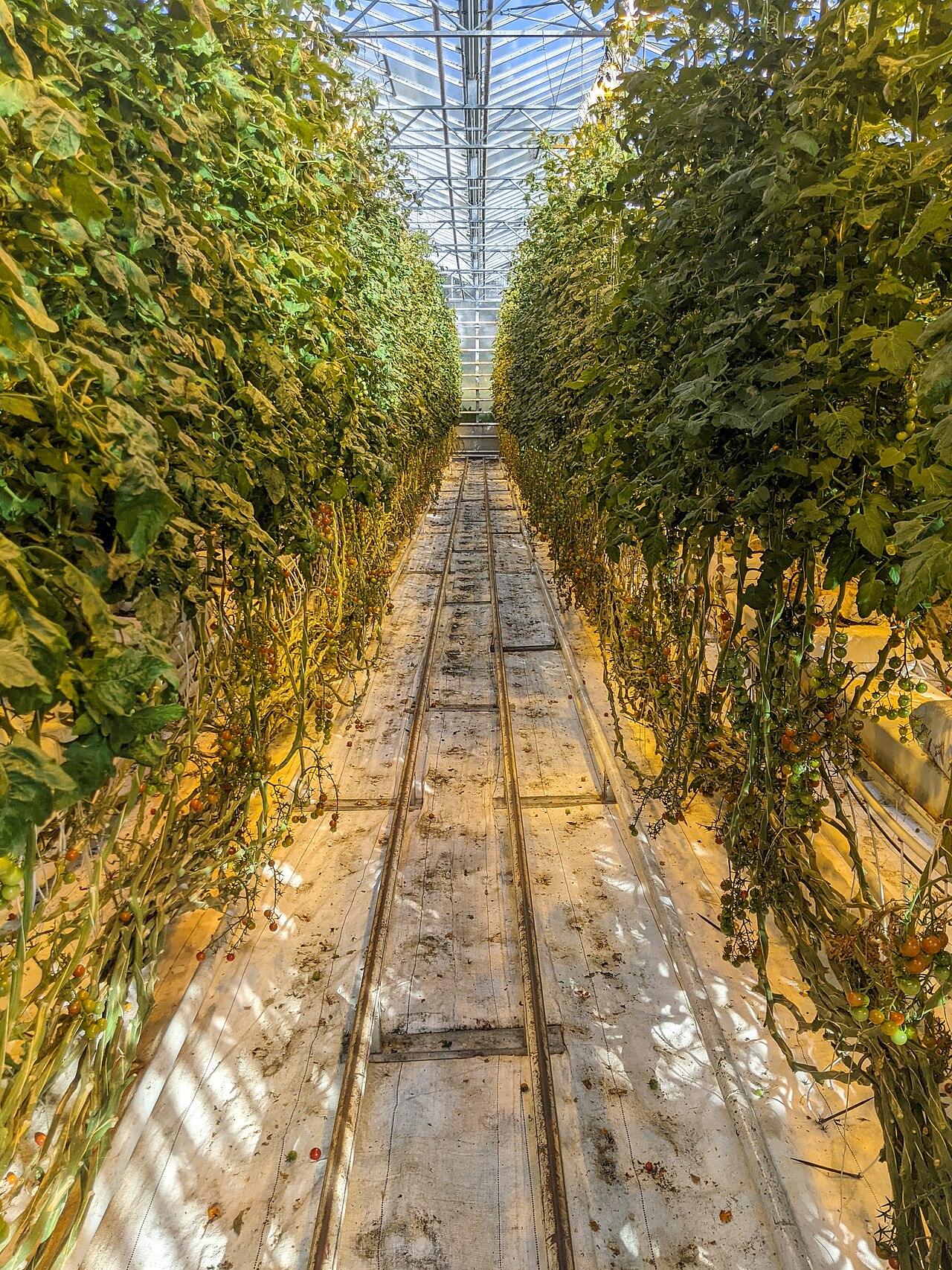
Friðheimar is not a show glasshouse but a group of glazed production greenhouses standing beside the road at Reykholt. What sets them apart is the climate they maintain: geothermal water, drawn from a borehole 200 metres from the buildings, reaches them at close to 95 °C and heats them all year, while grow lamps make up for the long Icelandic winter by reproducing Mediterranean conditions. Each greenhouse has its own controller regulating heat, humidity, carbon dioxide and lighting; the lamps switch off as soon as daylight is sufficient and come back on when needed. A weather station on the roof measures wind, temperature and light, and a central computer connected to the internet lets the growers monitor and adjust everything remotely. The irrigation water, the same water served at the table, comes from the springs of Fljótsbotnar, the source of the river Tungufljót.
The buildings came in stages: 1,174 m² between 1995 and 2001, 1,000 m² of fully lit greenhouse between 2002 and 2006, the raising of the oldest houses by 1.5 metres in 2016 and a large 5,600 m² greenhouse in 2020, which also holds the packing facility and the nursery. A tour operator's page written before that extension counted about 5,000 m² under glass, of which 4,200 m² were in cultivation. The restaurant occupies the growing greenhouse itself, between rows of tomato vines climbing towards the glass; the Vínstofa, opened in 2023, took over one of the estate's oldest greenhouses.
Plant collections
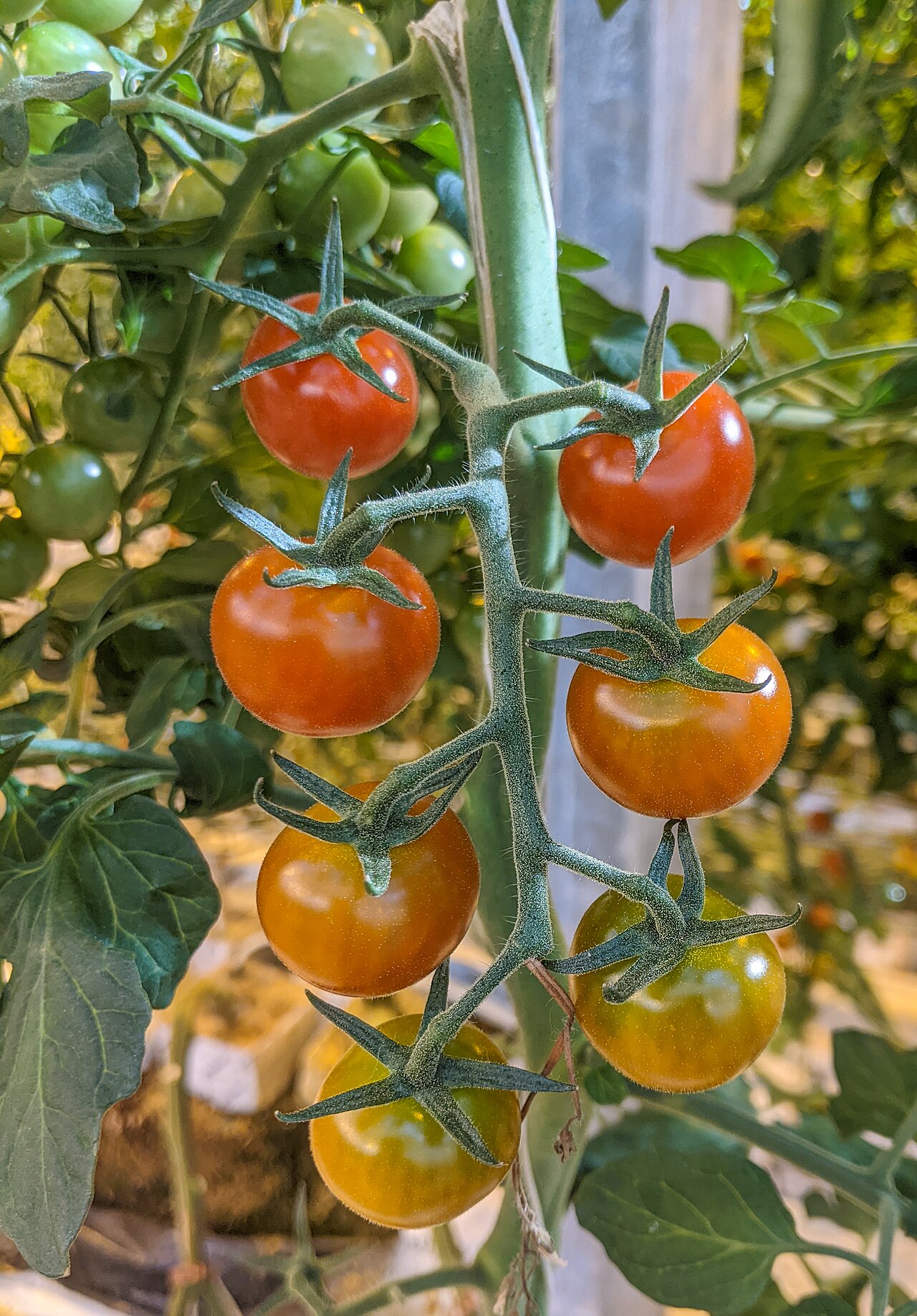
Visitors do not come here for a botanical collection but for a single crop grown on a large scale: the tomato. The official site counts some 25,000 plants, which have to be trimmed and picked every week; an older tour operator's page gave 10,000 plants and a harvest of 370 tonnes a year, more than a tonne a day. The varieties range from the small Piccolo cherry tomato, introduced by the Provençal seed house Gautier in 2008 and first tried at Friðheimar in 2012, to plum tomatoes, Flavorino cocktail tomatoes, traditional and heirloom varieties. Pollination is left to around 1,200 bumblebees living in the greenhouses, each able to visit up to 2,000 flowers a day, and pest control is biological. The harvest feeds the restaurant kitchen, with tomato soup, tomato beer and tomato ice cream, a tomato-jam cheesecake, and the pasta sauce, green tomato drink and cucumber salsa sold in the shop. Since 2025 the neighbouring Jarðarberjaland farm, taken over by Friðheimar, has added strawberries.
Visiting
Friðheimar lies at Reykholt on Route 35, about twenty minutes from Geysir, half an hour from Gullfoss and close to an hour from Þingvellir, which makes it a natural stop on the Golden Circle, some hundred kilometres from Reykjavík. Individual visitors see the greenhouse by having lunch in the restaurant, where booking is strongly advised; guided greenhouse visits, with a short talk on growing under glass, are reserved for pre-booked groups. Allow an hour to an hour and a half for the meal and the shop. The summer horse show, presented in fourteen languages, is designed for groups of 25 or more, and stable visits can be booked all year round.
64.18° N, 20.44° W
Do you have a good photo of this greenhouse? Suggest it for this page →
Sources (8)
Affiliate links — booking through Verrière helps fund our research, at no extra cost to you.