Subtropical Botanical Garden, Seogwipo Citrus Museum (감귤박물관 아열대식물원)
Seogwipo (Sinhyo-dong), Jeju

Sources checked October 2026
- Style
- Glasshouse echoing the shapes of Jeju's craters, outer walls clad in local natural stone
- Dimensions
- About 1,650 m² (city notice)
- Status
- Open to the public (museum renovated, reopened 26 June 2024)
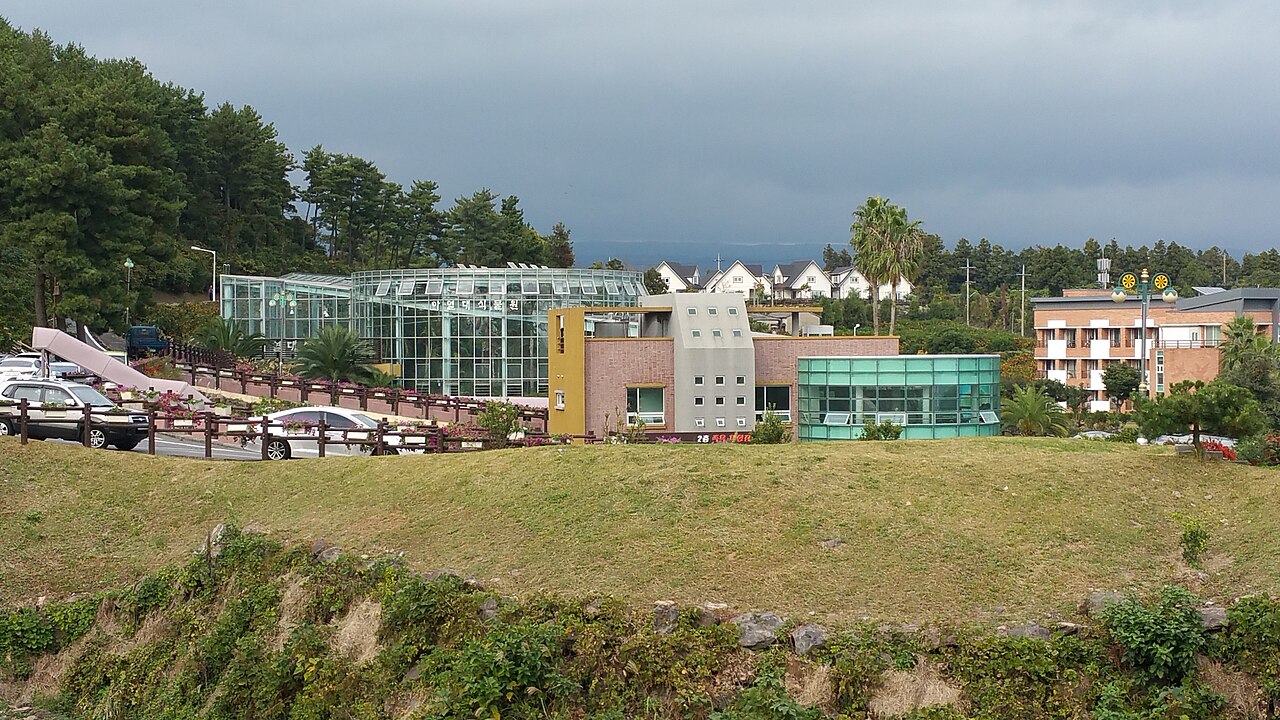
The subtropical garden (아열대식물원) occupies a separate glasshouse in the grounds of the Seogwipo Citrus Museum, in Sinhyo-dong on the south side of Jeju Island. The museum, a public institution run by the city, opened on 25 February 2005; the garden stands behind its exhibition building. Its form echoes the island's craters and its outer walls are clad in natural Jeju stone. Press counts list between 254 and 297 species and more than 7,000 plants, among them palms, cacti, banana, Australian baobab and coffee, complemented by a neighbouring pavilion of citrus from around the world.
Affiliate links — booking through Verrière helps fund our research, at no extra cost to you.
History
The Seogwipo Citrus Museum opened on 25 February 2005 in Sinhyo-dong, in southern Jeju, as a public institution of the city. A 2010 newspaper article says it was built on a 98,426 m² site for a total investment of 21.7 billion won, with a world citrus pavilion and a subtropical garden among its ancillary facilities from the start. A tourism website, by contrast, gives 2008 as the year the subtropical garden was created inside the museum.
The site then struggled to draw crowds: in 2010 the press cited about 75,000 visitors a year and a recurring operating deficit, and the city said it wanted to steer the museum towards more workshops and hands-on activities. The museum was later reworked: after renovation works that ran until May 2024 it reopened on 26 June 2024. In November 2025, for the museum's twentieth anniversary, local press listed the subtropical garden, beside the world citrus pavilion, among the spaces tied to the annual tangerine-picking season.
Architecture and engineering
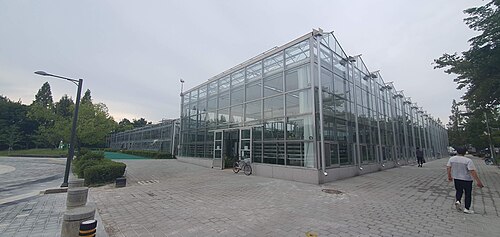
The subtropical garden does not occupy the museum's main building. According to a 2017 travel column, the museum has a single exhibition building but two glasshouses: one devoted to citrus from around the world, linked to the exhibition hall, and the subtropical garden behind it. A 2020 magazine piece describes it as a separate glasshouse within the museum grounds, and the OpenStreetMap outline draws it as a free-standing building about 140 m from the main one.
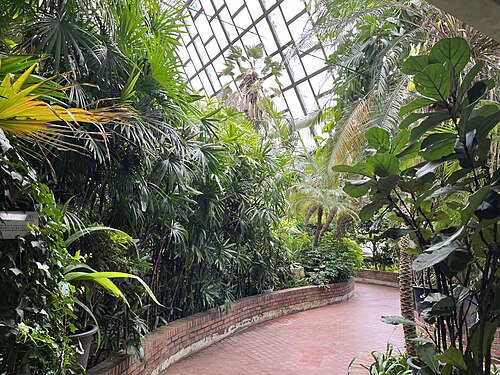
A tourism website adds that this glass house reproduces, in geometric form, the shapes of Jeju's craters, and that its outer walls are clad in natural island stone to recall the local stone walls. The interior is laid out as a walk with bridges, ponds, an artificial waterfall, a hanging pergola and labels explaining each plant. A notice on the city's ticketing page gives 1,650 m² for the subtropical garden and 2,471 m² for the glass citrus greenhouse; the OpenStreetMap outline gives the garden a similar footprint of about 1,750 m².
Plant collections
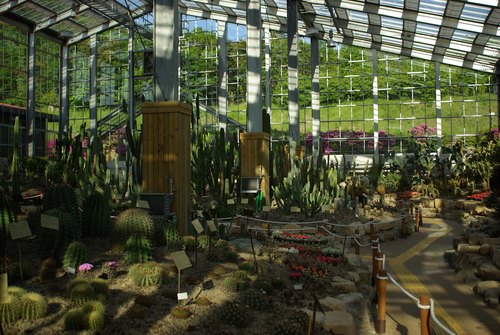
Counts vary from year to year. A 2017 article gives 297 species and more than 7,000 plants; a 2020 one breaks them down into 82 tree species, 83 shrubs and 89 herbaceous plants, 254 species and 7,272 plants in all. Palms stand out: palms with bottle-shaped or club-shaped trunks, a coconut palm, Canary and date palms, washingtonia. The walk also takes in cacti and succulents including aloe vera, a weeping fig, bird of paradise, a banana, a coffee tree and an Australian baobab; a tourism site adds papaya and pineapple, and a 2017 column a rubber tree.
Next door, the glass pavilion of world citrus, which the city lists among its facilities, was counted in 2017 at 143 citrus species in 201 specimens, down to oddities such as the fingered 'Buddha's hand'.
Visiting
The garden stands behind the museum's exhibition building, with a dedicated car park right in front, and is visited together with the museum and the world citrus pavilion. One columnist presents it as a winter stop, a season when tropical plants and flowers are on show. Each November and December, tangerine picking in the museum's orchards brings the site to life; the 2025 edition ran from 3 November to 30 December.
The same columnist continues along the neighbouring coast: the camellia grove at Wimi-ri, a protected Jeju monument, then the Keunmeong coastal path, about 1.5 km long. Yeomiji Botanical Garden, already in the catalogue, lies about 18 km to the west.
33.27° N, 126.61° E
Greenhouses nearby
More greenhouses — South Korea
Do you have a good photo of this greenhouse? Suggest it for this page →
Sources (8)
- eticket.seogwipo.go.kr/contents?bmcode=tangerines
- m.go.seoul.co.kr/news/2010/08/10/20100810013004
- sidae.com/article/2017011114478095598
- bravo.etoday.co.kr/view/atc_view/10390
- bbsj.kr/tour/tour_detail.php?tou_idx=125
- imaeil.com/page/view/2025110418475542420
- ko.wikipedia.org/wiki/감귤박물관
- openstreetmap.org/way/374925560
Affiliate links — booking through Verrière helps fund our research, at no extra cost to you.