Botanical Garden Greenhouse, Seoul Children's Grand Park (서울어린이대공원 식물원)
Seoul (Gwangjin-gu)

Sources checked October 2026
- Year
- 1973
- Style
- Two-level park greenhouse with geothermal heating and cooling
- Dimensions
- About 1,500 m² according to the operator (2,000 m² in press reports); 240 m² indoor garden upstairs
- Status
- Open to the public; a renovation is planned under the park's 2019-2025 redevelopment programme, with no date announced
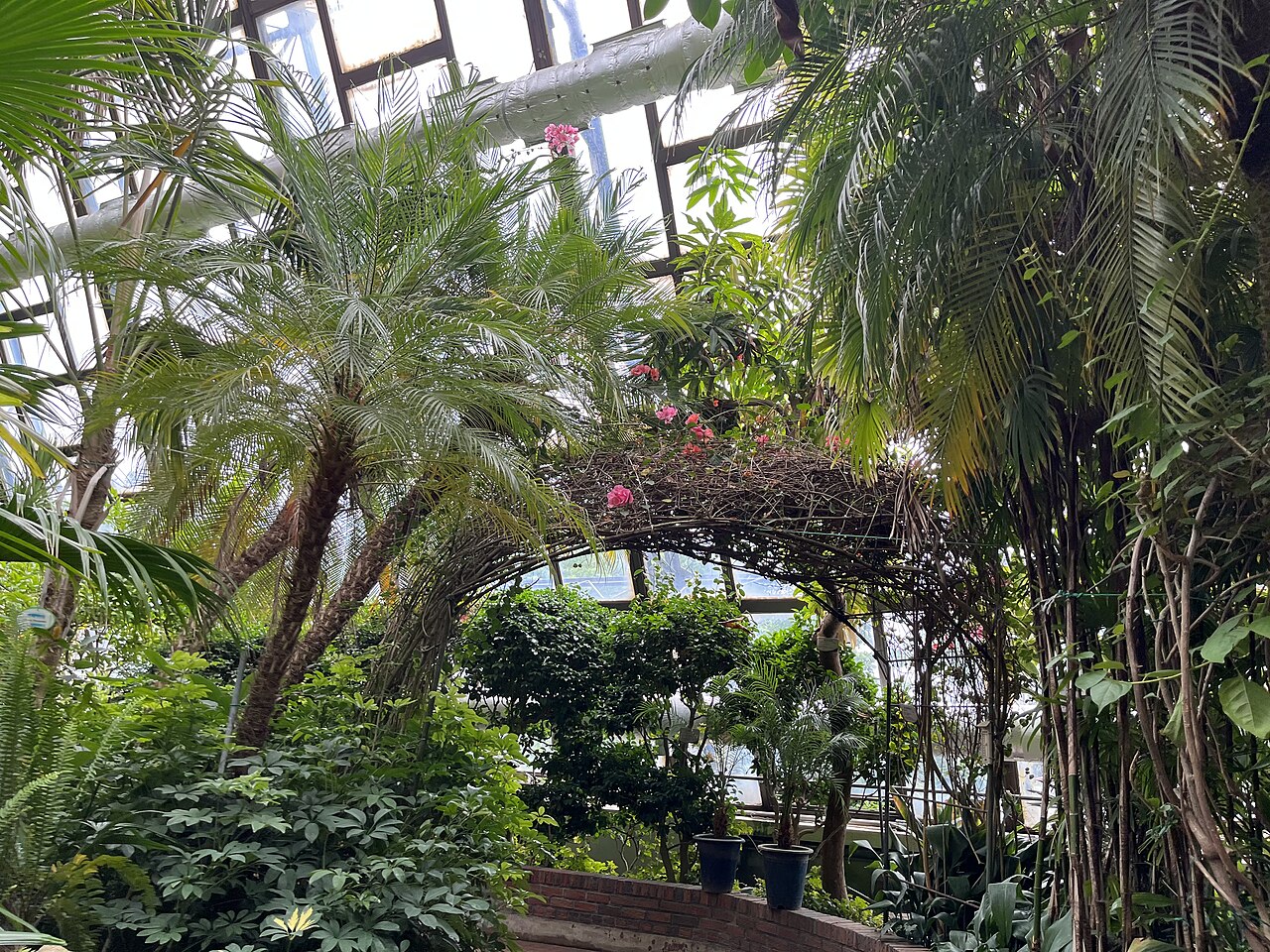
Opened in 1973 together with the park, which was laid out on the former Neung-dong golf course on the site of Empress Sunmyeong's tomb, the greenhouse of Seoul Children's Grand Park holds, according to its operator, 285 species of greenhouse plants on about 1,500 m²: succulents, foliage plants, bonsai and wildflowers. Since 2009 a 170 RT ground-source heat pump has heated and cooled the building. Upstairs, a 240 m² indoor garden runs through eight themes, from a waterfall evoking the Geumgang mountains to aquatic plants displayed in glass tubes.
Affiliate links — booking through Verrière helps fund our research, at no extra cost to you.
History
Seoul Children's Grand Park, in Gwangjin District, stands on the former tomb site of Empress Sunmyeong, wife of Sunjong, the last emperor of Korea: buried there in 1904, she was moved to Namyangju in 1926. From the 1930s to the 1960s the land held the country's first golf course. On 4 December 1970 President Park Chung-hee ordered the course moved and a children's park built in its place; construction began in November 1972 and ended with a hundred-day push in the spring of 1973. The park opened on 5 May 1973, Children's Day, to more than 300,000 visitors, and the botanical garden dates from that same year.
Admission to the park has been free since 4 October 2006. After several years of redevelopment the park reopened on 5 May 2009; in the same year, under a municipal renewable-energy programme, the greenhouse received a 170 RT geothermal heating and cooling system. The upper floor was later turned into a themed indoor garden, already described in the press by 2016. A further redevelopment programme covers 2019 to 2025: after the octagonal Palgakdang pavilion reopened in July 2023, the renovation of the greenhouse and the zoo was announced as the next step, without a published timetable.
Architecture and engineering
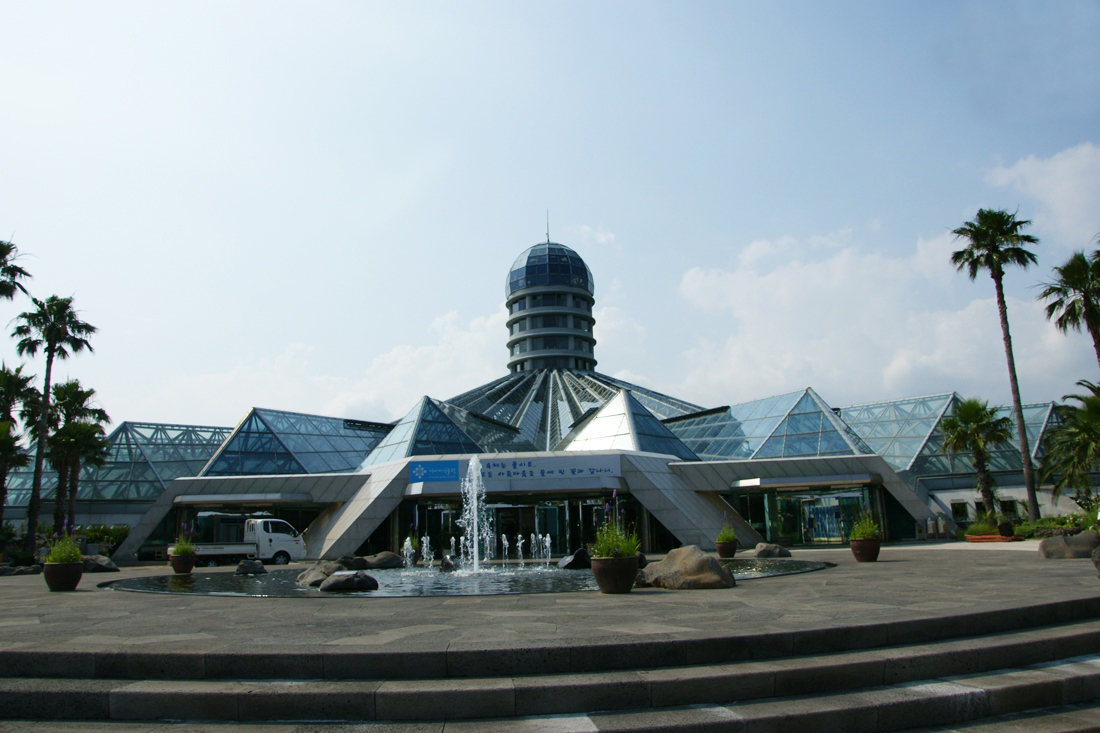
The park's operator, Seoul Facilities Corporation, gives the greenhouse an area of about 1,500 m²; the Encyclopedia of Korean Culture adds a further 500 m² for wildflowers, while the press reports 2,000 m², or some 600 pyeong. The building has two levels: the main collections on the ground floor and, upstairs, a 240 m² indoor garden reached by a ramp suitable for wheelchairs and pushchairs.
Its most distinctive feature is the way its climate is controlled. Since 2009 a 170 RT ground-source heat pump has drawn, through high-density polyethylene pipes buried in the ground, on a stable underground temperature of around 15 °C, give or take five degrees: in winter, heat is moved from the ground into the building; in summer the cycle reverses and surplus heat is returned to the earth. The operator says it intends to run the system on solar power so as to do without fossil fuels. Upstairs, aquatic plants are shown in glass tubes that reveal flowers, stems and roots alike.
Plant collections
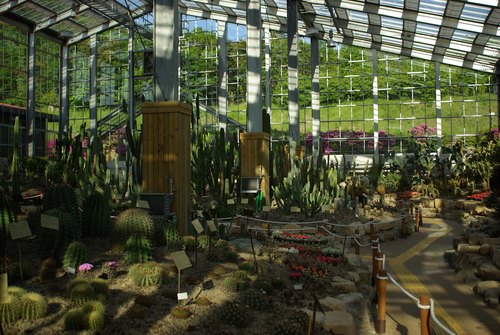
According to the operator, 285 species of greenhouse plants are arranged in four groups that the suggested route takes in turn: some 138 cacti and other succulents, whose flowers, spines and shapes draw the eye; more than 160 foliage plants, set in an exotic display with recorded birdsong; 49 bonsai trained into miniature old trees, some of them more than a century old; and 66 wildflowers planted by season along the path, among them the pasqueflower, the daffodil and the lily. Figures differ from one source to another: 347 greenhouse species according to the Encyclopedia of Korean Culture, 286 species plus 66 wildflowers in a 2016 press report, and 402 species and 5,506 plants, orchids included, in the Korean Wikipedia.
The indoor garden upstairs runs through eight themes: a flowers-and-butterflies display built by park staff around a dead juniper; a waterfall evoking the Geumgang mountains; tropical plants; succulents; hanging plants; aquatic plants in glass tubes; plants mounted on stone and wood; and a 'jingyeong' landscape recreating a Geumgang valley in the manner of late Joseon painters.
Visiting
The greenhouse is number 28 on the park map, in the Nature Land (자연나라) zone, next to its cafeteria and the ecological pond; the walk from the main gate to the rear gate takes about twenty minutes. Visitors arrive by subway line 7 (Children's Grand Park station, exit 1, main gate) or line 5 (Achasan station, exit 4, rear gate). The park itself is free, so the greenhouse combines easily with the zoo, the music fountain near the main entrance, the lotus pond and the octagonal Palgakdang pavilion, reopened in 2023 with a history room and a viewing space looking towards Mount Acha. The Seoul press counts the greenhouse among the city's winter outings, when its collections offer a mild refuge.
37.55° N, 127.08° E
Greenhouses nearby
More greenhouses — South Korea
Do you have a good photo of this greenhouse? Suggest it for this page →
Sources (8)
- sisul.or.kr/open_content/childrenpark/guidance/nature/botanical.jsp
- sisul.or.kr/open_content/childrenpark/guidance/nature/garden.jsp
- encykorea.aks.ac.kr/Article/E0028035
- ko.wikipedia.org/wiki/%EC%84%9C%EC%9A%B8%EC%96%B4%EB%A6%B0%EC%9D%B4%EB%8C%80%EA%B3%B5%EC%9
- en.wikipedia.org/wiki/Children%27s_Grand_Park
- mediahub.seoul.go.kr/archives/2008517
- lady.khan.co.kr/education/article/201601061826051
- wikidata.org/wiki/Q485465
Affiliate links — booking through Verrière helps fund our research, at no extra cost to you.