Yeomiji Botanical Garden
Seogwipo (Jeju)

Sources checked September 2026
- Year
- 1989
- Style
- Sunflower-shaped glasshouse in steel and glass
- Dimensions
- ≈12,500 m² of glasshouses
- Status
- Open to the public
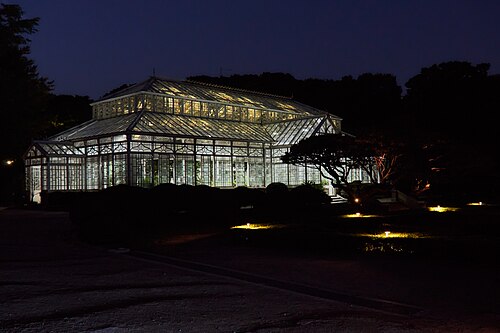
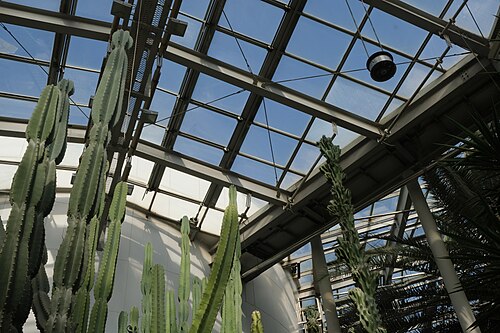
Opened on 12 October 1989 in the Jungmun resort complex at Seogwipo on Jeju Island, Yeomiji Botanical Garden is built around a sunflower-shaped main glasshouse of about 12,543 m². It holds six indoor themed gardens — water, flower, mystery, cactus, jungle and tropical — with more than 1,300 plant species between them. Outside, Korean, Japanese, French and Italian cultural gardens and specialist beds (rhododendrons, hostas, endemic plants) complete the visit. First run by the city of Seoul, the site was taken over by the private operator Buguk Development in 2005 and stays open year-round.
Affiliate links — booking through Verrière helps fund our research, at no extra cost to you.
History
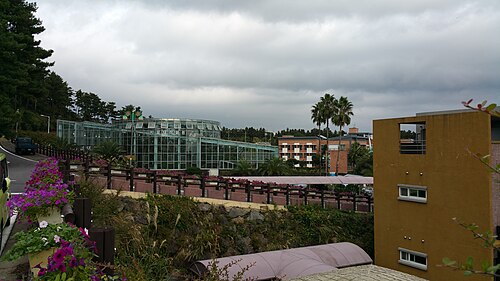
Yeomiji Botanical Garden, whose name means "beautiful land", opened on 12 October 1989 in the Jungmun resort complex on the south coast of Jeju Island. Its great glasshouse soon drew attention: in 1992 the Korea Guinness Association recognised it as the largest greenhouse in the Orient.
The site then changed hands several times. Following the collapse of the Sampoong Department Store in Seoul in 1995, ownership of the garden passed to the city of Seoul. From 1997 it was managed under contract by the municipal Seoul Facilities Corporation. On 19 April 2005 the garden was bought by Buguk Development, a subsidiary of the steelmaker Buguk Steel, which has run it ever since.
Over the years the garden established seed exchanges with many botanical gardens abroad; its former English-language website cited 180 gardens in 130 countries.
Architecture and engineering
The main glasshouse takes the form of a sunflower, organised around a central hall. Its floor area is about 15,024 square yards (roughly 12,560 m²) according to the garden's former English website, and 11,361 m² according to Jeju's tourism office.
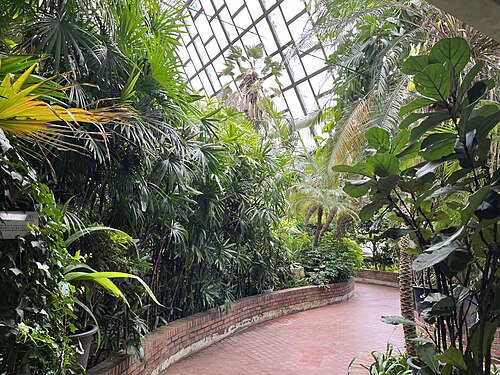
At its centre rises a 38-metre observation tower served by lifts, whose domed viewing deck looks out to sea. The themed rooms are arranged around the central hall, each with its own atmosphere: the aquatic garden, flower garden, mystery garden, cactus garden, jungle garden and tropical fruit garden. Outside, the open-air gardens cover about 112,000 m².
Plant collections
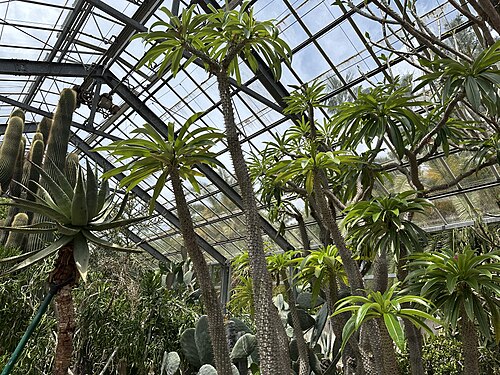
The glasshouse holds some 1,300 species of tropical and subtropical plants, spread across its themed gardens and supplemented by seasonal displays.
Including the outdoor areas, the garden claims more than 2,000 species, or over 2,300 according to Jeju's tourism office. The outdoor gardens, with more than a thousand species, include four cultural gardens (Korean, Japanese, French and Italian) and specialist gardens devoted to endangered species, Jeju's native flora, hostas, rhododendrons, herbs, bog plants, cycads, perennials and lawns.
Visiting
The garden lies at the heart of the Jungmun resort complex in Seogwipo and is open all year. Visits usually begin with the glasshouse, whose loop around the central hall takes about an hour, followed by the climb to the observation deck. Allow another hour for the outdoor cultural and themed gardens.
The glasshouse is a pleasant refuge on rainy or windy days. A visit combines easily with other Jungmun sights, notably Jungmun Beach and the Cheonjeyeon waterfalls.
33.25° N, 126.41° E
Greenhouses nearby
Architecture nearby
More greenhouses — South Korea
Do you have a good photo of this greenhouse? Suggest it for this page →
Affiliate links — booking through Verrière helps fund our research, at no extra cost to you.