Eco Center Greenhouse, Shingu Botanic Garden (신구대학교식물원 에코센터)
Seongnam (Sujeong-gu), Gyeonggi
No freely licensed photo of this greenhouse yet. Do you have one? Suggest it for this page →
Sources checked October 2026
- Style
- Transparent rounded glasshouse shaped like a dewdrop
- Dimensions
- ≈1,000 m², up to 19 m high
- Status
- Open to visitors of the botanic garden (reopening announced in March 2025 after refurbishment)
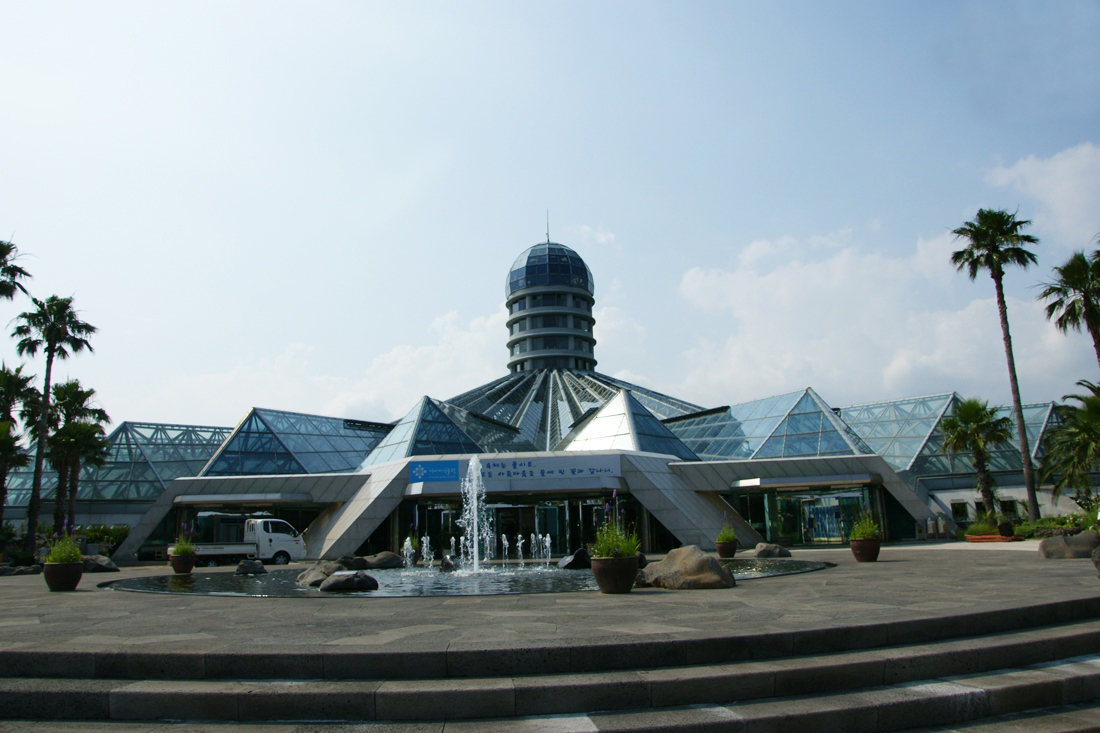
Shingu University's botanic garden in Seongnam (Gyeonggi), opened in 2003 at the foot of Cheonggyesan, has the Eco Center as its central glasshouse: about 1,000 m² and up to 19 m high under a rounded form said to evoke a dewdrop on a leaf. It shelters species from Jeju and the southern islands of Korea, camellias among them, planted so that warm-temperate plants can be seen at close range in the centre of the country. The basement holds classrooms and a plant laboratory. Its reopening after refurbishment was announced in March 2025.
Affiliate links — booking through Verrière helps fund our research, at no extra cost to you.
History
Shingu Botanic Garden extends a horticultural training ground created in 1981 by Shingu College, now a university, in Seongnam. According to the garden's own chronology, a master plan was drawn up in 1996, the city of Seongnam chose the former training farm as the site in 1999, the detailed design was completed and work began in 2001; the garden opened in April 2003 according to its official chronology, was registered as a school arboretum with the Korea Forest Service in June 2004 and was designated an ex situ conservation institution for threatened plants in 2010. It took its present name, Shingu University Botanic Garden, in December 2012.
The Eco Center is the garden's central glasshouse. It should not be confused with the Forest Exhibition Hall, finished in October 2013 for the garden's tenth anniversary: a building with one basement level and one level above ground, equipped with its own glass greenhouse, a 'sky garden', a plant shop and a café, and run with solar panels and rainwater treatment.
A 2014 article presents the Eco Center as the garden's central glasshouse, a 2018 text has the illuminated winter-festival route end there, and the garden's official account announced on 7 March 2025 that the refurbished building was opening.
Architecture and engineering
The Eco Center covers about 1,000 m² and reaches 19 m in height, according to a 2014 article repeated by a blog in 2026. Its rounded form is said to evoke a dewdrop resting on a leaf; a 2018 article describes a transparent, semicircular building that stands out against the snow when it falls, and a 2026 item published by the city of Seongnam sees a large glass dome visible from afar, with a high ceiling.
The building also has a basement, with an audiovisual classroom, an ecology learning room and a plant laboratory, and a rest room that hosts plant-photography exhibitions and concerts. The published dimensions predate the 2025 refurbishment.
Plant collections
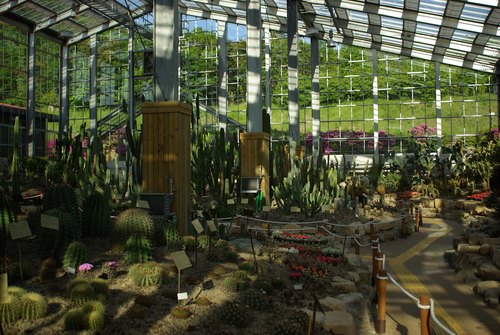
The Eco Center's plants come from Jeju and the southern islands of Korea: gulgeori-namu, don-namu, meon-namu, hubak-namu and camellias (dongbaek-namu), planted so that warm-temperate plants can be seen at close range in central Korea. On the ground, terrestrial orchids, saeu-ran and ja-ran, and teolmeowi flower in their seasons. The reopening announcement of March 2025 names ja-ran, baekseohyang, camellias, palson-i and namcheon; a December 2023 article points out that red camellias can be seen in flower in the glasshouses.
Descriptions differ: the 2026 item from the city of Seongnam speaks of tropical and subtropical plants and the feel of a small rainforest, whereas the garden and the press describe warm-temperate plants. Beyond the glasshouse, a 2026 blog counts 1,527 species (654 woody, 873 herbaceous) in the garden, which covers 570,000 m².
Visiting
According to a 2026 item from the city of Seongnam, the Eco Center comes into view past the central plaza, towards the garden's forest paths, with Cheonggyesan rising behind. In winter the Kkotbit light festival lights the route from the central plaza to the Eco Center; its tenth edition ran in the winter of 2023-2024. By day the glasshouse and the Forest Exhibition Hall show southern plants and the flowering of camellias.
The garden also has an insect ecology house, a traditional garden with low walls and storage jars, and the Forest Exhibition Hall, with its own glass greenhouse and a 'sky garden'.
37.43° N, 127.08° E
Greenhouses nearby
More greenhouses — South Korea
Do you have a good photo of this greenhouse? Suggest it for this page →
Sources (8)
- shingu.ac.kr/cms/FR_CON/index.do?MENU_ID=620
- ejanews.co.kr/news/articleView.html?idxno=100622
- gardening.news/news/articleView.html?idxno=11574
- news.unn.net/news/articleView.html?idxno=128652
- latimes.kr/news/articleView.html?idxno=51411
- instagram.com/reel/DG5JFH5zGKP/
- blog.naver.com/sntjdska123/224309724305
- kangdante.tistory.com/3104
Affiliate links — booking through Verrière helps fund our research, at no extra cost to you.