Insect Botanical Garden, Seoul Forest (서울숲 곤충식물원)
Seoul (Seongdong-gu)
No freely licensed photo of this greenhouse yet. Do you have one? Suggest it for this page →
Sources checked October 2026
- Year
- 2005
- Style
- Glazed steel-framed greenhouse inside the frame of a former water-filtration building
- Dimensions
- 1,800 m², on two levels
- Status
- Open to the public, free admission (renovated in 2024, reopened on 7 January 2025)
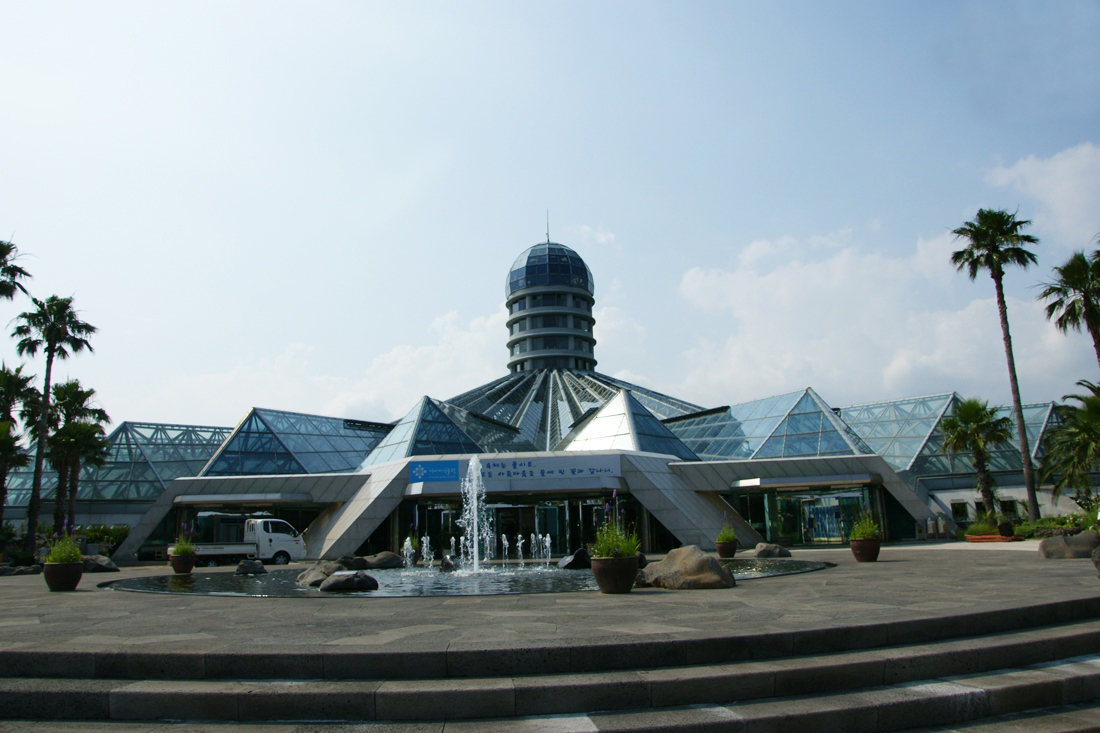
In the nature-learning section of Seoul Forest, the greenhouse occupies the structure of the rapid-filter building of the former Ttukdo water plant, closed in 2003: its wide-span frame was converted into a multi-purpose greenhouse, opened with the park in 2005. It covers 1,800 m² on two levels and holds more than a hundred species of tropical plants and about thirty kinds of animals, including beetles, fish and a sulcata tortoise. Renovated in 2024 (geothermal system, living wall), it reopened on 7 January 2025. Admission is free.
Affiliate links — booking through Verrière helps fund our research, at no extra cost to you.
History
Seoul Forest occupies the site of Ttukseom, which according to Korean Wikipedia was a royal hunting ground, then the site of Korea's first water treatment plant, set up in 1908, before becoming a leisure area, a racecourse and a sports park. Work to turn it into a park began in December 2003 and the park opened on 18 June 2005. The Ttukdo plant, closed in 2003, was partly reused: the municipal portal explains that the park's fourth theme, the "nature-learning garden", reuses facilities from the plant, including a greenhouse.
The greenhouse, opened with the park in 2005 according to the Newsis agency, moved into the plant's rapid-filter building. It was extended over the years: in May 2009 a butterfly breeding room and a 32 m² exhibition room in the basement; in February 2011 an 80 m² experience room upstairs; on 10 May 2011 a net-covered butterfly garden of 477 m² next door, on a wall of the former plant, according to EcoJournal. From winter to April the butterflies were then shown inside the greenhouse.
After twenty years the city found that heating and cooling had lost efficiency and that some plants were growing up to the ceiling. A geothermal installation was put in at the start of 2024, followed by interior and exterior works from August to December 2024. The greenhouse reopened on 7 January 2025.
Architecture and engineering
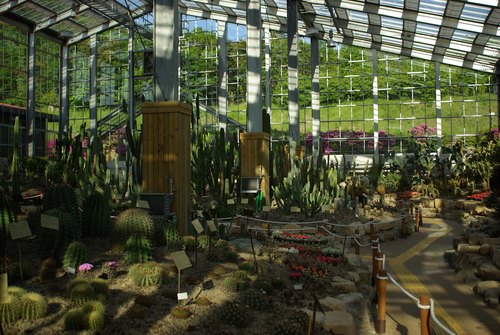
The building reuses the frame of a rapid-filter building of the former Ttukdo plant, whose widely spaced columns made it possible to fit a large multi-purpose greenhouse, according to Newsis (January 2025). The municipal portal gives 1,800 m² on two levels. The 2025 photographs show a glass façade on a metal frame with an entrance block clad in dark panels and, inside, a glazed roof over cactus beds, a flagstone path, a lobby with one wall fully planted as a living wall and, upstairs, a photo spot. On aerial imagery a glazed, framed roof can be read, adjoining the butterfly garden.
The 2024 renovation added geothermal heating and cooling, a wall-greening system and reworked ceiling lighting in the lobby to open up the space; the iron entrance door was replaced by a glass one. The floor, the log borders of the beds and the wooden steps were redone, the pond cleaned and pest control carried out.
Plant collections
The municipal portal reports more than a hundred species of tropical plants, among them bananas, papayas, gongjak palms (공작야자) and geumho cacti (금호선인장). The renovation added lemon trees and "tea trees" (티트리), and plants whose stems were bending against the ceiling were reworked. A 2022 account also mentions carnivorous plants upstairs, a bird-of-paradise flower (극락조화) and a room of insect specimens.
The greenhouse also shelters about thirty kinds of animals: insects such as rhinoceros beetles and stag beetles (장수풍뎅이, 왕사슴벌레), but also stick insects, land crabs, ornamental fish (discus, angelfish) and Korean freshwater fish (crucian carp, carp) and a sulcata tortoise, a herbivore. The upper floor overlooks the neighbouring butterfly garden, open from May to October, which holds more than ten species and about 3,000 butterflies according to a May 2025 announcement.
Visiting
The greenhouse lies in the southern part of the park, in the nature-learning area, next to the butterfly garden; admission is free and Monday is the closing day, with summer and winter hours to check on the official Seoul Forest site. Accounts recommend it above all for families with children, and one blog calls it cool in summer and warm in winter. The 2025 programme also announces activities around the greenhouse and the sulcata tortoise.
Access is from Seoul Forest station on the Suin-Bundang line: exit 4 is about ten minutes' walk according to the municipal portal, which also gives about 500 m from the park's gate 16; the park has a public car park. A visit combines with the butterfly garden, the ecological forest's deer enclosure and the floor fountain (May to October) named on the official hours page.
37.54° N, 127.04° E
Greenhouses nearby
More greenhouses — South Korea
Do you have a good photo of this greenhouse? Suggest it for this page →
Sources (8)
- parks.seoul.go.kr/mini/content.do?key=2605260009
- mediahub.seoul.go.kr/archives/2013179
- mediahub.seoul.go.kr/archives/2013477
- v.daum.net/v/tSiirPGkKa
- ecojournal.co.kr/m/view.php?idx=59799
- ko.wikipedia.org/wiki/%EC%84%9C%EC%9A%B8%EC%88%B2
- en.wikipedia.org/wiki/Seoul_Forest
- newswhoplus.com/news/articleView.html?idxno=26362
Affiliate links — booking through Verrière helps fund our research, at no extra cost to you.