Eskenazi Museum of Art (Indiana University)
Bloomington, Indiana
Sources checked October 2026
- Year
- 1982
- Architect
- I. M. Pei
- Type
- University art museum
- Access
- Open to the public, free admission, closed on Mondays (official website, October 2026)
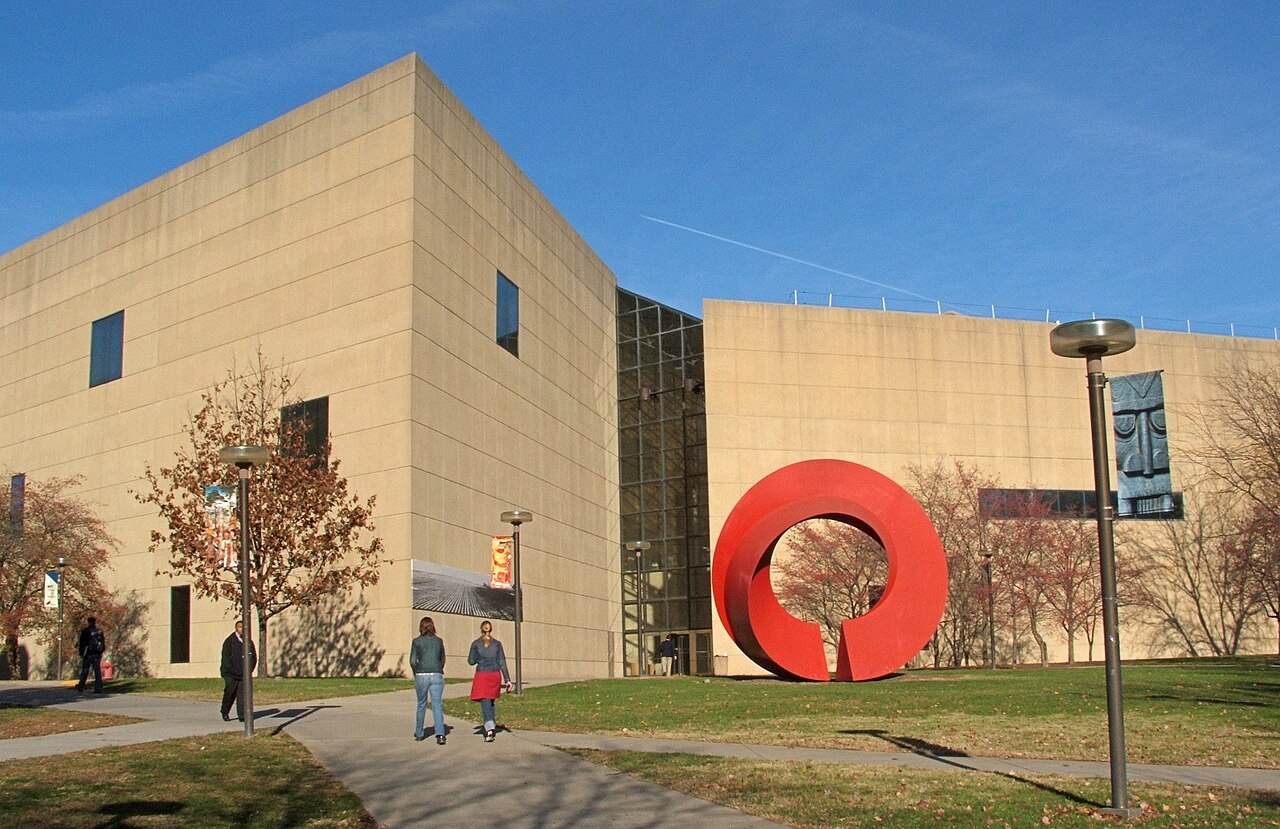
Designed by I. M. Pei and completed in 1982, Indiana University's art museum stands out in concrete and glass from the limestone buildings of the Bloomington campus. Two wings are joined by a triangular atrium with a glass ceiling. Renovated by Ennead Architects and reopened in 2019, it has seven galleries and free admission.
Affiliate links — booking through Verrière helps fund our research, at no extra cost to you.
History
Indiana University began building its art collection in 1941, when Henry Radford Hope, head of the art department, and the university president Herman B Wells imagined a collection that would bring together works of every period and from every part of the world. In 1962 the opening of the Fine Arts Building gave the collection a first place to be shown; but as it grew, it became clear that the university needed a museum of its own.
In 1971 Thomas T. Solley succeeded Hope as director of the museum. In 1973 he and the university commissioned Pei to design a building dedicated to the collection. The museum was completed in 1982.
In 2016 a $15 million gift from Sidney and Lois Eskenazi, the biggest cash donation the museum has ever received, helped fund a full renovation, and the museum took their name. It closed to the public from 15 May 2017 and reopened on 7 November 2019, after works costing $30 million.
Architecture
Built of beige-toned concrete, the museum stands out against the traditional limestone buildings of the rest of the Bloomington campus. It consists of two wings, one trapezoidal in plan at ground level, the other triangular, linked by a central atrium that is also triangular. A gridded glass ceiling brings daylight into this lofty space, which holds a grand staircase and concrete surfaces. The building covers 112,000 square feet, about 10,400 m².
The renovation was led by Ennead Architects, under Susan T. Rodriguez, with Browning Day Mullins Dierdorf of Indianapolis and the university's capital projects office; it was carried out within the building's existing footprint, which was not enlarged. A skybridge now crosses the atrium at the third level and joins the east and west wings: before, visitors had to go down to a lower level to move from one to the other. An entrance was opened on the north side, facing the campus arboretum, together with a café and gift shop. The window tinting was removed, blinds control the sunlight, and a glass wall set into the gallery of the arts of Asia and the Islamic world lets visitors see into the conservation center.
Use today
The museum holds more than 47,000 objects, from antiquity to contemporary art. Ancient art covers the Middle East and the Mediterranean region, from 10,000 BCE to 1000 CE. The arts of Asia and the Islamic world are especially strong in Japanese art. They are joined by the arts of Africa, Oceania and the Indigenous Americas, European and American art, including Stuart Davis's mural Swing Landscape, and a collection of prints, drawings and photographs.
The building has seven galleries, temporary exhibitions and three art study rooms where works can be viewed. Four centers are housed here: conservation, curatorial studies, education (the Kimberly and John Simpson Center for Education), and prints, drawings and photographs. It also holds a conservation analytical laboratory, a café and a gift shop.
Visiting
Admission is free. The galleries are closed on Mondays; they open from 10 a.m. to 5 p.m. on Tuesdays, Wednesdays, Fridays and Saturdays, from 10 a.m. to 7 p.m. on Thursdays and from noon to 5 p.m. on Sundays.
The museum is at 1133 E. Seventh Street, on the university campus. Paid parking at the Indiana Memorial Union is close by; on Saturdays and Sundays two campus garages are free. Accessible entrances open on the ground floor, on the mezzanine and on the arboretum side, and two elevators serve all the galleries.
Photos and videos are encouraged, without flash, tripods or selfie sticks. No food or drink is allowed in the galleries, nor backpacks; bags up to 12 x 18 inches (about 30 x 46 cm) are welcome.
39.17° N, 86.52° W
Greenhouses nearby
Architecture nearby
Sources (11)
- artmuseum.indiana.edu/about/index.html
- artmuseum.indiana.edu/about/history.html
- artmuseum.indiana.edu/visit/your-visit.html
- artmuseum.indiana.edu/collections/index.html
- artmuseum.indiana.edu/centers/index.html
- artmuseum.indiana.edu/news-events/news-stories/2017-04-04-renovation-plans.html
- artmuseum.indiana.edu/news-events/news-stories/2019-05-16-mourning-pei.html
- artandobject.com/news/eskenazi-museum-arts-renovated-i-m-pei-building-reopen
- dezeen.com/2020/02/11/im-pei-eskenazi-museum-indiana/
- openstreetmap.org/way/154762561
- wikidata.org/wiki/Q6023573
Affiliate links — booking through Verrière helps fund our research, at no extra cost to you.