South Garden Exhibition Greenhouse, China National Botanical Garden (国家植物园南园展览温室)
Haidian, Beijing
Entry updated on October 5, 2026
- Year
- 1950s–1965
- Architect
- Unknown
- Style
- Steel-framed glasshouse (since 1965) on a plan shaped like the character 王
- Dimensions
- 2,430 m² ("over 2,000 m²" in press reports), nine rooms
- Status
- Open to the public (restored in 2018, reopened April 2019)
Beijing's oldest display glasshouse belongs to the botanical garden of the Chinese Academy of Sciences' Institute of Botany, which became the South Garden of the China National Botanical Garden in 2022. Begun in the 1950s in brick and timber and given a steel frame in 1965, it was then the largest tropical glasshouse in the country. Its nine rooms, covering 2,430 m², display more than 2,000 tropical and subtropical species and cultivars, among them the Bodhi tree presented by Nehru.
Affiliate links — booking through Verrière helps fund our research, at no extra cost to you.
History
1 min
The botanical garden of the Chinese Academy of Sciences' Institute of Botany lies at the foot of the Fragrant Hills (Xiangshan), south of Xiangshan Road and opposite the municipal botanical garden. Its exhibition greenhouse was among its earliest facilities. According to the China National Botanical Garden's official site, building began in the 1950s in brick and timber, and the house was rebuilt on a steel frame in 1965. The Beijing News simply dates it to 1965 and calls it the first tropical and subtropical display greenhouse of the People's Republic. The sources agree that it was then the largest tropical glasshouse in the country and that it remains the oldest display glasshouse in Beijing.
Its story is bound up with diplomacy. In October 1954 the Indian prime minister Jawaharlal Nehru, visiting China at the government's invitation, brought a young Bodhi tree raised from a branch of the tree under which the Buddha is said to have meditated. The seedling, 15 cm tall with five leaves, was received with great ceremony by Zhou Enlai, entrusted to the Institute of Botany and later planted in the greenhouse at Xiangshan.
A restoration of the greenhouse was completed in 2018 and the house reopened to visitors in April 2019. In 2022 the inauguration of the China National Botanical Garden brought the Institute's garden, now the South Garden, together with the municipal garden north of the road, whose large modern tropical conservatory also appears in this atlas.
Architecture and engineering
1 min
The building is recognisable by its plan, which follows the shape of the Chinese character 王: three parallel ranges joined by a perpendicular spine. Begun in the 1950s, the building was first built of brick and timber; in 1965 that structure gave way to a steel frame carrying the glazing.
The National Botanical Garden gives a total area of 2,430 m², while the Beijing press speaks of "more than 2,000 m²". The interior is divided into nine themed rooms: the four-seasons flower hall, the palm room, the shade-plant room, the gymnosperm room, the carnivorous-plant room, the fruit-tree room, the succulent room, the aquatic-plant room and the Bodhi room, named after Nehru's tree. This division allows groups of plants with very different needs, from humid forest to arid ground, to be shown side by side.
Once the largest tropical glasshouse in China, the house now looks modest next to the North Garden's tropical conservatory, for which the National Botanical Garden quotes 17,000 m² of floor area. The comparison measures how far Chinese glasshouse building has travelled in half a century.
Plant collections
1 min
The greenhouse displays more than 2,000 tropical and subtropical species and cultivars. Its most famous resident is Nehru's Bodhi tree: the 1954 seedling is now more than 5 m tall, densely leaved, and has already borne fruit. Beijing newspapers describe it as the only Bodhi tree in China propagated from the sacred original, and count it among the "state-gift plants" on show in the garden.
Other groups deserve attention: more than 130 species of carnivorous plants, baobabs raised from seed brought back from Madagascar in 2017 by members of an Institute field expedition, and orchids from the collection assembled in the 1960s by the former commander-in-chief Zhu De. In the aquatic room, water lilies and giant water lilies with enormous leaves can be seen all year round. A number of rare plants were collected abroad by the Institute's researchers, a reminder of the South Garden's scientific purpose.
Visiting
1 min
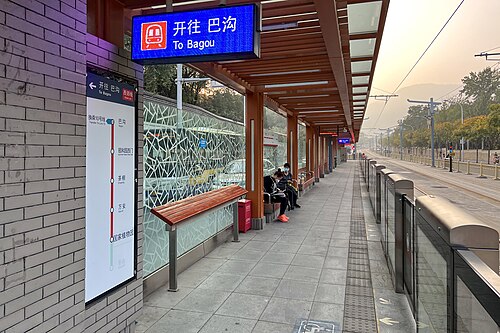
The greenhouse stands in the South Garden, at 20 Xiangshan Nanxincun, south of Xiangshan Road; the South Garden ticket includes entry to the house. The "National Botanical Garden" stop of the Xijiao tram line lies between the two gardens.
A visit pairs naturally with the North Garden, about a kilometre away, whose great tropical conservatory offers a striking contrast of scale and period, and with the nearby Fragrant Hills. Beijing newspapers recommend the garden's greenhouses in early winter, when they provide a warm, green refuge while the trees outside stand bare.
39.99° N, 116.21° E
Greenhouses nearby
More greenhouses — China
Do you have a good photo of this greenhouse? Suggest it for this page →