Fuligong Greenhouses, Kunming Botanical Garden (昆明植物园扶荔宫)
Kunming (Yunnan)
Entry updated on October 5, 2026
- Year
- 1986
- Architect
- Unknown
- Style
- Greenhouse complex; contemporary spiralling main glasshouse
- Dimensions
- Main greenhouse 4,200 m², 7.5 to 29.9 m high
- Status
- Open to the public (booking required)
The Fuligong is the greenhouse complex of Kunming Botanical Garden, part of the Kunming Institute of Botany of the Chinese Academy of Sciences. Completed in 1986 and named by the botanist Wu Zhengyi, it was enlarged from 2011 with a new 4,200 m² main glasshouse whose volume spirals up to 29.9 metres. Around it stand halls devoted to cryptogams, orchids and carnivorous plants, together with an education hall.
Affiliate links — booking through Verrière helps fund our research, at no extra cost to you.
History
1 min
Kunming Botanical Garden was founded in 1938. Part of the Kunming Institute of Botany, under the Chinese Academy of Sciences, it covers 44 hectares on the banks of the Heilongtan in the north of Yunnan's capital and includes fourteen specialist gardens.
Its greenhouse complex was completed and brought into use in 1986. The botanist Wu Zhengyi named it Fuligong, the 'Fuli Palace', a classical allusion to a building in the Han dynasty's imperial Shanglin park.
A renovation and extension project launched in 2011 received more than 26.4 million yuan, including 1.28 million of the institute's own funds. It paid for a new 4,200 m² main glasshouse and the renovation of three free-standing greenhouses. After a closure, the complex reopened on 22 November 2021 with an online booking system. That same year, during the COP15 biodiversity conference held in Kunming, the institute ran an outdoor themed exhibition area, and the press widely presented the Fuligong as a showcase of plant diversity.
Architecture and engineering
1 min
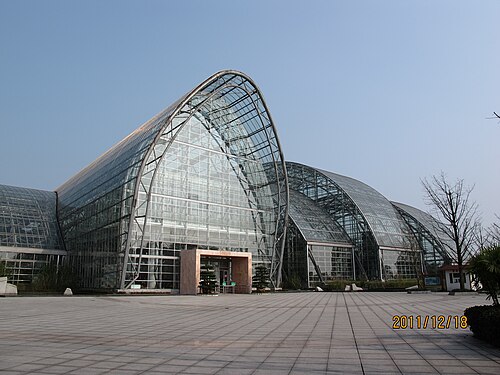
The heart of the complex is the 4,200 m² main glasshouse, made up of two separate but connected volumes, one tall and one low. Its roof traces a spiral that starts at 7.5 metres at the north end and peaks at 29.9 metres in the south; as the press describes it, the spiral form is meant to evoke the core structure of life. Winding paths unfold through it in successive levels.
The interior is divided into four zones: tropical aquatic plants, tropical fruit, tropical rainforest and tropical desert.
Smaller buildings stand around the great glasshouse: the cryptogam hall, combining a fern room and a moss-and-lichen room staged with rocks, old timber, small bridges and streams; the orchid hall; the carnivorous plant hall; and the Caomu Baijian Guan, an education space that houses a seed museum and whose name is linked to Wu Zhengyi.
Plant collections
1 min
The main glasshouse holds more than 1,800 species. The press singles out the miracle fruit (神秘果), the 'space banana' (太空香蕉), the giant water lily (王莲) and the screw pine (露兜树), as well as more dangerous plants such as the jianxue fenghou poison tree (见血封喉) and pitcher plants (猪笼草).
The smaller halls are specialised. The carnivorous plant hall, described as the most unusual, gathers 680 taxa including 378 original species, a collection said to be the largest among Chinese botanical gardens. The orchid hall has more than 600 species, with an emphasis on dendrobiums (over 400). The cryptogam hall shows more than 130 ferns and over 60 mosses. Across the biodiversity area as a whole, more than 2,500 characteristic plants are conserved.
Visiting
1 min
The Fuligong lies within Kunming Botanical Garden, in the north of the city near the Heilongtan. Visitor numbers are capped and entry is booked online one to seven days ahead through the garden's WeChat account; at the 2021 reopening, visits ran in timed slots and were reckoned to take an hour and a half.
The rest of the garden deserves time too: its fourteen specialist gardens include collections of camellias, rhododendrons, magnolias, gymnosperms and medicinal plants. In September 2023 an endangered species, Manglietia ventii, flowered there for the first time, an early sign of conservation success.
25.14° N, 102.74° E
Greenhouses nearby
More greenhouses — China
Do you have a good photo of this greenhouse? Suggest it for this page →