Plant Pavilion, Beijing Expo Park (北京世园公园植物馆)
Yanqing, Beijing
Entry updated on October 5, 2026
- Year
- 2019
- Architect
- URBANUS 都市实践 (Wang Hui, Hao Gang)
- Style
- Contemporary pavilion with an ETFE-roofed tropical glasshouse
- Dimensions
- ≈8,400 m² above ground, glasshouse ≈3,000 m², 23.95 m high
- Status
- Open to the public
Built for the 2019 Beijing International Horticultural Exhibition, south of Yanqing town, the Plant Pavilion was designed by URBANUS for the Vanke group, the Expo partner charged with building and running it. Under the theme 'The Incredible Intelligence of the Plant', it gathers more than 1,000 species and 20,000 tropical plants. Behind an entrance hall conceived as a 'rising horizon' and hung with suspended 'roots', an ETFE-roofed glasshouse of about 3,000 m² is explored along a path that spirals up from roots to canopy, ending at a rooftop bookshop and café.
Affiliate links — booking through Verrière helps fund our research, at no extra cost to you.
History
1 min
The Plant Pavilion was born of the 2019 Beijing International Horticultural Exhibition, held south of Yanqing town. In November 2015 the Vanke group signed an agreement with the Expo company that made it a global strategic partner of the event, responsible for building and then operating the pavilion; the clients were Vanke and the Beijing World Horticultural Exposition Investment Development Co.
The design went to URBANUS (都市实践), with a team that included Wang Hui and Hao Gang. The curatorial theme chosen for the building was 'The Incredible Intelligence of the Plant'.
After the exhibition the grounds became Beijing Expo Park (北京世园公园), a 503-hectare park facing the Great Wall, the Guishui River and Haituo Mountain. The pavilion stayed open: in 2023 the municipal government presented it with a new interactive exhibition, 'A Hundred Million Years of Evolution: The Adventures of Plants', which recreates the Cretaceous and its fossil plants, alongside the mangrove and the tropical collections.
Architecture and engineering
1 min
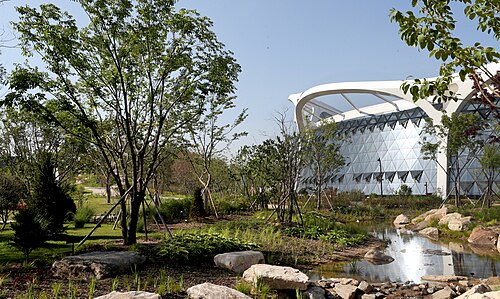
The architectural idea is a 'rising horizon': the ground appears to lift up to form the building, whose surface texture is inspired by root systems, while its elements allude to the mangrove ecosystem of soil, roots, trunks, leaves and roosting birds. On a 3.9-hectare site the pavilion offers about 8,404 m² of floor space above ground (around 10,000 m² according to other sources) over four storeys, and rises to 23.95 metres.
Visitors enter through a reception hall hung with suspended 'roots', which conceals the core of the building: a tropical glasshouse of about 3,000 m² (2,850 m² in another account) under an ETFE roof carried on a steel structure, with an envelope combining metal, concrete and glass. The route starts in a multimedia exhibition hall, climbs through the glasshouse in a spiral from root level to the canopy and returns to the exhibition spaces. It ends on the roof, where a bookshop and café sit beside a family of giraffe sculptures by the British artist James Doran-Webb, an installation 10 metres high. In the evening a light show on the theme of photosynthesis animates the building.
Plant collections
1 min
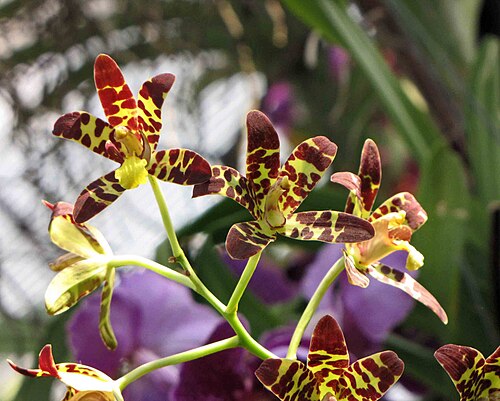
The pavilion holds more than 1,000 species, 1,001 according to the 2019 presentation, and over 20,000 tropical plants. The ground floor alone displays more than 600 species, arranged in five zones and twelve set pieces: an artificial mangrove subject to tidal variations, a tropical rainforest, a fern section, a palm collection and an area for succulents and carnivorous plants.
Among the specimens singled out is a century-old fig (青果榕). The interactive exhibition 'A Hundred Million Years of Evolution: The Adventures of Plants', presented after the Expo, adds a section on the Cretaceous and fossil plants, while desert plants and carnivorous species remain on show. The pavilion's theme, the unsuspected intelligence of plants, runs through the whole route from the roots to the canopy.
Visiting
1 min
The pavilion stands in Beijing Expo Park, south of Yanqing town, a 503-hectare park looking out over the Great Wall, the Guishui River and Haituo Mountain. Allow one to two hours to follow the route from end to end and up to the roof, where the bookshop-café makes a natural pause. The visit combines easily with the park's other landmarks, including the China Pavilion and the Yongning Pavilion (永宁阁). Throughout the year the park schedules seasonal flower festivals, lantern festivals, music festivals, sporting events and, in winter, ice-and-snow celebrations.
40.44° N, 115.94° E
Greenhouses nearby
More greenhouses — China
Do you have a good photo of this greenhouse? Suggest it for this page →