Greenhouse of the China National Botanical Garden
Haidian, Beijing

Sources checked September 2026
- Year
- 2000
- Architect
- Institut de conception architecturale de Pékin
- Style
- Sloped glass roof of interlocking panels, inspired by leaf veins
- Dimensions
- 17,000 m² built on 5.5 hectares; more than 3,000 species and 60,000 specimens
- Status
- Open to the public
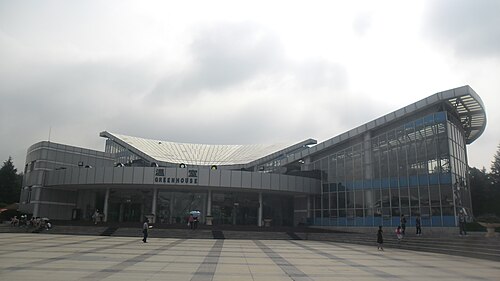
Completed in late 1999 by the Beijing Institute of Architectural Design, this great greenhouse at the National Botanical Garden of China was, according to the Chinese press at the time, the largest and most automated on the Asian continent. Its sloped, interlocking glass roof, designed around the theme of “the green leaf's memory of its root,” covers 17,000 m² built on a 5.5-hectare site. Four exhibition zones, ranging from humid rainforest to desert by way of orchids and carnivorous plants, bring together more than 3,000 species and nearly 60,000 specimens from all five continents.
Affiliate links — booking through Verrière helps fund our research, at no extra cost to you.
History
The botanical garden that houses this conservatory took decades to materialise. In 1954 a group of ten young scientists appealed to Mao Zedong for a major botanical garden in Beijing, a cause the botanist Hu Xiansu had championed for years. The chosen site, between Fragrant Hills Park and Jade Spring Hill in Haidian District, developed slowly, and the Beijing Botanical Garden only formally opened to fee-paying visitors on 23 April 1988.
The great exhibition greenhouse came next. Work on what was then called the tropical plant exhibition greenhouse began on 28 March 1998. The building received its first visitors during a trial opening on 1 January 2000 and was officially inaugurated on 28 March 2000. It cost 260 million yuan and was later counted among Beijing's ten landmark buildings of the 1990s.
The garden's status then changed in scale. On 28 December 2021 the creation of a China National Botanical Garden was approved, and it was formally inaugurated on 18 April 2022. It merges the garden of the Chinese Academy of Sciences' Institute of Botany, now the South Garden, with the former Beijing Botanical Garden, now the North Garden, where the conservatory stands. The planned area of the combined garden is nearly 600 hectares.
Architecture and engineering
Designed by the Beijing Institute of Architectural Design, the conservatory has 17,000 m² of floor space on a 5.5-hectare site, west of the North Garden's central axis. Its concept rests on a poetic image, green leaves remembering their roots: the steeply tilted glass roof is broken into panels whose pattern evokes a network of rhizomes.
Inside, four main exhibition halls each have their own climate. The largest, the Four Seasons Garden, covers 3,500 m² at the heart of the building and is divided between a central garden, organised around a large fountain, and a section given over to palms. Around it lie the tropical rainforest hall, a desert and succulent section of about 1,200 m², and a room of about 500 m² devoted to orchids, bromeliads and carnivorous plants.
Plant collections
According to the garden, the conservatory holds more than 3,100 species and cultivars, amounting to over 60,000 plants. The rainforest hall stages the typical dynamics of humid tropical forest, including epiphytes, hanging gardens and strangler figs; one 9-metre fig can be seen gripping a 16-metre date palm.
The desert section presents more than a thousand species of cacti and succulents, including a golden barrel cactus (Echinocactus grusonii) 80 cm across and columnar cacti 5.5 metres tall, along with desert roses, agaves and Euphorbia tirucalli. The orchid room shows cattleyas, phalaenopsis, cymbidiums, dendrobiums and oncidiums alongside bromeliads such as guzmanias and vrieseas, and carnivorous plants including pitcher plants and the Venus flytrap. The Four Seasons Garden combines seasonal flowers, tall ornamental trees and palms; plants singled out by the garden include the sacred fig (Ficus religiosa), Saraca and the talipot palm (Corypha umbraculifera).
Visiting
The conservatory stands in the North Garden, at the foot of the Fragrant Hills and west of the main avenue. A full circuit of the four halls takes roughly one to two hours. Beijing's long, dry winter is when the contrast between the frozen garden and the tropical halls is most striking; in spring the visit pairs well with the garden's flowering collections, notably the rose garden and the peony garden, which opened in 1981.
The North Garden also contains several historic sites that extend a visit: the Temple of the Sleeping Buddha (Wofo Temple), the memorial to Cao Xueqin, author of Dream of the Red Chamber, and the tombs of notable figures. Fragrant Hills Park lies close by.
40.00° N, 116.21° E
Greenhouses nearby
More greenhouses — China
Do you have a good photo of this greenhouse? Suggest it for this page →
Affiliate links — booking through Verrière helps fund our research, at no extra cost to you.