Glasshouses of the Botanical Garden of the Ural Branch of the Russian Academy of Sciences (Botanichesky Sad UrO RAN)
Yekaterinburg, Sverdlovsk Oblast

Entry updated on October 5, 2026
- Year
- 1952
- Architect
- Unknown
- Style
- Group of four collection glasshouses (1952-1983) with an exhibition pavilion
- Dimensions
- About 2,400 m² across four glasshouses
- Status
- Open for guided tours
The Academy of Sciences botanical garden in Yekaterinburg grew out of a municipal garden founded in 1936, which inherited a small greenhouse collection assembled in the 1920s by A. S. Kazansky. After a makeshift greenhouse was put up in 1943, Orangery No. 1 (500 m²) was completed in 1952, followed by three more houses in 1976, 1978 and 1983, the largest covering 777 m². Together they cover about 2,400 m², hold palms, gymnosperms, ferns and begonias, and receive thousands of visitors a year on guided tours.
Affiliate links — booking through Verrière helps fund our research, at no extra cost to you.
History
1 min
The garden's tropical collection goes back to the 1920s, when A. S. Kazansky, who set up Sverdlovsk's first botanical garden at the Ural State University, gathered a handful of tender species. That first garden was short-lived, and its plants passed to the glasshouses of the city's green-spaces trust. In 1936 the city council founded a new botanical garden, the direct ancestor of today's garden of the Ural Branch of the Russian Academy of Sciences, and the collection moved there; Wikipedia gives the founding date as 28 August 1936.
During the Second World War the plants were housed temporarily in the House of the Red Army on Pervomayskaya Street, where many died in unsuitable conditions. In 1943 the garden, by then on its own site on 8 Marta Street, built a greenhouse for the survivors and later began work on a proper orangery.
That building, Orangery No. 1, was finished in 1952 and remains in use. An exhibition pavilion followed in 1975, Orangery No. 3 in 1976, Orangery No. 2 in 1978 and the large collection house, No. 4, in 1983. The garden's museum was built the same year and opened to visitors in 2006.
Architecture and engineering
1 min
No designer is named in the sources, which describe the houses mainly by their size. Orangery No. 1 of 1952 covers 500 m², No. 3 of 1976 covers 495 m² and No. 2 of 1978 covers 542.7 m². The largest, collection house No. 4, completed in 1983, extends over 777 m² and holds most of the gene bank. A small 50 m² house is set aside for aquatic plants, and an exhibition pavilion has operated since 1975. A 2018 paper puts the combined area of the four glasshouses at about 2,400 m².
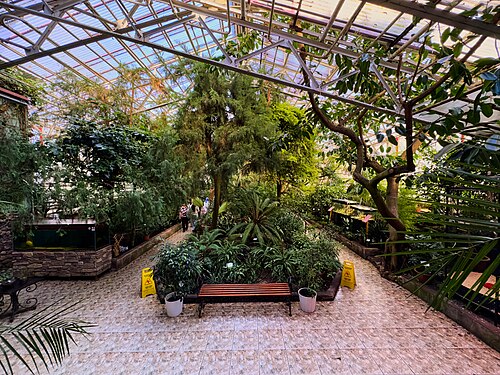
Inside, the displays are arranged as biotope modules: a tropical rainforest with an ornamental pool, an arid zone, a corner of Mediterranean flora and a fern display. The layout lets a single tour move from one habitat to the next within a few steps.
Plant collections
1 min
The garden reports a glasshouse collection of 2,000 taxa, while a 2018 paper counts more than 2,700. The most valued groups are palms, gymnosperms, ferns and begonias, and the garden also grows bananas, oranges, lemons, pomegranates, feijoas and papayas.
In 1952 the collection numbered only 170 species and varieties, yet some plants were already old: two cycads aged 27 and 38, two Canary Island date palms of 22 and 30, and trachycarpus, chamaerops, an American agave, a ginkgo, a cordyline, a pittosporum, an opuntia and figs that had reached twenty years. The aquatic collection is used for practical classes by students of the Ural medical academy, and water hyacinths from the garden have been put to work in the water-treatment plant of a regional power station.
Visiting
1 min
The glasshouses stand in the Academy of Sciences botanical garden in Chkalovsky District, bounded by 8 Marta, Moskovskaya and Nikolaya Ostrovskogo streets, close to Chkalovskaya and Botanicheskaya metro stations. They are seen on guided tours tailored to each group's age; the garden runs more than 500 a year and welcomes 18,000 to 20,000 people.
The busiest days fall on Museum Night in May and Yekaterinburg City Day in August. The garden's own museum, open since 2006, makes a natural addition to the tour.
56.80° N, 60.60° E
Greenhouses nearby
More greenhouses — Russia
Do you have a good photo of this greenhouse? Suggest it for this page →