Orangery of the Lobachevsky University Botanical Garden (Botanichesky Sad NNGU)
Nizhny Novgorod, Nizhny Novgorod Oblast
Entry updated on October 5, 2026
- Year
- 1936
- Architect
- Unknown
- Style
- Modern glasshouse rebuilt after 2010, successor to a 1936 wooden orangery
- Dimensions
- About 800 m² of glasshouses, 12 m ceiling height
- Status
- Guided tours by appointment, October to April
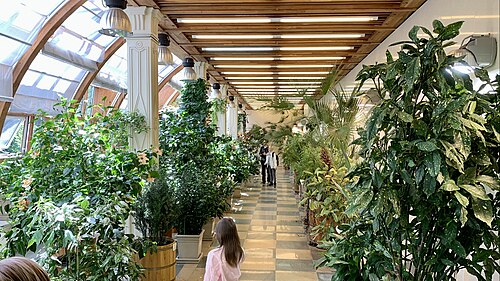
The botanical garden of Lobachevsky University in Nizhny Novgorod, founded in 1934 at the initiative of Professor Sergei Stankov, opened its first orangery in 1936: a wooden house only 3 m high. An iron-framed glasshouse 6 m high replaced it in 1961 and stood until 2010, when the university began a reconstruction that raised the ceiling to 12 m. Across roughly 800 m², the glasshouses now hold about 2,000 species from 110 families, including more than 500 tropical orchids, palms, camellias and fruit trees.
Affiliate links — booking through Verrière helps fund our research, at no extra cost to you.
History
1 min
The botanical garden of the university of Nizhny Novgorod, now Lobachevsky University, was created in the early 1930s at the initiative of Professor Sergei Stankov, head of the botany department and the garden's first director, with a layout by landscape architect E. V. Shervinsky. Wikipedia gives 1933 as the founding year, while the present director speaks of 1934. The first orangery went up in 1936, a wooden building just 3 m tall.
That same year the collection received its first tropical plant, a southern magnolia grown from seeds donated by the academician Nikolai Vavilov. By 1953 the glasshouses held 524 tropical and subtropical species. A reconstruction begun in 1957 under director S. I. Zavylenkov raised the number of houses to three, and in 1961 an iron-framed building 6 m high was completed.
That house served until 2010, when the university started another reconstruction. An article republished by the university in 2018 described new glasshouse blocks under construction and noted that the tropical collection had survived lean years almost intact. In March 2025 the local press still reported works, carried out by the garden's own staff. The garden marked its ninetieth anniversary in 2024 and is protected as a natural monument of regional importance.
Architecture and engineering
1 min
No source names the architect or builder of the present glasshouse, but its growth can be traced in height: 3 m for the wooden orangery of 1936, 6 m for the iron structure of 1961, and a 12 m ceiling in the rebuilt house. The extra volume matters for the largest specimens. Vavilov's magnolia, which reaches 25 to 27 m in the wild, still has to be cut back regularly, and flowers less often as a result.
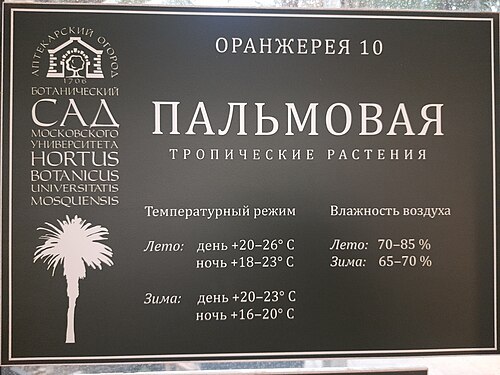
The glasshouses cover about 800 m² in total. Two climate regimes are kept, one subtropical and one tropical, alongside an orchid section, small pools for aquatic plants and cool rooms where seasonal orchids spend the winter. In summer the temperature under the glass can reach 60 °C, which is why the houses open to visitors only between October and April.
Plant collections
1 min
The glasshouses contain about 2,000 species from 110 families, roughly half of the garden's 5,000 or so species; according to the director, 90 per cent of the collection derives from plants gathered in the wild. Tropical orchids number more than 500 species, alongside palms, cacti, agaves, succulents and a much-praised camellia collection.
Notable plants include a wollemia that the director brought back from Kew, one of only three or four in Russian botanical gardens, a Bidwill's araucaria, tree ferns from Tasmania and two ant plants, Myrmecodia armata and Hydnophytum formicarum. Mandarins, lemons, oranges, vanilla, guava, loquat and feijoa all bear fruit here, and pineapple, coffee, avocado and papaya round out the useful-plants display.
Visiting
1 min
The orangery stands in the university botanical garden on Botanichesky Sad Street in Nizhny Novgorod. It can be seen only on guided group tours booked in advance, from October to April, and a visit lasts about an hour to an hour and a half.
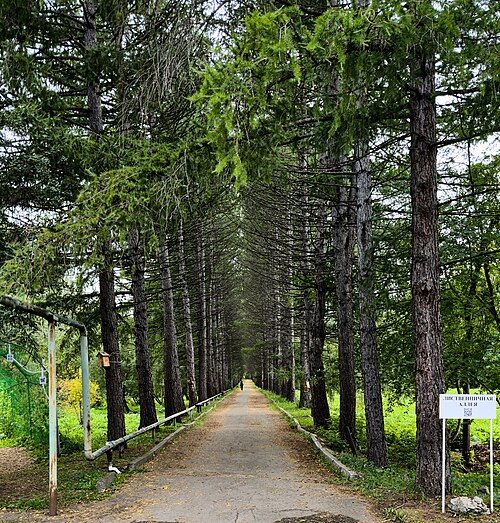
The garden's lead biologist recommends January and February, when camellias, azaleas and orchids are in bloom; the magnolia tends to open nearer spring. From May to October the arboretum takes over, with more than 130 rhododendrons and what the garden describes as Russia's only outdoor collection of northern orchids.
56.25° N, 44.00° E
Greenhouses nearby
More greenhouses — Russia

Do you have a good photo of this greenhouse? Suggest it for this page →
Sources (6)
- unn.ru/botanicus/visit.htm
- dengoroda-nn.ru/ru/s-yubileem/botanicheskomu-sadu-nngu-90-let
- ru.wikipedia.org/wiki/Ботанический_сад_(Нижний_Новгород)
- unn.ru/site/about/news/oranzhereya-botanicheskogo-sada-nngu-vopreki-vremeni
- tourister.ru/world/europe/russia/city/nizhniy_novgorod/parks/36843
- vz-nn.ru/news/obshchestvo/66516/