Cactus Greenhouse, Gimcheon Eco-friendly Ecological Park (김천친환경생태공원 선인장 온실)
Gimcheon (Daehang-myeon), North Gyeongsang
No freely licensed photo of this greenhouse yet. Do you have one? Suggest it for this page →
Sources checked October 2026
- Year
- 2014-2016
- Style
- Steel-framed glasshouse devoted to cacti and succulents
- Dimensions
- 982 m² steel frame according to the 2017 press; glass greenhouse of about 300 pyeong in the same article
- Status
- Open to the public (opening hours, closing days and admission to be checked with the operator)
In the Gimcheon Eco-friendly Ecological Park, laid out beside Jikjisa temple, the cactus greenhouse is the first stop on the route after the entrance lawn. The Korea Tourism Organization describes it with a transparent glass exterior and plants from subtropical or warm-temperate forest regions, among them the cactus 광자금호, the foxtail cactus and the 와룡목. According to the local press, construction ran from 2014 to 2016.
Affiliate links — booking through Verrière helps fund our research, at no extra cost to you.
History
The greenhouse belongs to the Gimcheon Eco-friendly Ecological Park (김천 친환경생태공원), which the city laid out beside Jikjisa temple to develop overnight ecotourism, in the formula "one night, two days". The newspaper Kimcheon Shinmun (21 February 2017) traces the operation: a feasibility study and project application in 2008, review by the provincial urban-planning committee in 2011, design studies completed in February 2012. Work began in 2014 with a 573 m path and the erection of the greenhouse's steel frame; it continued in 2015 with interior finishing and ancillary works, then in 2016 with the installation of the cacti and the opening of the access road.
The article announces completion of the park for March 2017, with a budget of 10.5 billion won and a site of 134,117 m² at Unsu-ri. Blogs from May 2025 and March 2026 describe recent visits.
Architecture and engineering
The Korea Tourism Organization describes a greenhouse with a transparent glass exterior. According to the 2017 press, the 982 m² steel frame was erected in 2014 and the interior finished in 2015; the same article speaks of a glass greenhouse of about 300 pyeong, a Korean unit equal to nearly 990 m².
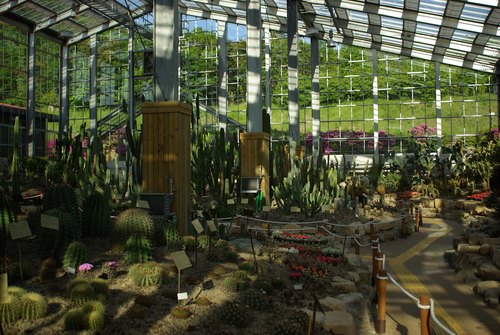
The 2017 article states that the house is laid out "according to the characteristics of cacti". A blog of May 2025 describes an aisle running straight ahead, lined with cacti and succulents on both sides, with a cave-like passage and tall cacti from the entrance. An entrance board gives the make-up of the collection. Outside, sculptures of cacti and insects line the access path, according to the Korea Tourism Organization, and the greenhouse stands beyond the park's entrance lawn.
Plant collections
The Korea Tourism Organization cites plants that are hard to see elsewhere in Korea, native to subtropical and warm-temperate forest zones: the cactus 광자금호, the foxtail cactus (여우꼬리선인장) and the 와룡목. It adds that the greenhouse stays green in the depth of winter.
The 2017 article planned more than 560 species of cacti and succulents. The entrance board recorded by a May 2025 blog reads 150 genera, 450 species and about 600 plants. A visitor in March 2026 mentions varied cacti and succulents and stresses the warmth of the house. Outside the greenhouse, the park also has an ecological pond and an azalea hill (철쭉) that blooms in spring.
Visiting
The greenhouse is the first stop in the ecological park, at the edge of the entrance lawn, and the route continues along the park path and the Sa-myeong Daesa trail (사명대사길). A visitor in March 2026 spent about half an hour there. From the greenhouse exit one can see the park's four-season sledding area, according to a May 2025 blog.
The place combines with Jikjisa temple, beside which the park is laid out, according to the blogs. The Korea Tourism Organization stresses the green scenery of the greenhouse in the depth of winter and the spring bloom of the azalea hill.
36.12° N, 128.01° E
More greenhouses — South Korea
Do you have a good photo of this greenhouse? Suggest it for this page →
Affiliate links — booking through Verrière helps fund our research, at no extra cost to you.