Annala Orangery (Annalan orangeria)
Vanhakaupunki, Helsinki, Uusimaa

Sources checked October 2026
- Year
- 1844
- Style
- Single-pitch orangery in stone and brick, with a sloping glazed front
- Dimensions
- About 70 m² on the ground from the OpenStreetMap outline
- Status
- Garden open to all; orangery by appointment (groups and individuals)
In Annala park, beside the Hämeentie road, a small stone-and-brick glasshouse with a sloping glazed front was completed in 1844 for the estate of the merchant Gustaf Otto Wasenius, who used it to shelter his citrus trees and potted plants over the winter. Turned into a canteen and then a store in the twentieth century, it was restored in 1999-2001 and returned to its original use. The association Hyötykasviyhdistys keeps a collection of houseplants and old pelargoniums there. The garden is open to all; the orangery can be visited at a time agreed with the association.
Affiliate links — booking through Verrière helps fund our research, at no extra cost to you.
History
The Annala estate dates from 1826, when Gustaf Otto Wasenius (1789-1852), a printer, tobacco manufacturer and prominent Helsinki figure, leased a plot from the City; the lease required him to improve the landscape seen at the entrance to the town along the Hämeentie road. He built a country villa, Anneberg, named after his wife Anna (the sources date it to 1826, 1830 or 1832), and laid out over thirteen hectares a French-style garden, a landscape park and greenhouses.
The orangery was completed in 1844, according to the record of a photograph held by the Helsinki City Museum and to the park's presentation on the Vihreät Sylit site. The record of a painting by Magnus von Wright (1850), kept by the museum, notes an orangery at the left of the villa that was insured against fire in 1846. The estate stayed in the family until Leonard Wasenius, the founder's grandson; he died childless and the property returned to the City in 1939.
In the twentieth century the orangery served as a dining room for seasonal workers in the 1920s and then as a store, while the land was leased to a market gardener until 1958. After archaeological excavations in 1997, the garden, the landscape park and the orangery were restored in 1999-2001, and the building returned to its original role for the Hyötykasviyhdistys society. The villa was bought in 2017 by a property company of the association, Kiinteistö Oy Pro Anneberg, which plans to make it a national centre for garden culture. The Helsinki City Museum had published a study of the orangery by Helena Mattila in 2003.
Architecture and engineering
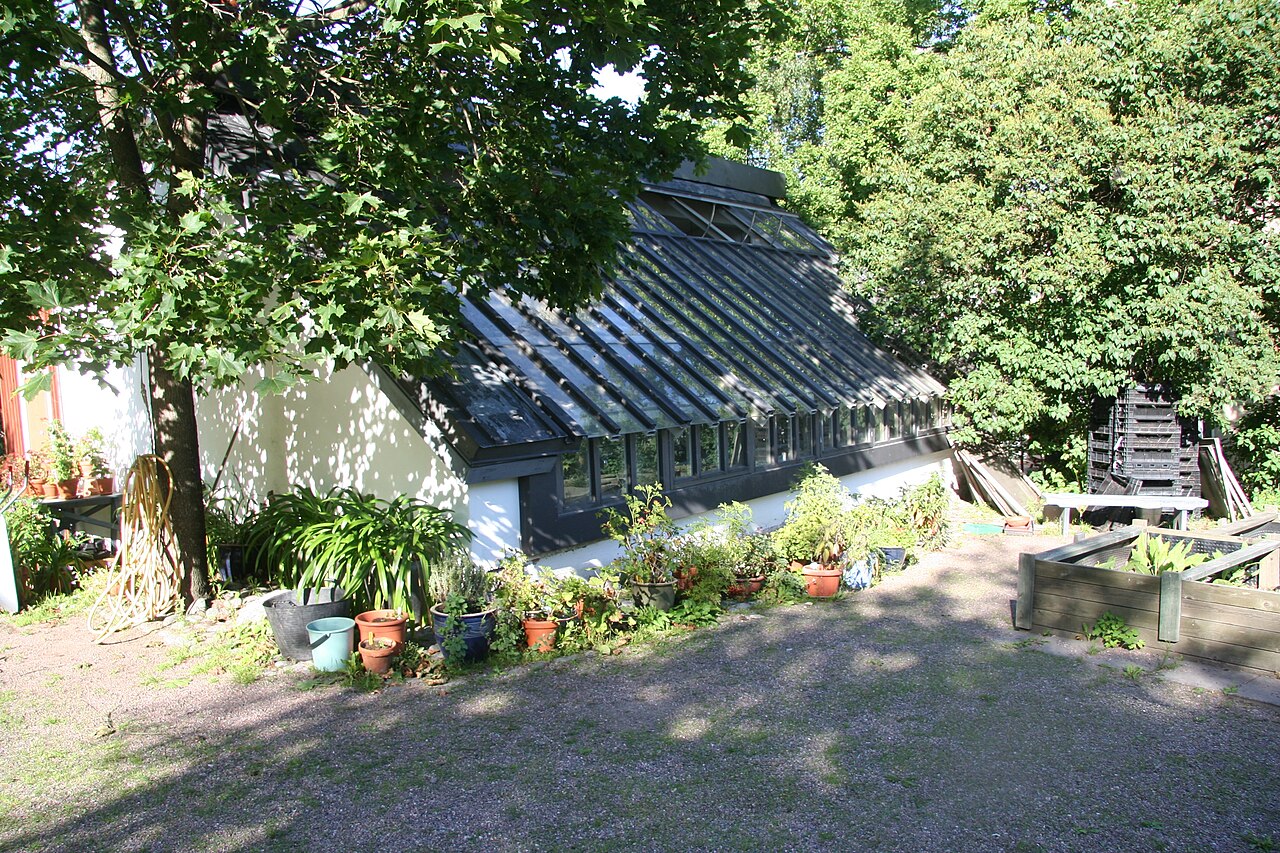
Finnish Wikipedia describes the orangery as an eighteenth-century-style glasshouse with a single pitch, an asymmetrical plan and an oblique cross-section, built of natural stone and brick; the Stadissa entry likewise speaks of a natural-stone orangery. In Wasenius's day, according to the same encyclopedia, it had large windows, a sloping glazed front wall and a tropical room temperature. The Helsinki City Museum calls it a small historic winter garden.
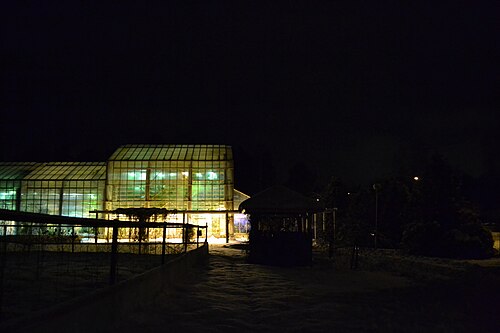
Photographs published on Wikimedia Commons show whitewashed masonry whose plaster has flaked in places, a large glazed roof slope with its glazing bars running down the pitch, a row of vertical windows at its foot and a brick chimney rising from the roof. The collaborative outline of the building in OpenStreetMap, tagged "Orangeria", covers about 70 square metres on the ground, an unofficial order of magnitude.
According to Wikidata, which reproduces the register of buildings protected by Helsinki's detailed plans, the orangery has been protected since 10 October 2003 (marks sr-1 and VP-1), and the register also records protection of the interior.
Plant collections
Today the Hyötykasviyhdistys society keeps a collection of houseplants and old pelargoniums in the orangery. Finnish Wikipedia reports the oldest houseplant collection there and several hundred species, without saying what that seniority is measured against. Groups and individuals can come to see the pelargoniums and old houseplants at a time agreed with the association, which sells pelargonium cuttings at its spring plant market and invites offers of old houseplants, except very large ones, for lack of space. Its potting room is used for plant dyeing, propagation by cuttings and spring sowing.
In Wasenius's time the orangery overwintered plants that spent the warm season in large pots. The Stadissa entry lists orange and other citrus trees, bitter oranges (pomeranssi), grapevines and other fruit trees, as well as medicinal herbs, dye plants and cacti; Finnish Wikipedia adds roses and heliotropes. Outside, the association's themed gardens include medicinal plants, dye plants and a butterfly garden.
Visiting
Annala occupies a hill in Vanhakaupunki, the Old Town of Helsinki, along the Hämeentie road, near the Vanhankaupunginkoski rapids. The garden is open to all; the orangery is visited at a time agreed with the association. The Café Anneberg runs in the villa on Sundays; plants and produce are sold at events in spring and autumn. An hour is enough for the park, best seen in the warm season.
Nearby, Kustaa Vaasa park preserves the foundations of Helsinki's oldest church. The two other Helsinki glasshouses in the catalogue, the Talvipuutarha and the Kaisaniemi Palmusali, lie 4 or 5 km away.
60.21° N, 24.98° E
Greenhouses nearby
More greenhouses — Finland
Do you have a good photo of this greenhouse? Suggest it for this page →
Sources (8)
- hyotykasviyhdistys.fi/annala/
- fi.wikipedia.org/wiki/Annalan_huvila
- finna.fi/Record/hkm.a04402cb-9d0b-4996-b83e-17a2a6507050
- finna.fi/Record/hkm.D1ADE7AA-C673-46C9-A982-B7A960E974DA
- vihreatsylit.fi/en/?p=3035
- stadissa.fi/paikat/829/annalan-huvila
- hel.fi/fi/kulttuuri-ja-vapaa-aika/ulkoilu-puistot-ja-luontokohteet/puistot/annalan-huvilap
- wikidata.org/wiki/Q98407301
Affiliate links — booking through Verrière helps fund our research, at no extra cost to you.