Palmusali (Kaisaniemen kasvitieteellinen puutarha)
Kaisaniemi Botanical Garden, Helsinki

Sources checked September 2026
- Year
- 1889
- Architect
- Gustaf Nyström
- Style
- Neoclassical 19th-century glass palace
- Dimensions
- One of Helsinki's most recognizable architectural landmarks, more than 1,200 taxa in cultivation
- Status
- Open to the public
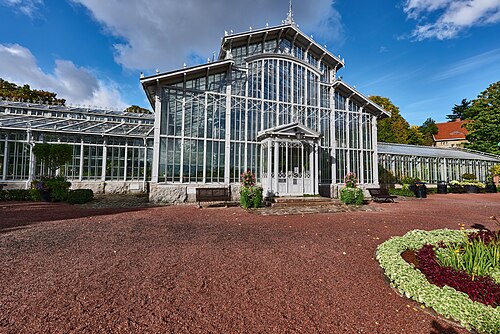
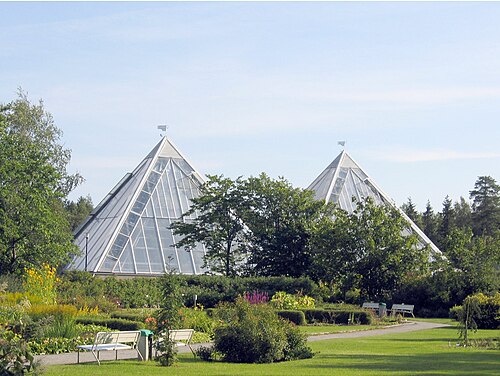
Designed by architect Gustaf Nyström and completed in 1889, with wings added in 1896, the Palmusali at the Kaisaniemi Botanical Garden has become one of Helsinki's most recognizable architectural landmarks. In February 1944, a bombing raid destroyed almost the entire garden collection, leaving only a single cypress alive; giant water-lily seeds preserved in the frozen pond, however, made it possible to rebuild the collections after the war. The greenhouse complex today shelters more than 1,200 taxa, continuing a history of greenhouses on the site that dates back to 1832.
Affiliate links — booking through Verrière helps fund our research, at no extra cost to you.
History
The University of Helsinki Botanic Garden traces its roots to the garden founded in Turku in 1678 by Elias Tillandz. After the Great Fire of Turku in 1827 the university moved to Helsinki, and in 1829 the garden settled at Kaisaniemi, on ground first laid out by Carl Ludvig Engel. A large wooden glasshouse, designed by Franz Faldermann of the St Petersburg Botanic Garden, was completed in 1832 and a smaller one in 1835; the garden opened to the public in 1833, and both glasshouses were extended in 1862.
Late in the century the architect Gustaf Nyström replaced the large glasshouse with the Palmusali, an iron-and-glass palm hall completed in 1889. He also designed its two wings, finished in 1896, and the savanna and rainforest houses were ready by 1898.
In February 1944 eight bombs fell on the garden, shattering the glass in the depths of winter. Around 1,500 taxa under glass froze to death, with the sole exception of a cypress. Seeds of the giant water lily Victoria cruziana, lying at the bottom of the frozen pond, nonetheless allowed the species to be grown again. The glasshouses reopened in 1948 with some 1,600 plants, and a round lily house followed in 1953. After a major renovation from 1996 to 1998, President Martti Ahtisaari opened the restored glasshouses on 21 September 1998.
Architecture and engineering
The Palmusali, the oldest and tallest part of the complex, is a wrought-iron and glass structure whose lofty glazed volume houses the big palms. Nyström extended it with two symmetrical wings, and the themed houses of the late nineteenth century and the round lily house of the 1950s were added later. Today ten public glasshouses are linked into a single continuous route.
Nyström also designed the botanical institute's main building of 1903, which housed teaching rooms, collections, a library and the professor's residence. Glasshouses, park and buildings together form a site on Finland's national inventory of built cultural environments of national significance (RKY), which highlights the garden's importance for Finnish horticulture.
Plant collections
Arranged by habitat, the ten glasshouses lead from scorching deserts to rainforests and tropical wetlands: Mediterranean woodland, African savanna and desert, rainforest and Australian flora. The garden cites more than 1,200 taxa under glass.
The Palmusali hosts a trail on 'the great inventions of the plant kingdom', tracing plant evolution and presenting living fossils, alongside tree ferns and tillandsias. The round lily house holds the Santa Cruz water lily, Victoria cruziana, descended from the seeds that survived the bombing. Bananas, coffee and cacao, flowering cacti and carnivorous plants complete the collection, together with what the garden presents as the world's biggest seed.
Visiting
Kaisaniemi lies in the heart of Helsinki, in the park of the same name, a few minutes' walk from the Central Railway Station; trams run along Unioninkatu and the nearest metro stations are about 700 metres away. Visitors enter by the Kaisaniemi Park gate or the Kaisaniemenranta gate, and the outdoor garden is free.
The glasshouses, open all year, are especially welcome in the dark Finnish winter. Besides the Palm House, the rooms are devoted to rainforest, African violets, savanna, desert, dry forest, islands, South Africa, the Mediterranean and water lilies. Allow an hour to an hour and a half. The building has step-free access, although its corridors and doorways are narrow. Café Viola serves lunch on site; in summer the visit extends into the outdoor garden and the park, and the university's second botanic garden, at Kumpula, is a few kilometres to the north.
60.18° N, 24.95° E
Greenhouses nearby
More greenhouses — Finland
Do you have a good photo of this greenhouse? Suggest it for this page →
Sources (8)
- helsinki.fi/fi/luomus/kaisaniemen-kasvitieteellisen-puutarhan-historia
- helsinki.fi/en/luomus/visit-us/kaisaniemi-botanic-garden/about-kaisaniemi-garden
- rky.fi/read/asp/r_kohde_det.aspx?KOHDE_ID=4655
- en.wikipedia.org/wiki/University_of_Helsinki_Botanical_Garden
- gardenartsociety.fi/pdf/PM/Helsinginyliopistonkasvitieteellinenpuutarha.pdf
- kotipuutarha.fi/kaisaniemen-kasvitieteellinen-puutarha/
- helsinki.fi/en/luomus/visit-us/kaisaniemi-botanic-garden
- openstreetmap.org/way/1427587508
Affiliate links — booking through Verrière helps fund our research, at no extra cost to you.