Walled-garden glasshouse, Hinton Ampner
Hinton Ampner, Hampshire

Sources checked October 2026
- Style
- Lean-to glasshouse against a brick garden wall
- Status
- Garden open to the public (National Trust)
Inside the walled garden of the Hinton Ampner estate in Hampshire, a low lean-to glasshouse is built against the brick wall that supplies its warmth. The National Trust, which has owned the estate since 1985, uses it to show exotic houseplants, changed regularly by the garden team and volunteers and arranged on a shelf at waist height. The house, listed Grade II, was rebuilt in 1960 after a major fire.
Affiliate links — booking through Verrière helps fund our research, at no extra cost to you.
History
The Hinton Ampner house has Tudor origins according to the Parks and Gardens UK record. A Georgian house was later built on a different site, with Victorian additions; the house was enlarged in 1864, redesigned in 1935 and rebuilt in 1960 after a major fire, according to that register. Wikipedia gives other dates: a redesign in 1867, a neo-Georgian remodelling from 1936 to 1939, a fire in April 1960 and a restoration completed in May 1963. Wikipedia adds that the house began as a hunting lodge and that the parkland once reached its façade. From 1930 Ralph Dutton gave the garden its present layout: a lily pond along the east façade, replanted southern terraces and formal gardens notable for the variety of their roses. Dutton also replanted the estate, which covers 667 hectares of chalk farm and woodland. The National Trust acquired it in 1985.
Architecture and engineering
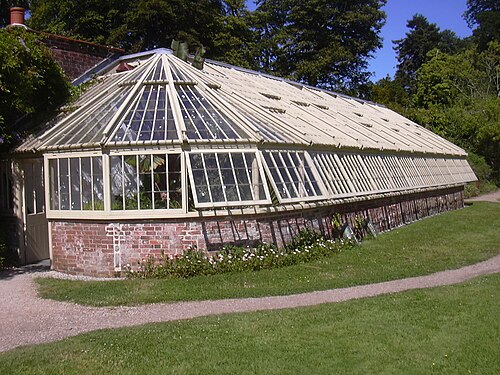
The glasshouse is a lean-to: its glazed roof and walls rest against the brick wall of the walled garden, which forms its back wall. The National Trust credits that wall with keeping the interior steadily warm, because the brick holds the heat. The photograph by David Martin, published on Geograph and on Wikimedia Commons under CC BY-SA 2.0, shows a long, low structure with white-painted framing, a glazed roof and glazed front panels, set on a low brick base. A gravel path runs along its front.
Plant collections
The glasshouse is above all a place of display. The garden team and volunteers maintain an ever-changing arrangement of exotic houseplants, all placed on a shelf at waist height. The National Trust notes that this height brings the plants to eye level, which makes the shapes, scents and details of each plant easy to observe. The walled garden looks out across the kitchen garden. The display depends on the team's seasonal choices rather than on a permanent collection.
Visiting
The glasshouse stands inside the walled garden of the estate and looks out across the kitchen garden. The National Trust presents the display as meant for close viewing, from a raised level that makes the plants easy to examine. Supergardens lists the walled garden, estate walks, the orchard, a temple and the glasshouse among the features of the site. According to Supergardens, touring the house costs extra on top of the gardens. Opening times and admission prices change from one season to the next and should be checked on the National Trust website before a visit.
51.04° N, 1.15° W
Greenhouses nearby
More greenhouses — United Kingdom
Do you have a good photo of this greenhouse? Suggest it for this page →
Sources (7)
- nationaltrust.org.uk/visit/hampshire/hinton-ampner/the-garden-at-hinton-ampner
- en.wikipedia.org/wiki/Hinton_Ampner
- parksandgardens.org/places/hinton-ampner
- supergardens.co.uk/gardens/hinton-ampner-gardens/
- geograph.org.uk/photo/5138571
- wikidata.org/wiki/Special:EntityData/Q2316888.json
- openstreetmap.org/way/266793182
Affiliate links — booking through Verrière helps fund our research, at no extra cost to you.