Samuel Wyatt Vinery, Holkham Walled Garden
Holkham, North Norfolk (Norfolk)
Entry updated on October 5, 2026
- Year
- 1780
- Architect
- Samuel Wyatt
- Style
- Georgian vinery: brick pavilion with a timber-and-glass lean-to glasshouse
- Status
- Open to the public (walled garden, late March to late October)
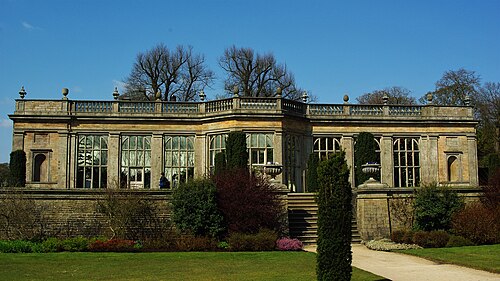
At the heart of the six-acre walled garden that Samuel Wyatt laid out for the Holkham Hall estate in the late eighteenth century, this vinery of 1780 pairs a gault-brick pavilion with a neoclassical front and a large south-facing lean-to glasshouse of timber and glass. Unused for more than a decade and judged structurally dangerous, it was placed on Historic England's Heritage at Risk Register in 2018; repaired with the agency's support, it came off the register in 2022. It now holds vines, citrus, olives, pomegranates and melons.
Affiliate links — booking through Verrière helps fund our research, at no extra cost to you.
History
1 min
The walled garden at Holkham, in north Norfolk, was laid out in the late eighteenth century by the Georgian architect Samuel Wyatt, who also designed its vinery; the listing description dates the building to 1780. The kitchen garden was then expected to supply prestige fruit: according to KL Magazine, pineapples were already being grown at Holkham in the late 1700s, when a single fruit was worth the modern equivalent of a small car.
The garden changed role in the twentieth century. From 1962 to 2010 it was let to a nursery, after which it returned to the estate, which began a gradual restoration and redesign of its compartments. The vinery, listed since 20 May 1983, had by then been unused for more than ten years and was judged structurally dangerous; Historic England added it to its Heritage at Risk Register in 2018.
The repairs, supported by a £200,000 grant from Historic England and partly by the Cultural Recovery Fund, were carried out by the conservation builders Messenger BCR with the Cambridge conservation architects RH Partnership. In November 2022 the vinery came off the at-risk register. The work formed part of a five-year programme to bring the walled garden back to life; in 2025 the garden became an RHS Partner Garden.
Architecture and engineering
1 min
The vinery combines two elements. To the north, a two-storey, seven-bay pavilion of gault brick carries the principal front. Its central bay, slightly advanced beneath a stepped parapet, opens through a large elliptical arch of rubbed brick with an ornate fanlight carried on Ionic columns in antis. A two-leaf door is flanked by plastered niches; a plain stone band, enriched only in the centre bay, runs at first-floor sill level, and sash windows sit beneath gauged brick arches. Coade stone embellishments, a moulded eaves cornice and internal gable chimney stacks complete the composition under a slate roof.
Against the south side of this building leans a large timber-and-glass glasshouse. The restoration covered its timber structure, the north slate roof, the ornate pediment fanlight, the external windows and doors, some of the masonry and the internal storerooms. The estate describes the interior as bright and airy, with regulated temperatures.
Plant collections
1 min
The glasshouse holds a collection of potted and planted vines along with sweetly scented tender plants that need controlled temperatures, and it is also used to overwinter citrus trees. KL Magazine further mentions olives, pomegranates and a melon pit growing sixteen varieties.
The rest of the walled garden, divided into four one-acre squares and one two-acre section, carries the theme further. In the cutting garden, nineteenth-century vineries hold peaches, nectarines and grapes; a large glasshouse built in 1929 by Thomas Messenger and Co. stands in the frame yard, where sunken pit houses are being restored. The vineyard, planted with Solaris and Regent trained in the double Guyot style, yields a wine made with Burn Valley Vineyard.
Visiting
1 min
The vinery stands in the walled garden, a ten- to fifteen-minute walk west of Holkham Hall. The garden is open from late March to late October; spring and summer are the times to explore its themed compartments, from the kitchen garden that supplies the Hall and The Victoria to the exotic garden with its late-flowering perennials and shrubs, by way of the cutting garden. Walking tours, art workshops and garden shows are held through the season, and a visit leads naturally on to the house and its park.
52.95° N, 0.79° E
Greenhouses nearby
More greenhouses — United Kingdom
Do you have a good photo of this greenhouse? Suggest it for this page →
Sources (6)
- holkham.co.uk/about-us/our-properties/historic-properties/samuel-wyatt-vinery/
- holkham.co.uk/visit/the-walled-garden/
- britishlistedbuildings.co.uk/101049485-the-vinery-holkham
- lynnnews.co.uk/news/medieval-church-added-to-at-risk-register-after-fire-damag-9283467/
- klmagazine.co.uk/articles/holkham-walled-garden
- openstreetmap.org/way/1284451057