Peach House and Vinery, Greenway Walled Gardens
Greenway, Galmpton, near Brixham (Devon), England

Sources checked October 2026
- Year
- Walled gardens laid out between 1791 and 1839; peach house late 19th century
- Style
- Kitchen-garden glasshouses built against walls: peach house with a semicircular metal framework, heated brick-and-timber vinery
- Dimensions
- Peach house 120 ft (about 36 m) long; vinery 14 m by 4 m according to the Devon Historic Environment Record
- Status
- Open to the public (National Trust estate); access to the interior of the glasshouses to be checked
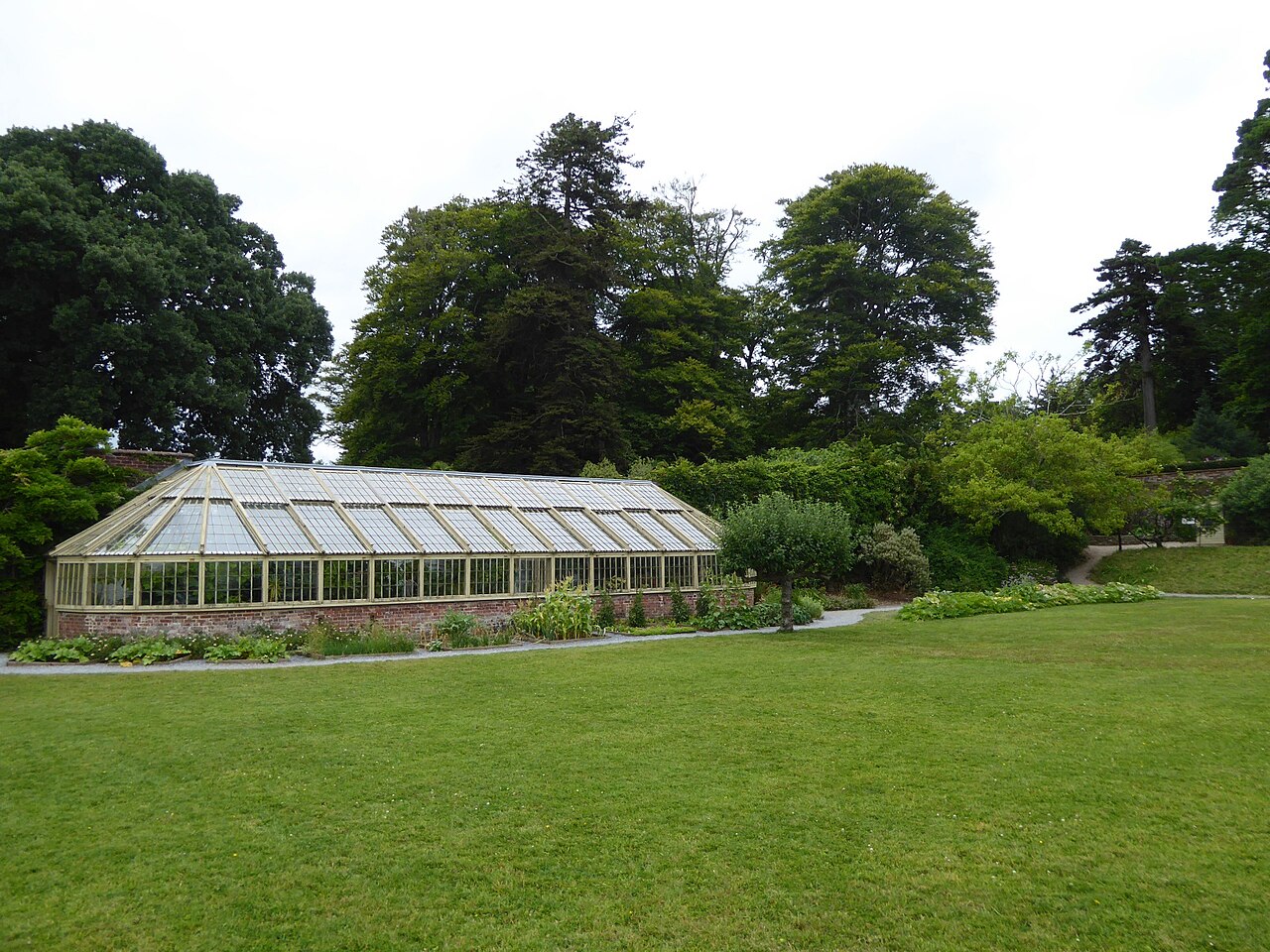
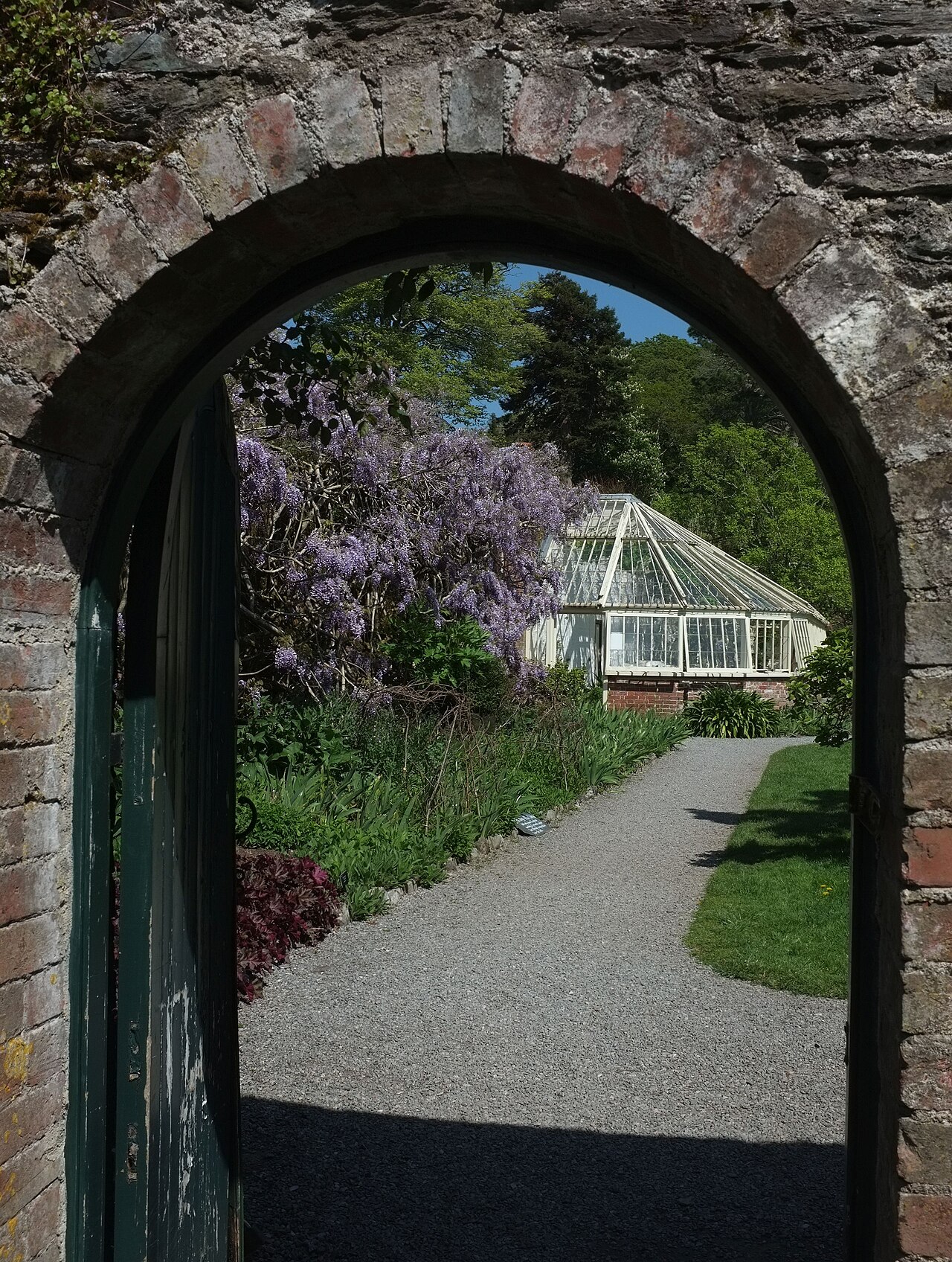
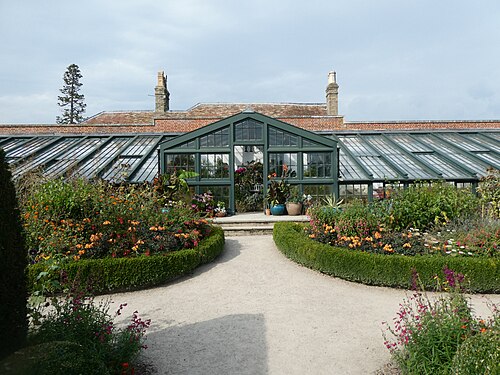
In the walled gardens of Greenway, Agatha Christie's former holiday home on the River Dart, now owned by the National Trust, several kitchen-garden glasshouses survive. In the north garden, the late 19th-century peach house, 120 ft (about 36 m) long, keeps the semicircular metal framework on which peaches were trained; peaches, apricots and nectarines are grown there. In the south garden, the vinery, a heated building that the Devon Historic Environment Record dates to the early 19th century, has been restored by the National Trust. The whole estate is on the Register of Parks and Gardens (Grade II).
Affiliate links — booking through Verrière helps fund our research, at no extra cost to you.
History
Greenway's walled gardens were created for the Elton family. Edward Elton bought the estate in 1791; the Register of Parks and Gardens dates the kitchen gardens to the period 1791-1832, replacing older enclosures east of the house, while the Devon Historic Environment Record gives the range 1791-1839. An estate map of 1791 places walled gardens elsewhere; the 1839 tithe map shows them where they stand today. The 1832 sale particulars already mention extensive walled gardens and a conservatory.
The 1839 map shows the garden in its present layout but without the stove house in the southern part, which the Register says was built very shortly afterwards and which appears on the Ordnance Survey map of 1865. This is the period of Richard Harvey, a copper magnate from Cornwall, to whom Wikipedia attributes two new greenhouses, without locating them. The 1882 sale catalogue describes the north garden as "the small walled garden", with a newly built orchard house, and the south garden as a large walled fruit garden containing a vinery in two compartments about 65 feet long, heated by a flue. The peach house is described in The Garden in 1901.
Agatha Christie bought Greenway in 1938. A commercial nursery was set up in the walled gardens in 1947, run by her son-in-law. The estate passed to the National Trust in April 2000 (some parts remain private). The vinery was the subject of a building survey and archaeological evaluation in 2011; the Devon record says it has been restored by the Trust.
Architecture and engineering
The kitchen garden lies some twenty metres north of the house. It is a brick-and-stone enclosure divided by an east-west wall into two compartments of unequal size, which the records call the north garden (the smaller) and the south garden. In the north compartment the Register describes a central freestanding glasshouse of mid-19th-century origin, another glasshouse of the early 20th century further east and, against the north wall, the late 19th-century peach house, whose semicircular metal framework was used to train the peaches; the National Trust gives it as 120 ft long. Against the south wall a stone lean-to shed housed the stoves that heated the vinery on the other side of the wall.
In the south compartment the Register describes a glasshouse or stove house of brick and timber, with curved ends to east and west, planting beds and slate paving; the north wall is heated and flues run round the outer walls beneath raised staging. The Devon record describes a rectangular greenhouse 14 m by 4 m, built against the north wall of that garden and known as The Vinery, without explicitly saying that it is the same building. The Register dates it to the early 19th century, while noting that it is absent from the 1839 map and present on that of 1865.
Plant collections
The National Trust says the peach house holds several varieties of peaches, apricots and nectarines, used in seasonal recipes at the estate's café. In the north garden, borders of cut flowers grown for floral arrangements at Greenway, looked after by volunteers, sit alongside fruit ripening under glass. East of the glasshouses the Register notes old fig trees, which in 1901 formed part of a group of standard trees.
In the south garden the vinery, which keeps its original vine holes, is laid out as an arid landscape inspired by the Middle East and by Agatha Christie's travels; it fills with grapes during the summer. Behind the walled gardens the summer lawn carries dahlias, one of the novelist's favourite flowers, which bloom deep into autumn.
Visiting
The walled gardens lie just north of the house, on the garden route. The National Trust highlights them in summer, when the vinery fills with grapes, before the dahlias of the summer lawn. Its pages present the peach house and the vinery as stops on the walk, without saying whether visitors may go inside the glasshouses: worth checking on site.
The visit combines with the Fernery behind the walled gardens, with the top garden and its views over the Dart, with the Battery and the Boathouse of the plot of Dead Man's Folly, and with the house itself. Visitors arriving by car must book parking; the visit itself does not need booking.
50.38° N, 3.59° W
Greenhouses nearby
More greenhouses — United Kingdom
Do you have a good photo of this greenhouse? Suggest it for this page →
Sources (7)
- nationaltrust.org.uk/visit/devon/greenway/visiting-the-garden-at-greenway
- nationaltrust.org.uk/visit/devon/greenway
- historicengland.org.uk/listing/the-list/list-entry/1001686
- historicengland.org.uk/listing/heritage-gateway/results/record/c39bc47e-3b72-4a06-9863-681
- historicengland.org.uk/listing/heritage-gateway/results/record/c39bc47e-3b72-4a06-9863-681
- en.wikipedia.org/wiki/Greenway_Estate
- openstreetmap.org/way/221586716
Affiliate links — booking through Verrière helps fund our research, at no extra cost to you.