Orangery and glasshouses, Norton Conyers Walled Garden
Norton Conyers, near Ripon (North Yorkshire), England
No freely licensed photo of this greenhouse yet. Do you have one? Suggest it for this page →
Sources checked October 2026
- Year
- Orangery before 1774 (it appears in a painting of that year); walled garden c. 1760
- Style
- Classical ashlar and brick orangery with a flat roof, flanked by two glasshouses
- Dimensions
- Central block of five bays; two flanking glasshouses about 11 m long each
- Status
- Walled garden open to the public Tuesday to Friday, April to the end of October 2026; orangery open to visitors
At the centre of the walled garden at Norton Conyers, near Ripon, a classical orangery of ashlar and brick, listed Grade II, is flanked by two glasshouses about eleven metres long. According to Historic England's listing, the left-hand one was fully glazed and the right-hand one only partly, with a boiler house and forcing room behind. The garden, laid out in the mid-18th century on the Graham family's estate, still supplies the house with flowers, fruit and vegetables; blocked heating flues in the north wall recall the cultivation of exotic plants. The orangery is open to visitors whenever the garden admits the public.
Affiliate links — booking through Verrière helps fund our research, at no extra cost to you.
History
Norton Conyers has belonged to the Graham family since 1624, when Richard Graham, created a baronet in 1628, bought the estate. The walled garden, a five-minute walk from the house, was laid out in the mid-18th century, around 1760 according to Historic Houses, and retains the essentials of its original design. A painting by Nicholas Dall dated 1774, in a private collection, shows the orangery prominently; the Register of Parks and Gardens dates it to the mid or late 18th century, and the building's listing speaks of "late C18 and later" glazing. The orangery has been listed Grade II since 22 July 1955. The garden's north wall keeps blocked heating flues: Historic Houses sees an early example of double-heated walls, and the National Garden Scheme reads them as evidence of the propagation of exotic species.
The garden is on the Register of Parks and Gardens at Grade II (first registered 10 May 1984) and was still in private ownership according to the 1998 register entry. It is still used for the purpose it was made for: supplying the house with flowers, fruit and vegetables. It first opened its gates to the National Garden Scheme in 1935 and had done so in 56 years by 2020, according to the organisation's article. In 2014 the estate won the Historic Houses Sotheby's Restoration Award, for the restoration of the house according to Historic Houses.
Architecture and engineering
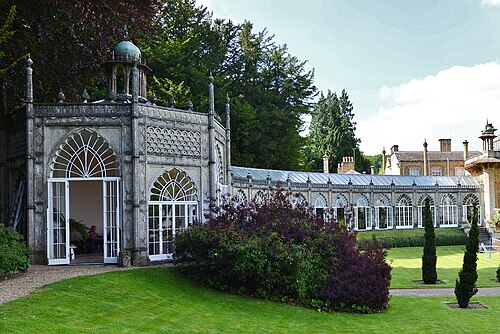
Historic England's listing describes an orangery of ashlar and red brick laid in Flemish bond, made up of a central block of five bays flanked by two glasshouses. At the centre are round-headed double doors, of panelled wood with glazing bars, and round-headed sash windows with glazing bars, all framed by a moulded archivolt and a double keystone. The building is crowned by a deep cornice and a parapet, and its roof is flat.
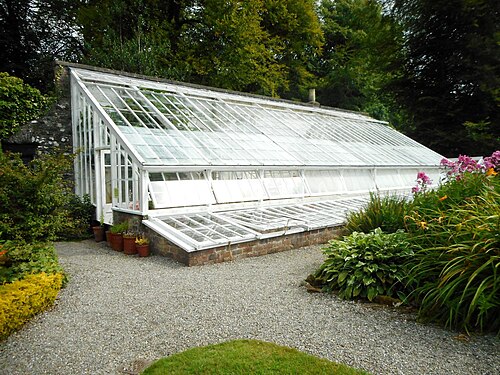
The two glasshouses are each about 11 m long. The one on the left, the listing says, had its glass complete, with a domestic building behind it, probably gardeners' rooms; the one on the right was only partly glazed, with a boiler house and forcing room behind.
The 2.5-acre (about 1 ha) walled garden is entered through a wrought-iron gate between two brick piers, aligned with the orangery. A path edged with clipped hedges and borders leads to a listed circular pool whose central pedestal has lost its statue.
Plant collections
Cut flowers are grown there from early summer to late November, along with old apple and quince trees, an established potager, fruit and vegetables; Historic Houses calls the whole a plantsman's garden.
According to the National Garden Scheme, the garden has in season borders of gold and silver plants, old-fashioned peonies and irises, buddleias that attract wildlife and tranquil ponds with water lilies. The heated wall points, in the organisation's words, to the propagation of exotic species here in the past. A small sales area offers unusual hardy plants in summer; plants, cut flowers, fruit and vegetables from the garden can be bought.
Visiting
The walled garden is a five-minute walk from the house. Two paths meet in front of the orangery, which has a small pond before it; from its windows the view runs to the garden's main gate and the park beyond. Historic Houses members fill in their visitor form there, and a garden open day on 14 June 2026 advertised tea in it.
In 2026 the garden opens from April to the end of October, Tuesday to Friday, and guided tours of the house run on only 28 days. The visit combines with the house, said to be one of the sources of Thornfield Hall in Jane Eyre. The estate lies about 4 miles north of Ripon.
54.18° N, 1.51° W
Greenhouses nearby
More greenhouses — United Kingdom
Do you have a good photo of this greenhouse? Suggest it for this page →
Sources (8)
- historicengland.org.uk/listing/the-list/list-entry/1150020
- historicengland.org.uk/listing/the-list/list-entry/1001068
- nortonconyers.org.uk/visiting-norton-conyers.html
- nortonconyers.org.uk/house-and-garden.html
- historichouses.org/house/norton-conyers/
- ngs.org.uk/norton-conyers-an-inspired-revisiting/
- parksandgardens.org/places/norton-conyers
- eventbrite.co.uk/e/open-garden-at-norton-conyers-with-tea-in-the-orangery-tickets-19907921
Affiliate links — booking through Verrière helps fund our research, at no extra cost to you.