Orangeries of the Botanic Garden of Irkutsk State University (Ботанический сад ИГУ)
Irkutsk, Irkutsk Oblast
No freely licensed photo of this greenhouse yet. Do you have one? Suggest it for this page →
Sources checked October 2026
- Style
- Orangeries with a metal frame and a glazed roof
- Dimensions
- Large tropical orangery of about 1,000 m²
- Status
- Open to the public (closed on Mondays); guided visits by booking
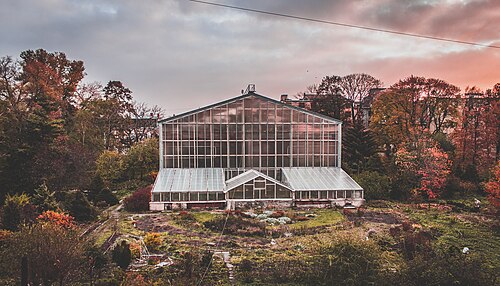
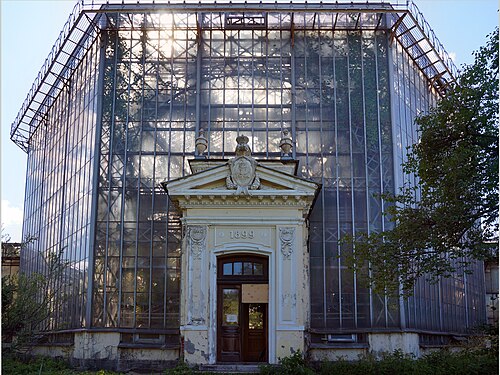
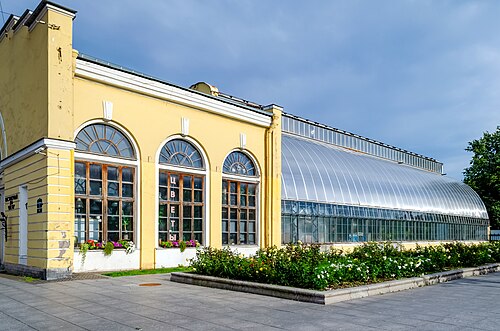
The Botanic Garden of Irkutsk State University, created by a municipal decision of 1940, has two orangeries: a large tropical orangery of about 1,000 m², split into a display part and a stock-collection part, and a smaller one. The roof of the large orangery, seen on an official photograph published in October 2026, is made of transparent panels on a metal frame. The garden's audio guide counts more than 3,000 tropical species there and describes a setting with a waterfall, a bungalow, a pond and a Japanese rock garden.
Affiliate links — booking through Verrière helps fund our research, at no extra cost to you.
History
The Botanic Garden of Irkutsk State University was born of a decision of the city soviet's executive committee, taken on 15 April 1940 (no. 255): it allotted 18 hectares in the Sverdlov district, behind the tourist base and the cemetery, towards the village of Melnikovo. Pavel Malinovsky was its first director and the first plant collections were laid out in 1941. During the war the garden served as the university's vegetable plot, with at least two hectares of crops. In the 1980s it held 1,324 species, varieties and forms and was counted among the best in the Soviet Union.
They do give two episodes. In the winter of 1991-1992 the failure of a heating main froze more than 60% of the plants in the orangeries, at a time when the garden's buildings and services were in poor repair. The revival began in 1992 with the appointment of Viktor Kuzevanov, director until 2015. At the end of 2009, according to the regional press in March 2010, a "tropical corner" was fitted out in an orangery on the students' initiative: an islet with a rock, a waterfall and a bungalow with bamboo-panel walls and a palm-leaf roof, built in two months with the help of geologists to serve as a green classroom, a place for garden therapy and a backdrop for photo sessions.
In 2015 the garden was attached to the university's faculty of biology and soil science, and Svetlana Sizykh took over its management. In November 2023 it offered a quest in the large tropical orangery on the izi.TRAVEL app.
Architecture and engineering
The garden has two orangeries. Its official website separates a tropical orangery and a subtropical orangery in its menus, and speaks in its news items of a "large" and a "small" orangery, without stating that these two pairs of terms name the same buildings.
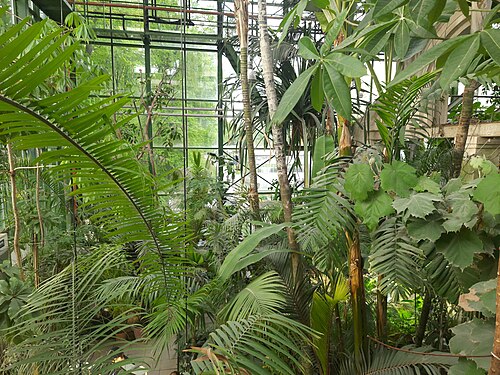
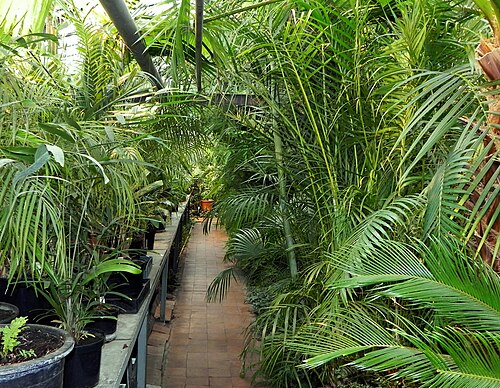
The large tropical orangery covers 1,000 m² in all, according to the garden's audio guide, and is divided into a display part and a part kept for the collection. The display brings together plants of tropical and subtropical latitudes, a photo area with a decorative waterfall and a tropical bungalow, a pond for aquatic plants and a Japanese rock garden. A photograph published on the official website in October 2026, taken under the roof of this large orangery, shows a metal frame of small glazing bars whose clear panels let the sky show through.
Plant collections
The curators chose to build the tropical and subtropical collection along geographical lines: South-East Asia and the tropical and subtropical regions of the Asian continent. The garden's website lists rarities such as Csapodya splendens, endemic to Chiapas (Mexico) and extinct in the wild, very rare East Asian plants (Amentotaxus, Nageia, Podocarpus deflexus, Cupressus vietnamensis), Vietnamese liliaceous plants, Aspidistra and Chinese gesneriads of the genera Primulina, Boea and Hemiboea.
The audio guide speaks of more than 3,000 species, the richest collection in Eastern Siberia, including endemics and plants lost from their habitat such as Bulbophyllum hiepii. Its stops mention a bamboo, Arabian coffee, a lemon of the 'Irkutsky Krupnoplodny' cultivar and Tetrastigma voinierianum. The display part regularly hosts themed exhibitions; in October 2026 the website reports a konjac (Amorphophallus konjac) in flower in the large orangery and a Haemanthus in the small one.
Visiting
The garden covers 30 hectares, on Koltsova Street. One ticket covers the two orangeries, another the dendrarium, and a joint ticket combines them; guided visits are by booking. The "Botanichesky sad" public-transport stop, in the Pervomaysky district, is served by several bus routes, and suburban trains serve Melnikovo station, according to the official website.
Combine it with the Japanese rock garden, open since 2012, the Korean garden, the ethnobotanical centre with its Buryat yurt, the herb garden, the heather garden and the "Wheel of Time" mill museum. An audio guide on izi.TRAVEL and a quest round out the visit to the orangeries.
52.26° N, 104.25° E
More greenhouses — Russia
Do you have a good photo of this greenhouse? Suggest it for this page →
Affiliate links — booking through Verrière helps fund our research, at no extra cost to you.