Orangeries of the Ushinsky Pedagogical University Botanical Garden (Yaroslavl)
Yaroslavl (Kotorosl embankment), Yaroslavl Oblast

Sources checked October 2026
- Year
- 1927 (garden); 1972 (new orangery)
- Style
- Two orangeries, tropical and subtropical, in a university botanical garden
- Dimensions
- Two orangeries in a 1.98 ha garden
- Status
- Guided visits all year by booking (groups of 10 to 15)
The botanical garden of Ushinsky Yaroslavl State Pedagogical University, founded on 1 June 1927 beside the faculty of natural sciences and geography, covers nearly 2 hectares in Yaroslavl's historic centre, on the left bank of the Kotorosl. It has two orangeries, one tropical and one subtropical, and its official history dates the building of a new orangery to 1972. Orchids, palms, citrus, coffee and succulents are grown, and its website presents it as the only botanical garden in the oblast. The orangeries can be visited in groups of 10 to 15 people, all year round, by booking.
Affiliate links — booking through Verrière helps fund our research, at no extra cost to you.
History
The garden was founded on 1 June 1927 on the plots next to the faculty of biology, now the faculty of natural sciences and geography, on the initiative of Nikolai Shakhanin (1890-1955), a botany lecturer and its first head. It served as a teaching base and a ground for field practice. From the start it planted fruit collections, including the best varieties of Michurin apple trees, exotic trees and medicinal plants, and tried to acclimatise ornamental plants (kolomikta actinidia, Chinese schisandra, Japanese yew). Under the direction of A. N. Sokolov, from 1937 to 1944, the garden grew trees and shrubs from seed to increase their frost resistance; the arboretum was laid out in 1950.
From 1952 to 1960, under F. L. Sharov, the greenhouse farm was rebuilt, which widened the range of subtropical ornamental and fruit plants. In 1972, under director V. A. Chirkov, a new orangery was built. Over the last twenty years new displays have been added: the orchard "To My Teachers" (2010), a memorial garden dedicated to the Lokomotiv hockey club (2011), a Japanese garden (2013) and a friendship garden (2022). In March 2009 an exhibition on the succulent flora of Africa opened in the subtropical orangery. According to the passport of the Council of Botanical Gardens of Russia, the collections hold about 1,600 taxa on 1.98 hectares.
Architecture and engineering
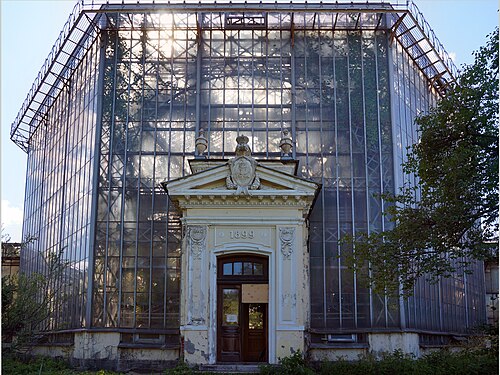
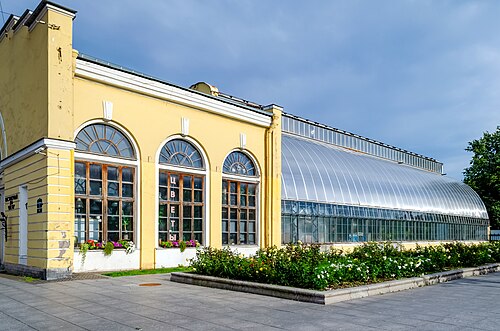
The passport of the Council of Botanical Gardens of Russia lists the two orangeries as two units, tropical and subtropical. The official history records two stages, the reconstruction of the greenhouse farm between 1952 and 1960, then a new orangery in 1972, without saying which of the two current houses the latter corresponds to. The aisles are narrow, which is why groups are limited to 12 or 15 people and children under three are not admitted; photo sessions there are limited to five people, photographer included.
A photograph published on Wikimedia Commons, taken in February 2012, shows in one of the houses a sloping roof that lets daylight through, on a metal frame, above potted palms standing on benches along a brick-paved aisle. The garden's website describes orchids in bloom and green foliage in midwinter, which implies heating. The OpenStreetMap map traces a greenhouse building of about 570 m² footprint at the garden's address, without written confirmation that it is the two orangeries.
Plant collections
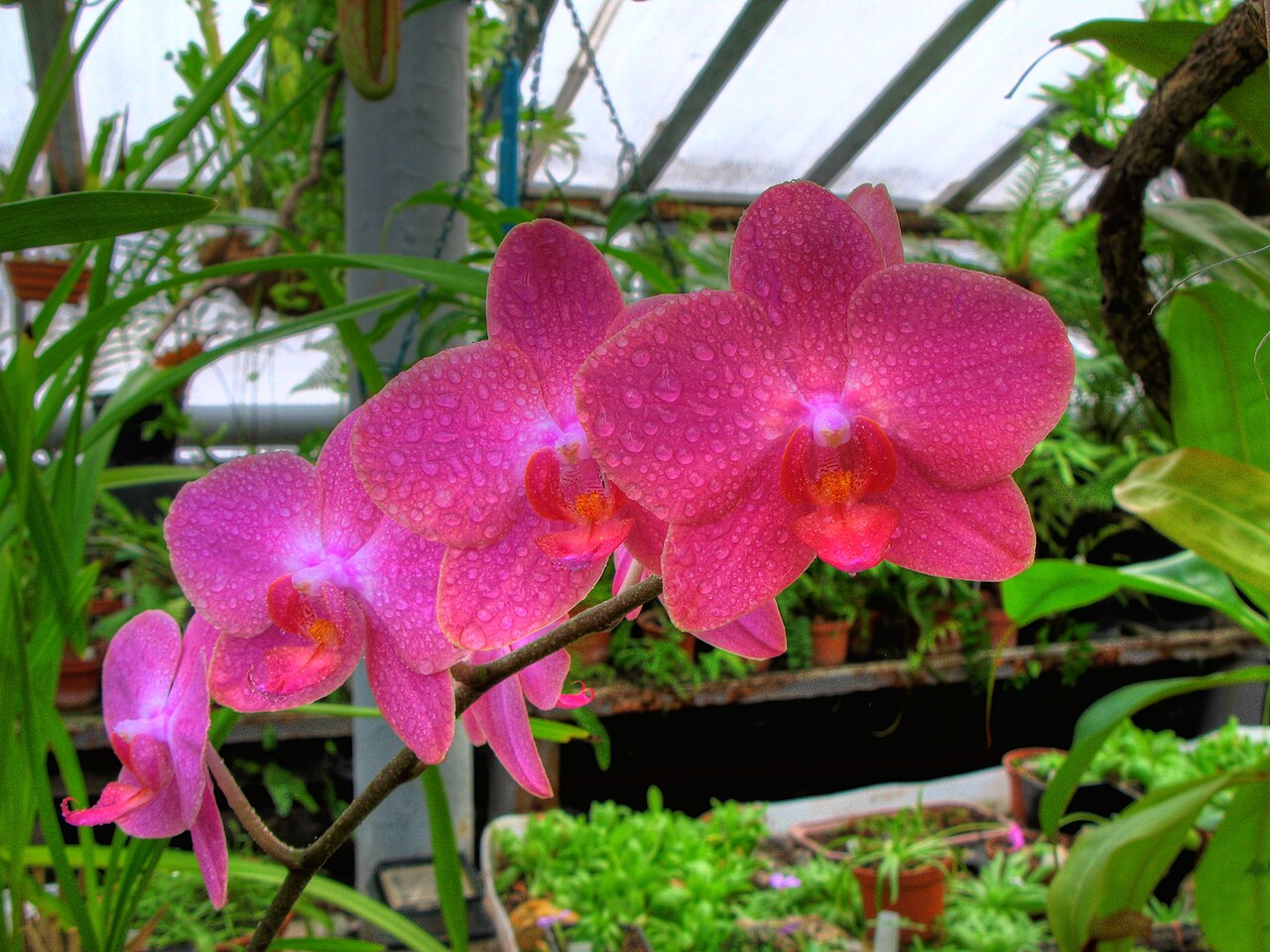
According to the news pages of the official website, both orangeries flower even in winter. Mentioned there are orchids (Phalaenopsis amabilis, oncidiums, dendrobiums, a Vuylstekeara 'Cambria' hybrid, Spathoglottis plicata), peace lilies (Spathiphyllum wallisii) and flamingo flowers (Anthurium andreanum), Japanese camellia, sweet osmanthus, loquat (Eriobotrya japonica) and a Boussingaultia. A monstera, the Arabian coffee tree (Coffea arabica), a passion flower, lemon trees (Citrus × limon) and calamondins also bear fruit; palms, ficus and ferns complete the planting.
Since March 2009 the succulent flora of Africa has been displayed in the subtropical orangery, beside an enlarged display of New World succulents; the collection of cacti and other succulents exceeds 200 species and varieties. Outdoors, the garden holds an arboretum, a syringarium (lilacs), hydrangeas, peonies, roses and a Japanese garden.
Visiting
The orangeries are visited in a group with a guide, all year round, by telephone booking; the open-air collections are offered from May to October. A group numbers 10 to 15 people, and the university also prices an individual visit. The outdoor garden is promoted at the flowering of the Japanese cherries, in late April and early May, then of the hydrangeas, from the second half of July to early September, the periods cited by the university.
The garden lies in the historic part of the city, within the 17th-century limits, on the left bank of the Kotorosl, one kilometre from its confluence with the Volga. An announcement on the website says the entrance is on the river side.
57.62° N, 39.87° E
Greenhouses nearby
More greenhouses — Russia
Do you have a good photo of this greenhouse? Suggest it for this page →
Sources (8)
- botsad-web.yspu.org/temp_9.html
- sovetbotsadov.ru/botsady/umno-botanicheskij-sad-yagpu-im-k-d-ushinskogo/
- newyspu.ru/pay/botsadyspu/
- botsad-web.yspu.org/temp_14.html
- botsad-web.yspu.org/temp_29_2.htm
- botsad-web.yspu.org/temp_29_4.htm
- botsad-web.yspu.org/temp_25.htm
- commons.wikimedia.org/wiki/File:%D0%A0%D0%B0%D1%81%D1%82%D0%B5%D0%BD%D0%B8%D1%8F_2_(%D0%91
Affiliate links — booking through Verrière helps fund our research, at no extra cost to you.