Tropical Plant Garden (dome) and greenhouses, Gyeongsangnam-do Arboretum (경상남도수목원 열대식물원)
Jinju (Iban-seong-myeon), South Gyeongsang
No freely licensed photo of this greenhouse yet. Do you have one? Suggest it for this page →
Sources checked October 2026
- Style
- Circular dome with a triangulated metal frame and transparent panels; small themed houses
- Dimensions
- 1,072 m² dome, 10 m or 14 m high
- Status
- Open to the public with the arboretum ticket; closed on Mondays
The provincial Gyeongsangnam-do Arboretum, at Iban-seong-myeon near Jinju, holds a circuit of greenhouses that the province's official blog calls an indoor arboretum. The tropical garden is its centrepiece: a circular dome of 1,072 m² according to the official public-facilities portal, where a palm area, a tropical orchard, a foliage garden and a carnivorous-plant garden bring together 300 to 320 species. Official photographs from 2022 show a triangulated frame with transparent panels, topped with a shade net. A warm-temperate house, a cactus house and an ecological greenhouse complete the route.
Affiliate links — booking through Verrière helps fund our research, at no extra cost to you.
History
The Gyeongsangnam-do Arboretum, at Iban-seong-myeon near Jinju, grew out of a finding made in 1987: once the Gwangneung arboretum in Gyeonggi was finished, the need for regional arboretums became apparent. A basic plan was drawn up in 1989 and the site opened on 5 April 1993 as the provincial Banseong Arboretum (도립반성수목원), according to Korean Wikipedia. It took its present name in February 2000; its forest museum was built in July 2001, per the Encyclopedia of Korean Culture, and 2026 press dates the museum's opening to 1 November 2001. In September 2002 the arboretum was registered as the fifth public arboretum recognised by the Korea Forest Service. It is now run by the provincial Forest Environment Research Institute.
A post of 11 January 2018 on the province's official blog already presents the tropical garden, the warm-temperate house, the cactus house and the ecological greenhouse as a winter route, and describes the water lily house as a facility opened only recently. The most precise photographs of the dome date from 6 December 2022 (the film-location database gnfilm.or.kr), and the press of summer 2026 still counts it among the site's attractions. Its height is given as 10 m or 14 m: these figures are best read as official orders of magnitude rather than construction measurements.
Architecture and engineering
The tropical garden (열대식물원) is a domed greenhouse on a circular plan. The public-facilities portal eshare gives it 1,072 m² of floor area and a height of 10 m, whereas the press in 2026 speaks of a dome 14 m high; both values are given here as published. Official photographs from December 2022 show a triangulated metal frame: a low ring of transparent panels, then a cap covered with a black shade net, with an entrance porch under a metal roof and a wooden deck along the edge of the dome. Inside, the triangulated vault is fitted with translucent panels above the planting, and stone-slab paths edged with boulders wind between the beds.
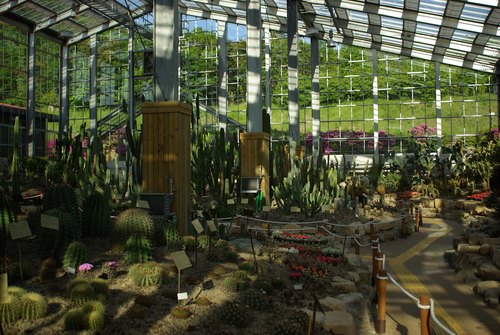
The layout is described as mixed: tropical, subtropical and warm-temperate plants grow together, arranged in zones (palm area, tropical orchard, foliage plants, carnivorous plants). The warm-temperate house (난대식물원), set apart from the dome, is 11 m high according to the Korean national encyclopedia; the smaller cactus house shows, on an official photograph, translucent walls, an interior shade net and a rock garden. The official blog notes, for the greenhouses as a whole, a mild temperature and humidity kept above 60 per cent.
Plant collections
The tropical dome holds about 300 species according to the 2026 press and 320 according to the eshare portal. The official 2018 blog names the royal palm (대왕야자), banana, olive, coffee, baobab, an Australian "bottle tree" (호주보틀츄리) and bay laurel (월계수) there; a 2024 visitor blog adds peperomia (페페로미아) and a citrus, the 광귤. The water lily house, described in 2018, brings together water lilies of several kinds, including the Victoria and other rare species, carnivorous plants, ferns and tropical plants such as bougainvillea and the 문주란 (munjuran).
The warm-temperate house gathers more than 150 species, ferns included: in January 2018 the camellia 애기동백 was in flower there, next to the 붓순나무, 생달나무, 담팥수 and 까마귀쪽나무, all plants of southern Korea. The small cactus house shows a few dozen species, some of them donated to the arboretum, and the ecological greenhouse combines bonsai and aquatic plants in a setting of natural stones. Outside the glass, the arboretum's aquatic garden holds some forty kinds of water lily, according to the 2026 press.
Visiting
The greenhouses lie on either side of the forest museum: the water lily house to the museum's left, the tropical garden at the end of the path that leaves to the right, according to the official 2018 blog, and 2026 press places the specialised greenhouses in the western part of the grounds. That blog suggests starting with the water lilies, then the tropical garden, the warm-temperate house, the cacti and the ecological greenhouse, and finishing with the museum. Access to the greenhouses is included in the arboretum admission, according to the eshare portal, and the route is under cover: a winter visit as much as a summer one.
The grounds, closed on Mondays, also offer an avenue of dawn redwoods, an aquatic garden, a park devoted to the mugunghwa (the national flower) and an enclosure of wild animals. Visit Korea notes access ramps as well as wheelchairs and strollers to borrow. From Jinju as from Changwon, local press puts the drive at 30 to 40 minutes; Banseong railway station is about 4 km away.
35.16° N, 128.30° E
More greenhouses — South Korea
Do you have a good photo of this greenhouse? Suggest it for this page →
Sources (8)
- eshare.go.kr/UserPortal/Upv/UprResrcFacl/index.do?rsrc_no=DF15J2830794
- encykorea.aks.ac.kr/Article/E0075257
- blog.naver.com/gnfeel/221182770994
- ko.wikipedia.org/wiki/%EA%B2%BD%EC%83%81%EB%82%A8%EB%8F%84%EC%88%98%EB%AA%A9%EC%9B%90
- gnfilm.or.kr/location/show/805
- access.visitkorea.or.kr/ms/detail.do?cotId=50befadd-86a2-4dcc-849f-97448506fb7e
- balpumnews.com/travel/gyeongsangnam-do-arboretum-3
- ardentnews.co.kr/news/articleView.html?idxno=16649
Affiliate links — booking through Verrière helps fund our research, at no extra cost to you.