Botanical Society Conservatory (Kirstenbosch)
Kirstenbosch National Botanical Garden, Cape Town

Sources checked September 2026
- Year
- 1997
- Style
- Contemporary display glasshouse with recreated regional beds
- Status
- Open to the public
Opened in 1997 at Kirstenbosch National Botanical Garden, on the eastern foot of Table Mountain, this conservatory was funded by the Botanical Society of South Africa, which counts it among its largest contributions to the country's gardens. Its first purpose was to shelter succulents from Cape Town's wet winters. The main house sets out beds devoted to individual southern African regions, from the Namib to the coastal fynbos, each built with rocks from the region it represents and presided over by a baobab. Four corner houses display stone plants, welwitschias, bulbs and subtropical forest flora.
Affiliate links — booking through Verrière helps fund our research, at no extra cost to you.
History
Kirstenbosch lies on the eastern foot of Table Mountain, on an estate bought by Cecil Rhodes in 1895 and bequeathed to the nation. On 1 July 1913 the government set it aside for a botanical garden, and the botanist Harold Pearson took charge without a salary. It was the first botanical garden in the world devoted to its country's native flora. The Botanical Society of South Africa administered it at first, followed by successive state bodies, the latest being SANBI, which has run the garden since 2004.
The conservatory came out of the building drive of the 1990s. SANBI recalls that the Kirstenbosch Development Campaign, launched by Professor Huntley to fund capital projects, together with corporate donors, the Botanical Society and later the government, brought a wave of construction unmatched since the garden's early decades: a research centre, the Botanical Society Conservatory (1997), and a visitor centre and conference centre (1998). The conservatory was built chiefly to protect succulents from Kirstenbosch's wet winters, and it also allowed the garden to try growing a baobab again, a tree that SANBI admits was far from easy to get inside.
The Botanical Society states that the building went up in 1996 and opened in 1997, and lists it as one of its largest contributions to turnkey infrastructure. The four corner houses bear the names of Leslie Hill, Ian Reddihough, Kay Bergh and Mary Mullins. The collections have kept developing: the welwitschias in their dedicated house were sown on 11 November 2009.
Architecture and engineering
SANBI describes the conservatory as a main house with four corner houses. In the main house each bed stands for an ecological region or biome of southern Africa and is built with that region's rocks and soil: granite, dolomite from Khowarib Poort and dolerite from the Brandberg for the Namib, the smallest bed; Sand River gneiss, sandstone, dolomite and Waterberg conglomerate for the Bushveld; dolerite and shale from the Fraserburg area for the Nama Karoo; and quartz gravel donated by a Knersvlakte farm for that region's bed. A small rectangular plot in the south is given over to coastal fynbos, while on the west side a fossil bed and a Triassic bed, whose stones carry plant fossils some 200 million years old, lead into the Gondwana Garden.
The corner houses offer distinct conditions. The north-western one, devoted to forest plants, is the only unit kept permanently shaded, warm and humid. The stone plant house is laid out as a transect from the west coast to the Eastern Cape, with its middle beam roughly dividing winter-rainfall from summer-rainfall flora.
Plant collections
The baobab (Adansonia digitata) is the centrepiece and the largest plant in the conservatory; it is deciduous, dropping its leaves in May and putting out new ones at the end of November. Around it the Bushveld bed brings together corkwoods (Commiphora), mopane, tree euphorbias, Mpumalanga aloes and the leopard orchid (Ansellia gigantea), planted along the step railing.
The welwitschias in their corner house were all raised from seed, mostly from the northern Namib in south-western Angola, because the species cannot be transplanted. The stone plant house shows Lithops, Pleiospilos, Argyroderma and Gibbaeum, while the bulb house pairs a permanent planting, strong in Clivia, with a changing display of pot-grown bulbs. The Gondwana Garden exhibits 240-million-year-old fossil trunks of Araucarioxylon from Senekal beside Ginkgo biloba, cycads and tree ferns, and is one of the few places at Kirstenbosch where non-native plants are grown. The coastal fynbos bed holds Erica verticillata, extinct in the wild.
Visiting
The conservatory stands within Kirstenbosch, whose outdoor collections concentrate on Cape plants and are known above all for their proteas; it provides the counterpoint, with plants from arid and subtropical regions that could not survive outside here. The southern spring is the richest season: the pot display in the bulb house peaks from mid-August to the end of September, when the Clivia and the leopard orchid are also in flower. The baobab, by contrast, stands bare from May to November. A visit extends naturally onto the trails climbing towards Table Mountain, including the Skeleton Gorge route, or, in summer, to the Sunday evening concerts in the garden.
33.99° S, 18.43° E
More greenhouses — South Africa
All greenhouses — South Africa →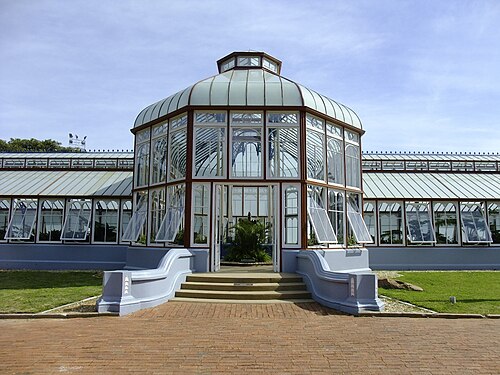
Do you have a good photo of this greenhouse? Suggest it for this page →
Sources (8)
- sanbi.org/gardens/kirstenboch/seasons/botanical-society-conservatory/
- sanbi.org/1990s/
- botanicalsociety.org.za/110-years-of-protecting-plants/
- sanbi.org/gardens/kirstenboch/seasons/botanical-society-conservatory/kirstenbosch-conserva
- sanbi.org/gardens/kirstenboch/seasons/botanical-society-conservatory/kirstenbosch-conserva
- sanbi.org/gardens/kirstenboch/seasons/botanical-society-conservatory/kirstenbosch-conserva
- sanbi.org/gardens/kirstenboch/seasons/botanical-society-conservatory/kirstenbosch-conserva
- en.wikipedia.org/wiki/Kirstenbosch_National_Botanical_Garden
Affiliate links — booking through Verrière helps fund our research, at no extra cost to you.