Stellenbosch University Botanical Garden Glasshouses
Stellenbosch, Western Cape
Entry updated on October 3, 2026
- Year
- Garden 1922 · tropical house 1920s
- Style
- University botanic garden glasshouses: tropical house, arid houses, ferneries
- Status
- Open to the public
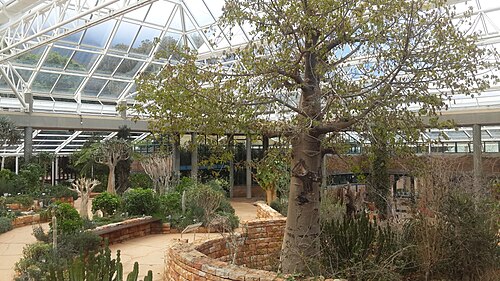
Stellenbosch University Botanical Garden, described as the oldest university botanic garden in South Africa, has occupied its plot in the centre of the town since 1922. Its glasshouses are its core: a tropical house built in the 1920s whose roof was raised during a renovation, arid houses for succulents and Karoo plants, and two ferneries. One arid house still holds the Welwitschia mirabilis sown in 1926 by Hans Herre, the first curator, whose plants made international headlines in 1949 when they produced cones and seed.
Affiliate links — booking through Verrière helps fund our research, at no extra cost to you.
History
1 min
The garden began in 1902, when Augusta Vera Duthie, then a botany lecturer, grew plants next to the university's main building of the time for research and student practicals. Professor Gert Cornelius Nel later persuaded the university council to set aside land for a garden, in 1921 according to some sources and 1922 according to others; work on the present site began in 1922. The garden now describes itself as the oldest university botanic garden in the country.
Hans Herre, appointed first curator in 1925, held the post until 1962. A specialist in the Aizoaceae, the vygies that are almost all endemic to Namibia and South Africa, he led many plant-hunting expeditions through desert regions. In 1926 he sowed seed of Welwitschia mirabilis; twenty-three years later, in 1949, the plants coned and set viable seed, a first in cultivation according to the university, and the event made international headlines. His successors include Wim Tijmens (1962-1999), Deon Kotze (1999-2012), Martin Smit (2013-2018) and Donovan Kirkwood (2018-2025).
The glasshouses have been rebuilt over the years. Arid House 2, home to Herre's Welwitschia, has been reconstructed twice while the plant stayed in its original position. The tropical house, put up in the 1920s, was renovated and reopened to the public after several years out of use. In 2018 the garden received accreditation from Botanic Gardens Conservation International for its conservation work, and it marked its centenary in 2023.
Architecture and engineering
1 min
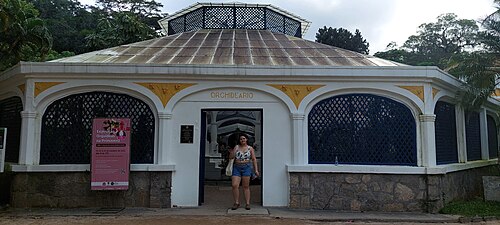
The garden has no monumental palm house; instead it has a group of growing and display glasshouses spread over a site of a few hectares: 1.7 ha according to a 2023 article, 3 ha of landscaped grounds according to the Botanic Gardens Conservation International record. Guides describe three main glasshouses, given over to tropical plants, succulents and Karoo flora; the Wikipedia article refers to two arid houses and two ferneries.
The tropical house, built in the 1920s, was reshaped during its renovation: the roof was raised to make room for large tropical specimens, and a technical system keeps the temperature between 18 and 30 °C without heavy energy use. In Stellenbosch's Mediterranean climate, with dry warm summers and cool rainy winters, such control is essential. The university described it at the time as the only functioning public tropical glasshouse in South Africa, a claim that predates the opening of other glasshouses in the country.
The arid houses do the opposite job, sheltering drought-adapted plants from the winter rain. The sources consulted give neither the names of the designers nor the dimensions of the buildings.
Plant collections
1 min
The best-known specimen is the Welwitschia mirabilis sown in 1926 by Hans Herre, still on display in Arid House 2. The arid houses and the wider garden hold succulents and xerophytes chiefly from southern Africa and Madagascar, including the quiver tree (Aloidendron dichotomum), the elephant's foot (Dioscorea elephantipes) and rare vygies such as Herreanthus meyeri, a genus named after Herre. Ferns, among them tree ferns of the genus Cyathea, and horsetails are concentrated in the two ferneries.
The garden also grows carnivorous plants (Nepenthes, Sarracenia, Drosera), an Oxalis collection started in 2001 that covers about 70 percent of southern African species, and the Western Cape Bonsai Heritage Collection, probably the largest publicly accessible bonsai collection in South Africa. It also safeguards highly threatened species such as Marasmodes undulata, five of whose six known individuals were held there according to a 2023 article.
Visiting
1 min
The garden lies in central Stellenbosch, on Neethling Street, a short walk from the town's historic streets. One to two hours is enough to see the glasshouses, then the lotus and koi pond, the Japanese garden, the herb garden and the arboretum. The Katjiepiering restaurant, the shop and the specialist nursery round off a visit.
The rainy southern winter is when the contrast between the heated glasshouses and the garden outside is most striking. For its centenary, in October 2023, the garden held a flower festival, the Stellenbosch Flora Festival, alongside the Woordfees festival. A visit combines easily with the historic town centre and the surrounding wine estates.
33.94° S, 18.87° E
Greenhouses nearby
Do you have a good photo of this greenhouse? Suggest it for this page →
Sources (7)
- su.ac.za/en/node/2348
- su.ac.za/en/visitors/outdoor/botanical-garden/learn/about-us
- en.wikipedia.org/wiki/Stellenbosch_University_Botanical_Garden
- af.wikipedia.org/wiki/Universiteit_Stellenbosch_Botaniese_Tuin
- stellenboschvisio.co.za/subg-woordfees/
- tools.bgci.org/garden.php?id=584
- gardenvisit.com/gardens/stellenbosch_university_botanic_garden