Glass Greenhouse, Yanggu Arboretum (양구수목원 유리온실)
Yanggu (Dong-myeon), Gangwon
No freely licensed photo of this greenhouse yet. Do you have one? Suggest it for this page →
Sources checked October 2026
- Style
- Glass greenhouse in a mountain arboretum, where wildflower bonsai are displayed (KBS report of 2024)
- Dimensions
- 13-hectare arboretum
- Status
- Open to the public with the arboretum (admission and closing days to be checked)
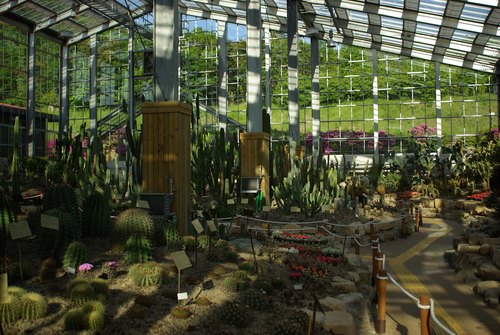
In Yanggu's public arboretum, at the foot of Mount Daeam, 450 m above sea level and close to the demilitarised zone, the official plan lists a “glass greenhouse” (유리온실) as number 04, grouped in the Sup Kiumteo zone with the garden of threatened plants and the garden of flowers with stories. A 2024 KBS report films wildflower bonsai there. The DMZ Wildflower Bonsai Garden, opened in 2017, has a glazed building of its own.
Affiliate links — booking through Verrière helps fund our research, at no extra cost to you.
History
Yanggu Arboretum began in 2004 as an ecological botanical garden, according to the town's tourism page; in April 2024 a KBS news report said it had reached twenty years of opening. The Korea Forest Service entered it on 29 June 2020 in the register of public arboreta, with 13 hectares and 1,074 species in the survey dated end of 2025. The press of July 2020 hailed the conversion of the former Yanggu ecological park into a public arboretum and counted it as the fourth in Gangwon, whereas the current tourism page ranks it sixth.
The DMZ Wildflower Bonsai Garden, laid out in May 2017 on 33,000 m², belongs to the complex; a 2020 article lists a glass greenhouse, a building devoted to bonsai ecology, an outdoor display area and a wildflower trail. KBS counts 48,000 visitors for the whole of 2023.
Architecture and engineering
The texts read describe glass structures without giving their dimensions. The arboretum's official plan numbers the greenhouse 04, in the Sup Kiumteo zone (roughly “the place for raising the forest”), alongside the propagation facility, which is closed to visitors, and the garden of flowers with stories.
The DMZ Wildflower Bonsai Garden holds another glazed building: a 2018 farming-press article describes, right at the entrance, a pyramid-shaped glass greenhouse containing more than 800 small bonsai gathered from across the country.
Plant collections
For the pyramid-shaped pavilion, the 2018 article names pines, camellias and quince trees among more than 800 small specimens, within a total of over 1,500 bonsai (1,600 in a 2020 article), with wild plants from the far north of South Korea. A KBS report (April 2024) shows wildflower bonsai under the glass, which visitors compare to a home garden, and a November 2025 blog mentions a bonsai pine said to be about 400 years old and plants that stay green in every season.
Outdoors, the arboretum is registered with 1,074 species and stresses the woodland flowers of spring, among them the noru-gwi (노루귀, literally “roe-deer ear”), which KBS says can be seen on the paths in April.
Visiting
The greenhouse is number 04 on the plan, among the first landmarks of the route (the management building is number 06); a 2024 visitor began the circuit with it and found it pleasant in rain or winter. Allow one to three hours for the whole arboretum. The barrier-free DMZ trail (무장애나눔길) can be walked in a wheelchair or with a pushchair, according to the local press, and naturalist guides offer commented tours.
Spring is the most praised season: at 450 m the wildflowers open in April.
38.19° N, 128.07° E
More greenhouses — South Korea
Do you have a good photo of this greenhouse? Suggest it for this page →
Sources (9)
- yg-eco.kr/plant/botanical_introduce
- yg-eco.kr/plant/botanical_list
- yg-eco.kr/park/park_flower
- ygtour.kr/HotPlace/P40000/html
- forest.go.kr/kfsweb/kfi/kfs/cms/cmsView.do?cmsId=FC_000874&mn=AR03_07_01
- nongmin.com/article/20180604291934
- kado.net/news/curationView.html?idxno=1039088
- news.kbs.co.kr/news/view.do?ncd=7939629
- v.daum.net/v/83pLCnj3Lr
Affiliate links — booking through Verrière helps fund our research, at no extra cost to you.