Alpine Glass House (고산온실), Jade Garden
Chuncheon, Gangwon (Namsan-myeon)
No freely licensed photo of this greenhouse yet. Do you have one? Suggest it for this page →
Sources checked October 2026
- Year
- 2011
- Style
- Glass house with a dark metal frame on a stone base, gabled entrance
- Dimensions
- Garden of about 16 ha
- Status
- Open to the public with the garden (paid entry), all year round
In the valley of Jade Garden, a private arboretum opened in 2011 near Chuncheon, a glass house on a stone base shelters mountain plants from the Alps, the Himalayas and Mount Baekdu. The 2011 press specifies that it is planted mostly with species that need no heating in winter, which settles the question of heating oil. According to the visit plan of a 2016 blog, it is the fourth stop on the circuit, after the English border, the Italian garden and the kitchen garden, and before the ginkgo maze.
Affiliate links — booking through Verrière helps fund our research, at no extra cost to you.
History
Jade Garden (제이드가든) is a private arboretum created and run by Hanwha Hotels & Resorts at Namsan-myeon, about 4 km from Gulbongsan station on the Gyeongchun line. It opened in spring 2011: in April according to ko.wikipedia, in May according to the Encyclopedia of Korean Culture and a blog of the city of Uijeongbu, while a March 2011 article announced the opening for mid-April. Built around the motto "a little Europe in the forest", it occupies a valley of about 16 hectares and has 24 theme gardens. The encyclopedia credits it with 4,063 species, the Chuncheon city tourism page 3,000, a blog 4,045: the figures differ.
The alpine house is one of the original features. The Landscape Times article of March 2011, published before the opening, lists it among the gardens designed to save water and energy: planted mostly with species that need no heating in winter, it settles the question of heating oil, just as the dry garden, planted with hardy species, makes do with minimal watering. A Korean tourism organisation page, updated in April 2014, places it between the Namu-naeum ("tree scent") path and the maple path.
According to the encyclopedia, the estate is also designated as a forest genetic resource conservation institution, which propagates and reintroduces legally protected endangered plants, among them 섬개야광나무 and 연잎꿩의다리.
Architecture and engineering
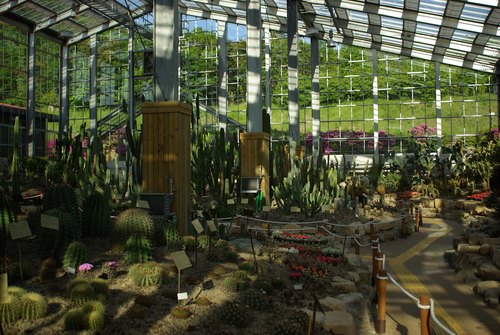
The glass house is an elongated building whose vertical walls are fully glazed, divided by slim dark metal mullions, on a stone base. In a photograph published in November 2016 by the official blog of the city of Uijeongbu, the left end is a gabled entrance bay with a glass door, while the rest of the roof, also glazed, is sloped. In front of the building, a rock garden planted with low plants borders a paved path. A tourism site describes it as a "glass building in front of the fountain" (분수 앞 유리 건물) housing the "alpine garden" (고산식물원).
On satellite imagery, a rectangular building with a pale, reflective roof stands about 130 m from the garden entrance, along the main path; this identification rests on approximate shape and position, to within some thirty metres. According to the 2011 press, the glass house is designed for plants that need no heating in winter.
Plant collections
The glass house gathers high-mountain plants: the Korean tourism organisation names the Alps, the Himalayas and Baekdu as regions of origin, and the Uijeongbu blog speaks of plants collected and displayed. A June 2022 press article names, for the site's alpine garden, 벼룩이울타리, 콤무타타앵초, 스피카타꼬리풀 and 연잎꿩의다리; a tourism site mentions "small wild flowers". The same "alpine garden" is housed in the glass building.
The rest of the estate provides context: more than 200 varieties of rhododendron (만병초) according to the 2011 press, as well as maples, hostas and magnolias according to the encyclopedia. The city of Chuncheon also names irises and blueberries among its 3,000 species.
Visiting
On satellite imagery the glass house stands about 130 m from the entrance, on the garden's main circuit, which the Uijeongbu blog put in 2016 at 1.5 km and 90 minutes. According to that plan, which may have changed, it is the fourth stop, after the English border, the Italian garden and the kitchen garden, and before the ginkgo maze. A 2014 page places it between the Namu-naeum path, covered with larch chips, and the maple path, which overlooks the garden and is not recommended for pushchairs and wheelchairs (ko.wikipedia).
The garden is open all year round according to the city of Chuncheon, and a shuttle serves it from Gulbongsan station according to the 2016 blog. The glass house can be combined with the ginkgo maze, the rhododendron garden and, in autumn, the maple path whose colours the 2016 blog praises.
37.83° N, 127.54° E
More greenhouses — South Korea
Do you have a good photo of this greenhouse? Suggest it for this page →
Sources (8)
- chuncheon.go.kr/tour/destination/all-tour/detail/?tourId=228
- encykorea.aks.ac.kr/Article/E0075274
- latimes.kr/news/articleView.html?idxno=8990
- korean.visitkorea.or.kr/detail/rem_detail.do?cotid=32574b93-1ca6-4101-ad21-2cb2141a743b
- ksilbo.co.kr/news/articleView.html?idxno=939651
- m.blog.naver.com/hope_city/220850754831
- ko.wikipedia.org/wiki/%EC%A0%9C%EC%9D%B4%EB%93%9C%EA%B0%80%EB%93%A0_%EC%88%98%EB%AA%A9%EC%
- bbsj.kr/tour/tour_detail.php?tou_idx=797
Affiliate links — booking through Verrière helps fund our research, at no extra cost to you.