Kumamoto Prefectural Ancient Burial Mound Museum (熊本県立装飾古墳館)
Yamaga, Kumamoto Prefecture
Sources checked October 2026
- Year
- 1992
- Architect
- Tadao Ando
- Type
- Archaeology museum (decorated tombs)
- Access
- Open to the public, closed on Mondays, paid admission (official website, October 2026)
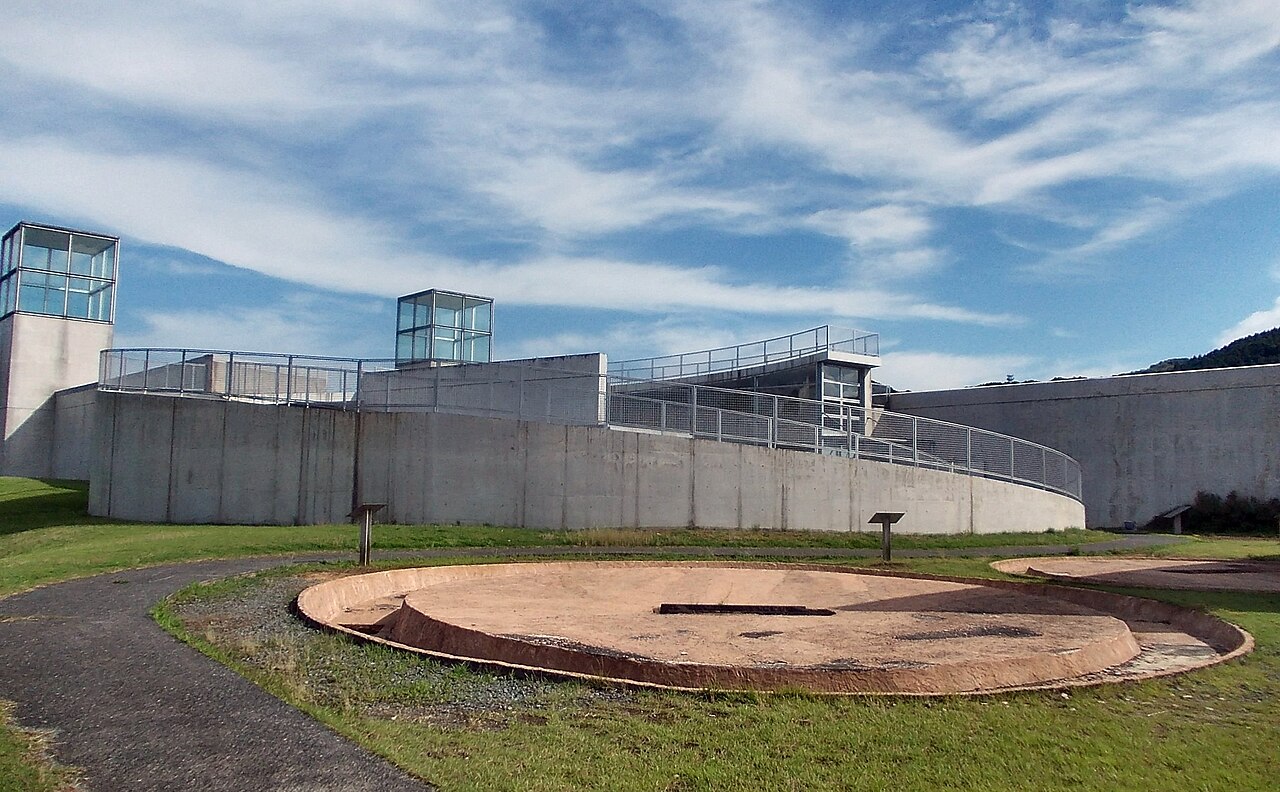
Tadao Ando designed this archaeology museum as a tomb of today: it imitates the shape of a keyhole-shaped tomb and faces, in point symmetry, a real 107 m burial mound. Its exposed concrete serves as a plinth from which the whole Iwabaru mound group, a National Historic Site, can be seen. Inside are full-scale replicas of the prefecture's main decorated tombs. Completed in 1992 as part of Kumamoto Artpolis.
Affiliate links — booking through Verrière helps fund our research, at no extra cost to you.
History
The museum is the central facility of the "Higo Ancient Forest" (肥後古代の森, Higo Kodai no Mori). This archaeological park became, in fiscal year 1992, the country's eleventh "Fudoki no Oka" (風土記の丘), a programme of the Agency for Cultural Affairs that aims to preserve and make use of large groups of sites. For its own, Kumamoto Prefecture acquired and developed three districts of the Kikuchi River valley: Yamaga, Kaō (鹿央) and Kikusui (菊水, now part of the town of Nagomi).
The building is also part of Kumamoto Artpolis (くまもとアートポリス), an architecture programme the prefecture has run since 1988 to improve townscapes and the environment through high-quality buildings. The museum is presented as its flagship, completed in 1992 to a design by Tadao Ando (安藤忠雄). Construction ran from October 1990 to April 1992 and cost 1.59 billion yen; the museum opened on 15 April 1992. It is described as the first museum in Japan devoted specifically to burial mounds (古墳, kofun).
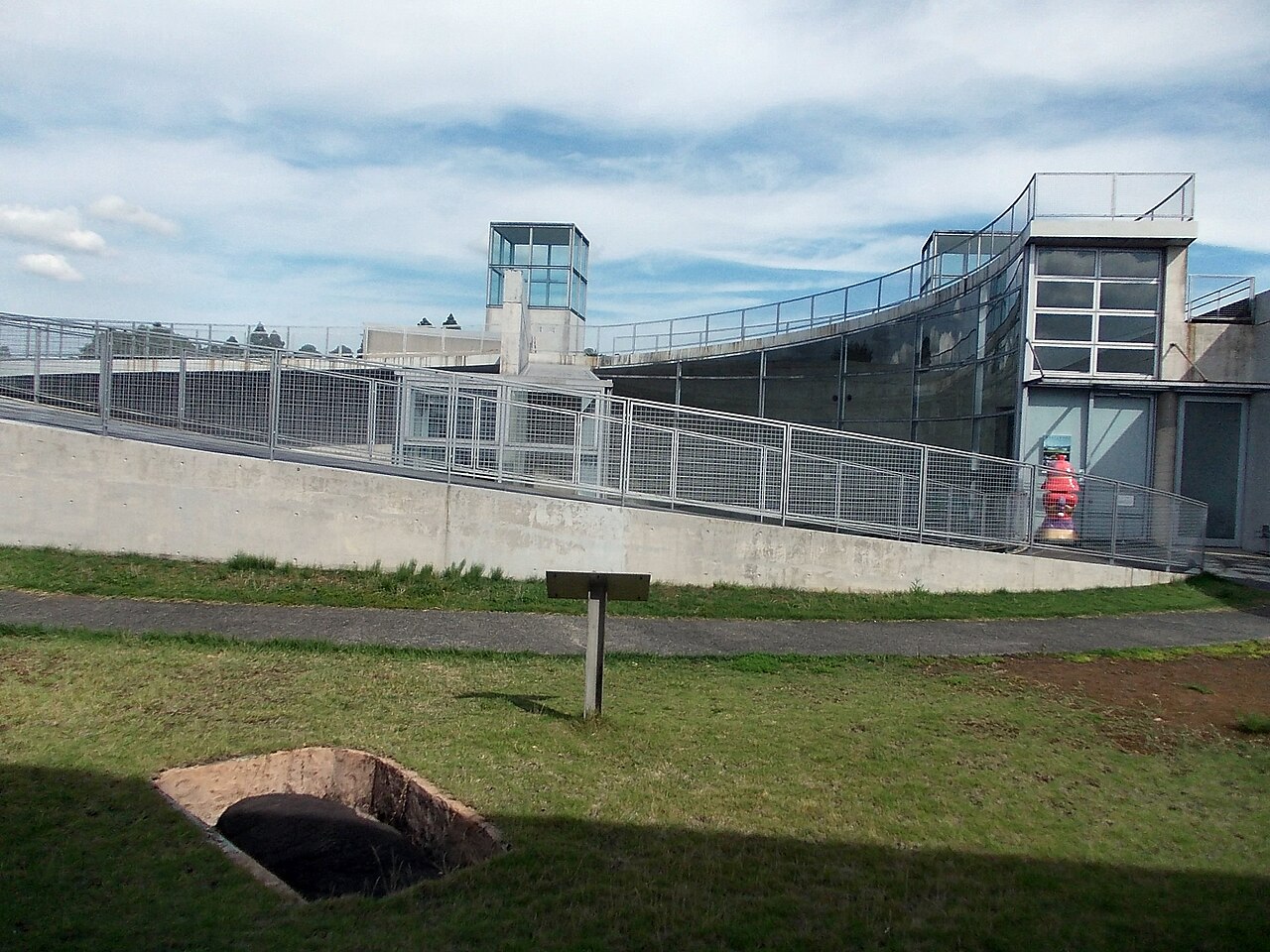
The works also touched the ground: two small round mounds were excavated on the site. All that remained of them was the stone coffin, a box of Aso welded-tuff slabs (阿蘇溶結凝灰岩), and the ring-shaped ditch around it. The excavation is reconstructed as a full-size model, and the authentic remains are reburied beneath it.
Architecture
The building imitates the shape of a keyhole-shaped tomb (前方後円墳, zenpō-kōen-fun) and is meant as a tomb of today. It stands facing one of the largest mounds in the prefecture, Iwabaru Futagozuka (岩原双子塚古墳, 107 m long, 57 m across the round part, 9 m high), in point symmetry with it. Ando did not conceive it as a mere display case but as an "environmental museum": the mound group and the landscape are shown together with it, and the building serves as a plinth (基壇) from which the whole group can be taken in at a glance.
The route is part of the design. It begins at the car park of the Kaō local-products centre (鹿央物産館), from where one walks about ten minutes up a tree-lined path. Past a water curtain, an outdoor staircase opens onto the view of the mounds in the greenery. The intended circulation starts on the roof: a ramp leads down from it, with the mound group on the left, to the entrance of the main building, then down to the basement and the hall of decorated tombs.
The concrete is exposed, cast in place and treated with a water repellent. The structure combines steel and reinforced concrete. The main building has a footprint of 1,448.83 m² and 2,098.98 m² of floor area, over one storey above ground and one basement, on a 6,338 m² plot. A single-storey annex (実習棟), the workshop wing, has a footprint of 783.39 m².
Use today
This is an archaeology museum devoted to decorated tombs (装飾古墳, sōshoku kofun): tombs whose coffin, chamber or entrance carry carved, sculpted or painted designs.
At the heart of the route, the decorated-tomb hall shows precise full-scale replicas of the prefecture's main decorated tombs, together with their grave goods (among them Chibusan, Benkei-ga-ana, Daibō and Eianji-higashi). The originals are often restricted to protect them, so here they can be compared at leisure. A permanent room displays finds from the Kikuchi River valley and another holds temporary exhibitions. The basement hall shows cave tombs (横穴墓, yokoana) on its walls, and the basement's outdoor display area a boat-shaped stone coffin from the 辻古墳 tumulus. In the Imagination Hall, original films are screened. The annex hosts "ancient experience" workshops, starting with making magatama (勾玉, comma-shaped beads).
Outside lies the Iwabaru group (岩原古墳群), thirteen mounds designated a National Historic Site, built in the 5th century around Futagozuka; a haniwa park (はにわ公園) and walking paths link them. In the nearby cliff are 131 cave tombs, eight of them decorated; at the entrance of no. 32, in front of the car park, a quiver (靫, yugi) is visible in relief. The 横山古墳 tumulus, a decorated mound 39.5 m long, was moved and rebuilt here; its interior can be visited at certain times.
Visiting
The museum is open from 9:30 to 17:15 (last entry 16:45). It is closed on Mondays (the following day if Monday is a public holiday) and from 25 December to 4 January. Admission is charged, with a reduced rate for university students; it is free from kindergarten to high school and for holders of a disability certificate. Photography is allowed.
The museum has a lift and lends three adult wheelchairs; assistance dogs are admitted. Address: 3085 Iwabaru, Kaō-machi, Yamaga, Kumamoto Prefecture. By car, allow about an hour from Kumamoto along National Route 3; about fifty free spaces surround the building, and more are at the Kaō local-products centre (鹿央物産館), from where one can walk up as the design intends. Without a car, the bus stops at "県立装飾古墳館入口", a twenty-minute walk away.
Photos
32.99° N, 130.67° E
Greenhouses nearby
Architecture nearby
Sources (14)
- kofunkan.pref.kumamoto.jp/ando/
- kofunkan.pref.kumamoto.jp/about/
- kofunkan.pref.kumamoto.jp/guide/
- kofunkan.pref.kumamoto.jp/exhibition/
- kofunkan.pref.kumamoto.jp/iwabaru/
- kofunkan.pref.kumamoto.jp/access/
- kofunkan.pref.kumamoto.jp/kodainomori/
- kofunkan.pref.kumamoto.jp/en/
- kofunkan.pref.kumamoto.jp/imagination-hole/
- pref.kumamoto.jp/soshiki/115/4296.html
- ja.wikipedia.org/wiki/%E7%86%8A%E6%9C%AC%E7%9C%8C%E7%AB%8B%E8%A3%85%E9%A3%BE%E5%8F%A4%E5%A
- wikidata.org/wiki/Special:EntityData/Q4557656.json
- api.openstreetmap.org/api/0.6/way/248200835/full.json
- nominatim.openstreetmap.org/search?q=%E7%86%8A%E6%9C%AC%E7%9C%8C%E7%AB%8B%E8%A3%85%E9%A3%B
Affiliate links — booking through Verrière helps fund our research, at no extra cost to you.