Ishikawa Nishida Kitarō Museum of Philosophy
Kahoku, Ishikawa Prefecture
Sources checked October 2026
- Year
- 2002
- Architect
- Tadao Ando
- Type
- Museum of philosophy
- Access
- Open to the public, closed on Mondays (official website, October 2026)
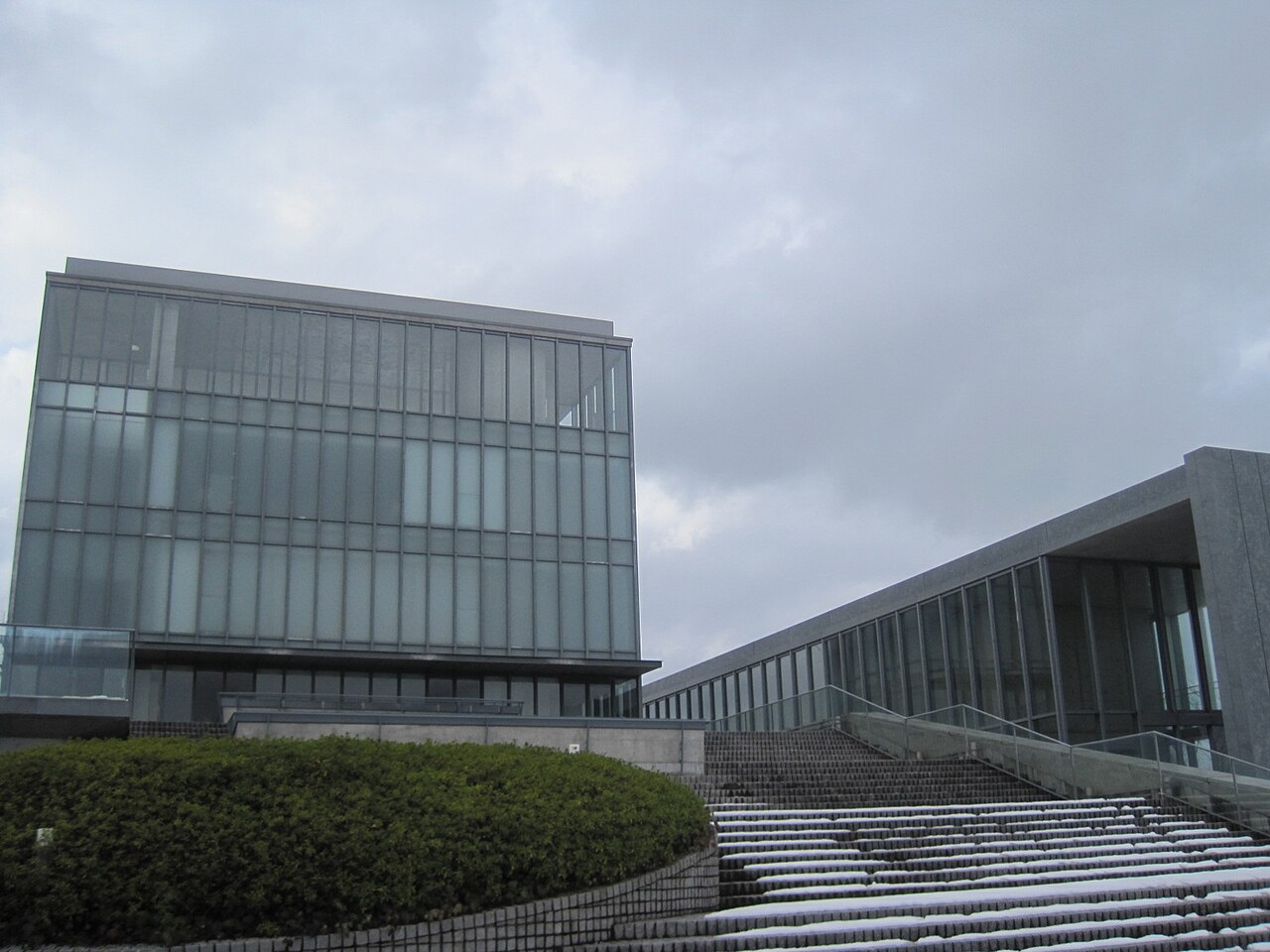
This museum in Kahoku, 20 km north of Kanazawa, is devoted to the philosopher Nishida Kitarō (西田幾多郎) and opened in 2002 to designs by Tadao Ando. A stepped garden covers the buried part of the building, whose exterior is glazed at the top of the hill; inside, a maze of rooms built around the theme of "thinking" leads to a circular foyer under a skylight, a courtyard open to a square of sky and a panoramic lounge over the Sea of Japan. The philosopher's study, a registered cultural property, has been rebuilt in the grounds.
Affiliate links — booking through Verrière helps fund our research, at no extra cost to you.
History
The philosopher 西田幾多郎 (Nishida Kitarō) was born on 19 May 1870 in what is now the city of Kahoku and died in Kamakura on 7 June 1945. His 『善の研究』 (Zen no kenkyū, "An Inquiry into the Good") is the first full-fledged work of philosophy written in Japan. The museum presents itself as Japan's only "museum of philosophy".
It replaced a small memorial hall, the town of Unoke's Nishida Memorial Hall (宇ノ気町立西田記念館), built in 1968 and grown too small for the documents gathered there. The new building, the 石川県西田幾多郎記念哲学館, was built by Ishikawa Prefecture and the town of Unoke to designs by Tadao Ando (安藤忠雄) and opened on 8 June 2002; it won the 9th Ishikawa Landscape Grand Prize (いしかわ景観大賞) the same year. It is now run by the city of Kahoku, of which Unoke is now part.
Architecture
The museum stands on a slope of the Uchinada dune (内灘砂丘), facing the Sea of Japan. Part of the volume is buried in the hillside and its roof forms a long, wide stepped garden; at the top of the hill, the exterior is glazed. Visitors arrive by these steps: with each one, the wind, the woods below and then the town in the distance come into view. The building is reinforced concrete, with one storey below ground and five above, and 2,952 m2 of floor area. It has two parts: the exhibition block (展示棟) and the training block (研修棟), which holds a 303-seat hall, a training room, a café, a library and a panoramic lounge.
Ando gave the place the theme of "thinking" (考えること). The interior is complex, almost a maze: visitors choose their way as they reflect, and spaces for contemplation are set out throughout. The foyer (ホワイエ) is a circular bowl in which curved, slanting concrete walls widen toward a large skylight that cuts out a circle of blue sky. Its counterpart is the "sky garden" (空の庭), a court closed by four walls and open to the sky, which frames a square of sky. The panoramic lounge (展望ラウンジ) looks out over the Sea of Japan, Lake Kahokugata (河北潟), Mount Hōdatsu (宝達山) and, in the distance, the Hakusan range (白山); sunset over the sea behind the pine woods is not to be missed.
Use today
The exhibition block has three rooms. The first, "Invitation to Philosophy" (哲学へのいざない), on the ground floor, sets out quotations from thinkers of past and present, East and West, with a dialogue game on a tablet; a large screen shows a film on Nishida's life and readings of his essays. The second, "The World of Nishida" (西田幾多郎の世界), upstairs, traces his life and character through more than two hundred items (personal belongings, manuscripts, letters) and also has a space for temporary exhibitions. The third, in the basement, is devoted to his calligraphy. The training block holds a library of books on Nishida and on philosophy, from introductions to specialist works, as well as the café Theoria (喫茶テオリア); lectures, courses and concerts are held there.
In the grounds stands Nishida's study, Kossei-kutsu (骨清窟), once part of his Kyoto house, built in 1923. When the house was demolished in 1974, only the study was saved and rebuilt next to the old memorial hall, then moved in 2010 to the museum's grounds; its furniture and books remain as Nishida used them. It bears the name the philosopher gave it from a poem by the Zen monk Jakushitsu (寂室) of the Muromachi period, and since 2003 has been among the registered tangible cultural properties of the state (登録有形文化財): a single-storey timber building of 20 m2.
The museum is tied by an exchange agreement, signed in October 2011, to the D. T. Suzuki Museum (鈴木大拙館) in Kanazawa: Nishida and Suzuki Daisetsu (鈴木大拙), born in the same year, 1870, had sat side by side at the Fourth Higher School and stayed friends all their lives.
Visiting
Open 9:00 to 17:00, last entry 16:30; closed on Mondays (if the Monday is a public holiday, the closure falls on the next weekday), from 29 December to 3 January, and during exhibition changeovers and maintenance periods. Admission is charged, at a reduced rate from age 65; free up to high-school age, and for holders of a disability certificate and one companion. The training block (panoramic lounge, library, café) can be used without a ticket if you do not enter the exhibition block. Photographs are discouraged in the exhibition rooms. The café is open 10:00 to 17:00 (last order 16:30) and closed on Mondays.
From Unoke Station (宇野気駅, Nanao Line, 25 minutes from Kanazawa), it is a 20-minute walk; by car, 3 minutes from the Shiroo (白尾) exit of the Noto Satoyama Kaidō.
36.71° N, 136.69° E
Greenhouses nearby
Sources (11)
- nishidatetsugakukan.org/mainmenu1.html
- nishidatetsugakukan.org/mainmenu2.html
- nishidatetsugakukan.org/mainmenu2_shisetsu.html
- nishidatetsugakukan.org/mainmenu4.html
- nishidatetsugakukan.org/column2.html
- pref.ishikawa.lg.jp/eizen/noto/nisida/nisida.html
- pref.ishikawa.lg.jp/toshi/keikantaisho/kako_jushou/h14/nishita.html
- kunishitei.bunka.go.jp/heritage/detail/101/00003229
- ja.wikipedia.org/wiki/石川県西田幾多郎記念哲学館
- openstreetmap.org/way/638940247
- wikidata.org/wiki/Q11586041
Affiliate links — booking through Verrière helps fund our research, at no extra cost to you.