Himi Seaside Botanical Garden Greenhouses (氷見市海浜植物園)
Himi, Toyama Prefecture
Entry updated on October 5, 2026
- Year
- 1996 (renewed 2021)
- Architect
- Itsuko Hasegawa (長谷川逸子・建築計画工房); renewal: FULL POWER STUDIO
- Style
- Ring-shaped building with translucent glasshouses around a central garden
- Dimensions
- 2,335.87 m² footprint, 2,875.24 m² floor area on two storeys (whole building)
- Status
- Open to the public
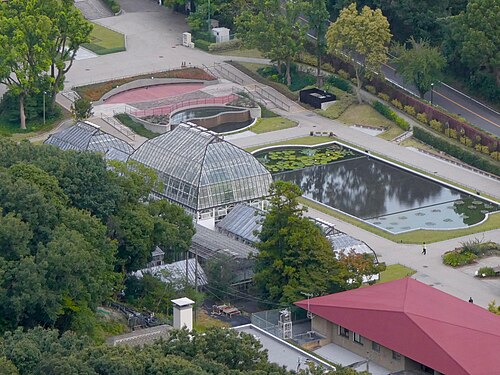
Opened by the city of Himi on 14 May 1996 facing Toyama Bay, on the Matsudae no Nagahama beach celebrated in the Man'yōshū, this 6.4-hectare garden is the only one in Japan to bear the name of seaside botanical garden. The architect Itsuko Hasegawa designed an oval building that visitors can walk all the way round, with translucent glasshouses along its outer edge, a display garden at the centre and a projecting lookout. Renewed in 2021 and nicknamed Seaside Park, it shows cycads, bottle palms and tropical climbers alongside the flora of Japan's shores.
Affiliate links — booking through Verrière helps fund our research, at no extra cost to you.
History
1 min
Himi Seaside Botanical Garden grew out of a Toyama Prefecture scheme to link the botanical institutions on its territory into one great garden at regional scale. Within that plan, the Himi site was given a speciality: the flora of the shore. The garden opened on 14 May 1996 at Yanagida, beside the beach of Matsudae no Nagahama, which is mentioned in the Man'yōshū and lies within the Noto Peninsula Quasi-National Park. It remains the only institution in Japan to bear the name of seaside botanical garden.
The building is the work of the architect Itsuko Hasegawa and her studio; an architecture directory dates its completion to 1994, two years before the opening. The city of Himi owns the garden and entrusts its management to the company Actio.
Following a design proposal competition won by FULL POWER STUDIO, the garden underwent a major renewal and reopened on 2 April 2021. The works, carried out with the Nakagawa office and the play-equipment maker Taiyokogyo and built by Ishiguro Construction, added play and learning spaces while keeping the botanical function. The nickname Seaside Park was chosen from public suggestions.
Architecture and engineering
1 min
Itsuko Hasegawa drew an oval, ring-shaped building, laid out so that visitors can walk all the way round without a break. The glasshouses, glazed in translucent glass, run along the outer edge: they enclose the plants while letting the eye travel out to the surrounding landscape. The centre of the ring holds an open-air display garden, and a projecting lookout facing the beach now houses an Italian restaurant.
The building has a footprint of 2,335.87 m² and 2,875.24 m² of floor space on two storeys. The 2021 renewal set out to transform it without betraying it: cedar from the Himi hills lines the interiors and play structures, a learning room was slipped into the existing large glasshouse, and glazed tubes link the spaces so that visitors can move under cover in any weather. Part of one glasshouse was altered to let vehicles through, and a large play net and an inflatable dome were placed in the courtyard, while the threatened cycads were protected.
Plant collections
1 min
The garden is devoted to seashore plants, which withstand salt spray, burial by sand and swings of temperature thanks to deep roots and tough leaves. In the glasshouse, rare foreign cycads, some of them threatened species, grow beside the bottle palm (トックリヤシ) with its swollen trunk, as well as pineapples and other tropical and subtropical plants.
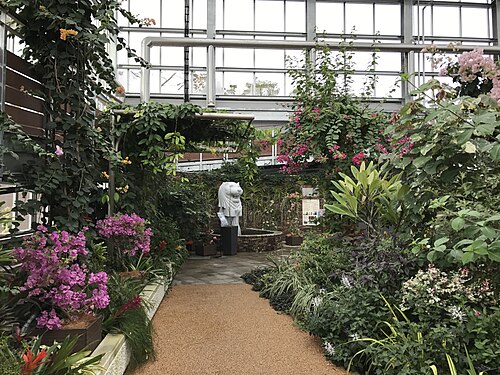
The glass tube displays climbers and potted specimens such as bottlebrush, bougainvillea and hibiscus. The central garden brings together the shore flora of the nearby beach, of Abugashima island and of other Japanese coasts. Outside, a hands-on garden shows wild camellias and seasonal plants, and across the road a beach trail lets visitors see the beach rose (ハマナス) and ハマボウフウ growing in place.
Visiting
1 min
The garden lies at Yanagida, about fifteen minutes on foot from Shimao Station on the JR Himi Line. Conceived as a garden for play in sunshine, rain or snow, it also suits winter days, since visitors move between glasshouses and rooms under cover. The coastal trail across the road extends the visit along Toyama Bay; on clear days the view reaches the Tateyama range. The restaurant in the projecting lookout overlooks the beach. Workshops and children's birthday parties feature among the events on the programme.
36.84° N, 137.00° E
Greenhouses nearby
More greenhouses — Japan
Do you have a good photo of this greenhouse? Suggest it for this page →