Japan Pavilion, Seville Expo 1992
Seville, Andalusia
Sources checked October 2026
- Year
- 1992
- Architect
- Tadao Ando
- Type
- Temporary national pavilion
- Access
- Gone: an ephemeral pavilion of the 1992 World Exposition
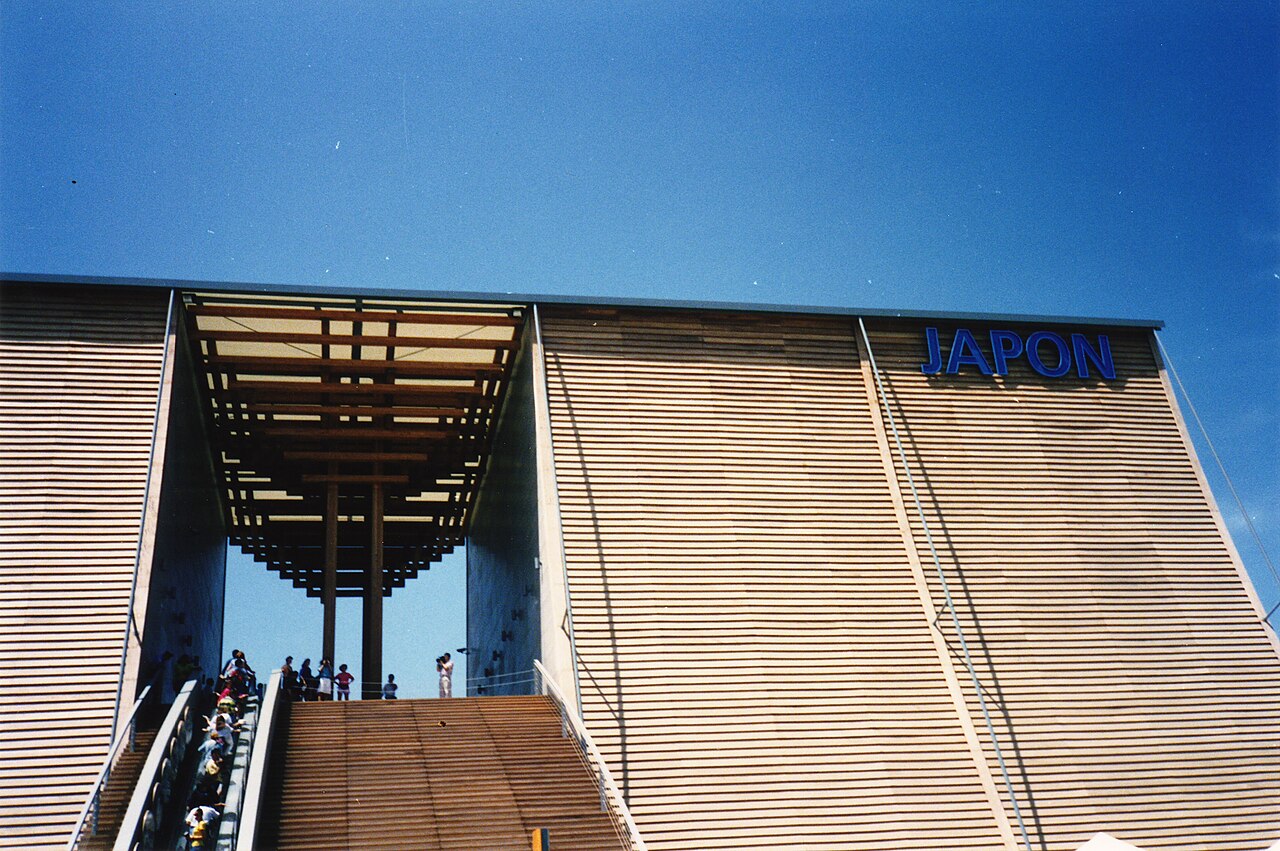
The Japan Pavilion (日本政府館) at the Seville World Exposition of 1992 was an ephemeral building by Tadao Ando. A wooden parallelepiped 60 m by 40 m and 25 m high housed, under an immense translucent Teflon membrane, a space reached by an arched bridge. It no longer exists.
History
The Seville World Exposition of 1992 had "The Age of Discovery" as its theme. In response, the Japan Pavilion (日本政府館) was to be a highly refined construction, uniting Japan's traditional culture with the most advanced technology, and to foster cultural exchange that overcomes national borders. Its design and construction ran from 1989 to 1992.
Tadao Ando conceived it as a flower that blooms in spring and dies with the autumn. Ephemeral, the pavilion is one of the Exposition's buildings that have disappeared.
Architecture
Clad in solid wood slats, the building takes the form of a parallelepiped 60 m by 40 m and 25 m high, divided into four levels, with a floor area of 5,660 m2. At the centre, an arched bridge eleven metres long rises to the top level, where visitors reach a space covered by an immense roof of translucent Teflon membrane, held up by columns and beams of glued laminated timber.
True to the "sensitive tradition" and "raw nature" of Japanese culture, the pavilion used natural, undyed wood for the structure and the finishes alike. Based on Japanese building techniques, this timber architecture was completed with craftspeople from countries around the world at every stage: supply and processing of materials, construction work, manufacture of hardware.
Seville, Andalusia