Jinchōkan Moriya Historical Museum (神長官守矢史料館)
Chino, Nagano Prefecture
Sources checked November 2026
- Year
- 1991
- Architect
- Terunobu Fujimori
- Type
- Municipal museum of historical documents
- Access
- Open to the public (Chino city website, November 2026)
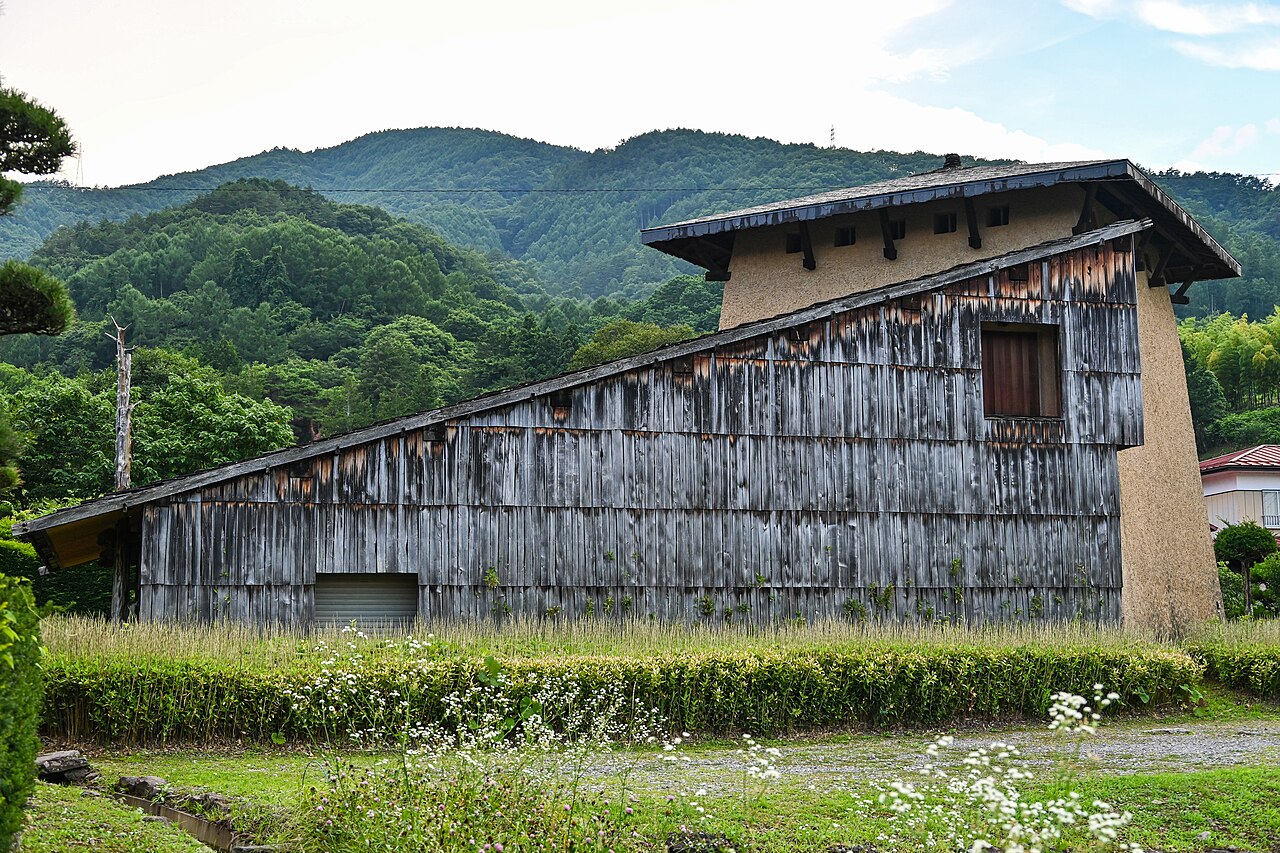
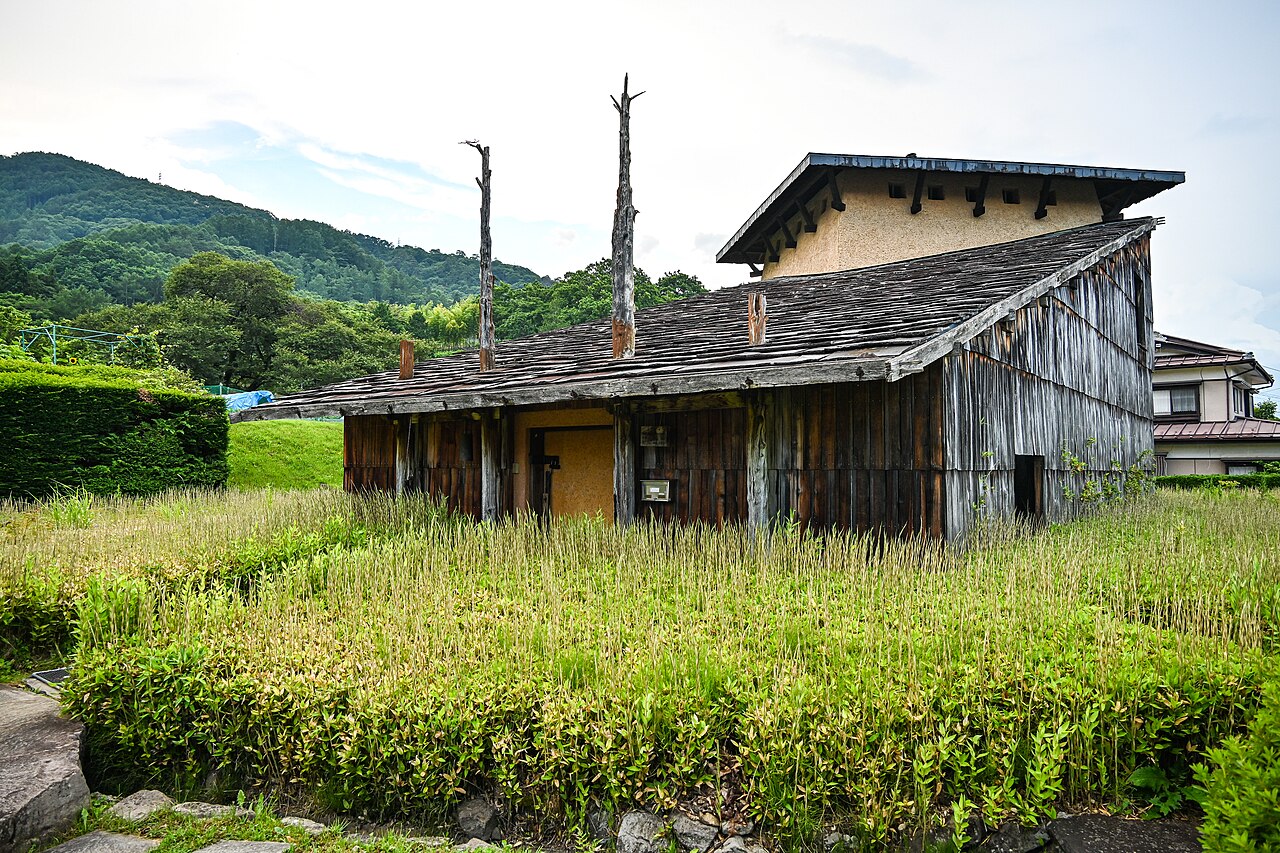
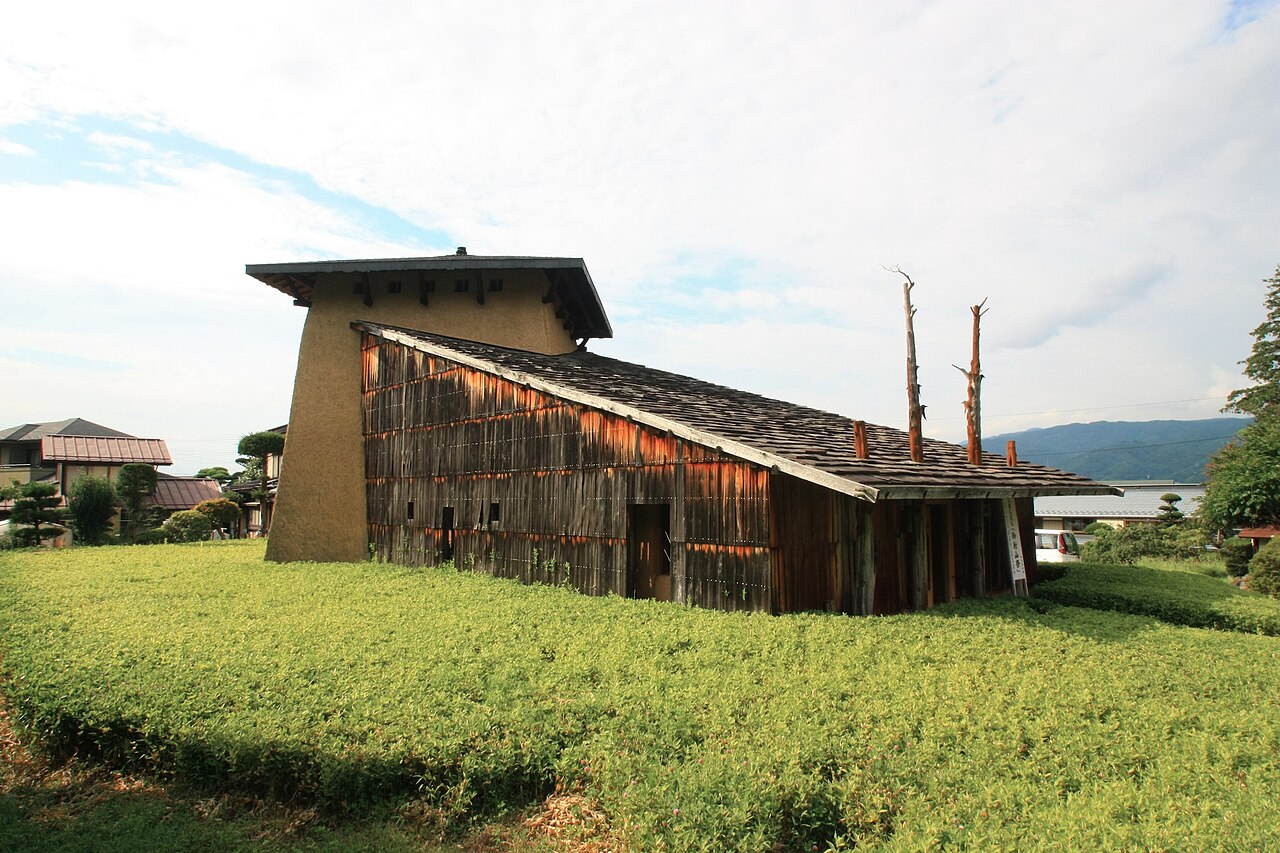
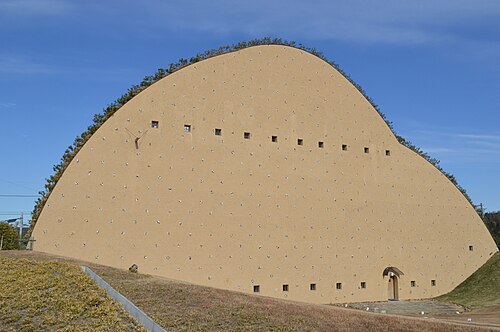
This municipal museum in Chino houses the documents of the Moriya family, who held a priestly post at the upper shrine of Suwa Taisha. Completed in 1991, it is Terunobu Fujimori's first building: he drew up the basic design, and the architect Yoshio Uchida, who co-signs it, handled the design work and site supervision. Its reinforced-concrete structure, partly timber, is dressed in split sawara boards and a straw render, and four yew posts pass through the entrance canopy.
Affiliate links — booking through Verrière helps fund our research, at no extra cost to you.
History
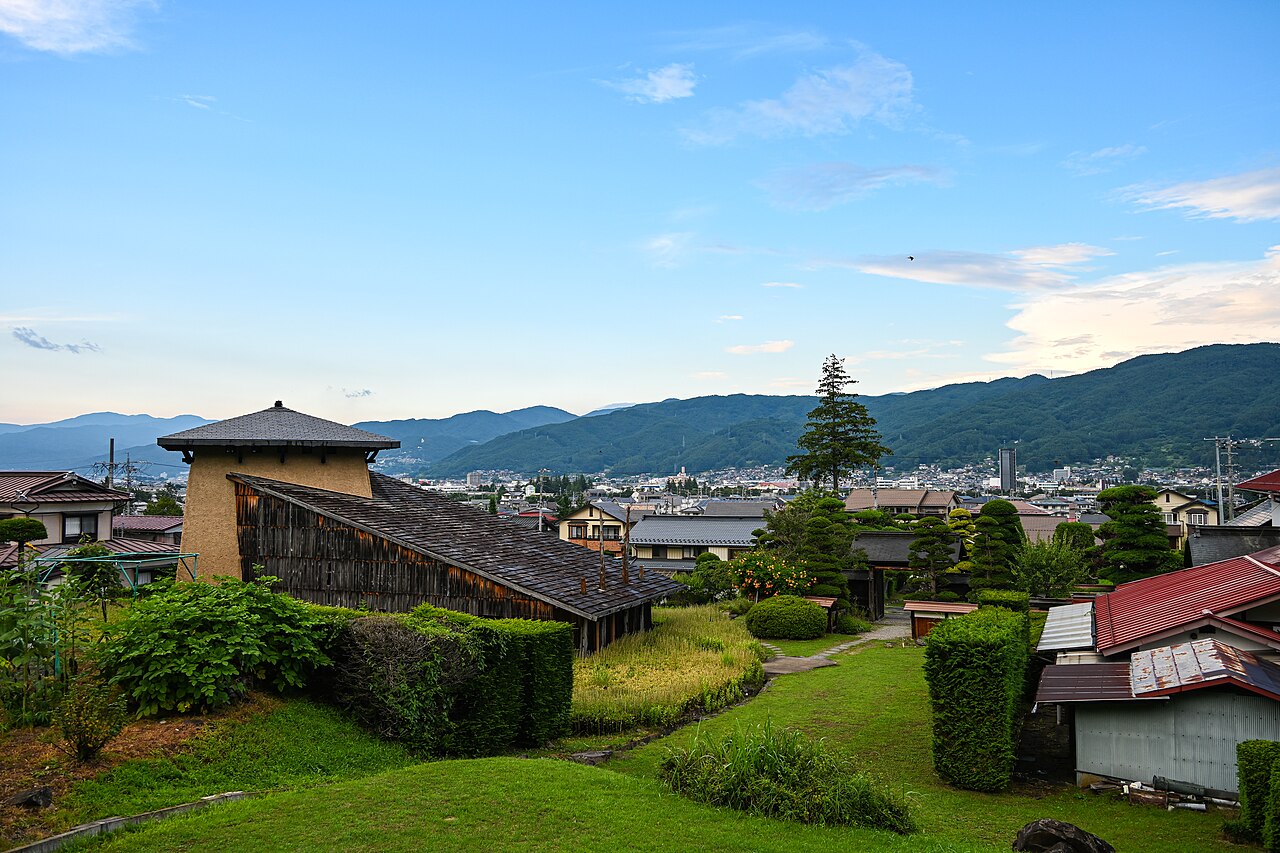
The Moriya family held the office of jinchōkan (神長官), one of the priestly posts of the upper shrine of Suwa Taisha, until the Meiji era, and has kept old documents handed down since the Kamakura period. The city of Chino founded the museum to preserve and display them; it opened in 1991 within the grounds of the former Moriya residence, a municipal historic site, between the main shrine and the front shrine of Suwa Taisha (上社本宮 and 前宮).
Terunobu Fujimori, who comes from the same district, drew up the basic design; the design is a joint one, with the architect Yoshio Uchida handling the design work and site supervision. For Fujimori, who had until then studied the history of modern architecture in Japan, it is his first building, the starting point of his work as an architect.
Architecture
The museum is made of two volumes: an exhibition hall under a single-pitch roof and, set against it at an angle, a square, two-storey store for the documents. The floor area is 184 m2. The pyramidal roof of the store is natural slate; the exhibition hall is roofed with slabs of flat Suwa stone, laid over a profiled steel deck with generous overlaps and held by wire mesh, to recover the traditional roofing of the region.
The building had to resist fire: the structure is reinforced concrete, partly timber, yet the design seeks to use as many natural materials as possible. On the exhibition hall, the concrete wall is dressed, like a timber curtain wall, with sawara boards split by hand, a Kamakura-period technique; such boards were once used to cover roofs. The two-storey volume is finished to evoke a rough earth wall: on the concrete, a bamboo lath reproduced in stainless steel takes a straw-mixed render. The interior walls are also rendered with straw, applied with a wooden trowel, and the floor is a tataki, rammed earth.
At the entrance, four posts of yew, a local wood, pass through the canopy and rise above the roof; they recall the onbashira (御柱), the posts that mark the shrines of Suwa.
Use today
The museum keeps and displays the Moriya family's documents: 1,618 items, among them 155 prefectural treasures and 50 properties designated by the city of Chino. Most relate to the rites of Suwa Taisha. Among the medieval documents, the letters of Takeda Shingen are the most numerous, and the permanent exhibition room puts them first; it also shows the excavation carried out in 1990 for the construction of the museum and the objects it yielded.
In the lobby, a reconstruction of the Ontosai festival (御頭祭), one of the important rites of the upper shrine of Suwa alongside the festival of the onbashira, is based on the sketches of Sugae Masumi, who travelled across Japan in the late Edo period.
Visiting
The museum is open from 9:00 to 16:30. It is closed every Monday, from 29 December to 3 January and on the day after a national holiday; when that day is a Monday, the following day is closed as well.
From JR Chino Station, allow about 40 minutes on foot (3 km).
Photos
36.00° N, 138.13° E
Greenhouses nearby
Architecture nearby
By the same architect
Sources (7)
- city.chino.lg.jp/soshiki/bunkazai/1639.html
- navi.chinotabi.jp/spot/3135/
- navi.chinotabi.jp/en/spot/3135/
- bunka.go.jp/kindai/kenzoubutsu/research/nagano/024/index.html
- ja.wikipedia.org/wiki/%E8%8F%85%E6%B1%9F%E7%9C%9F%E6%BE%84
- ja.wikipedia.org/wiki/%E6%AD%A6%E7%94%B0%E4%BF%A1%E7%8E%84
- id.ndl.go.jp/auth/ndlna/01030593
Affiliate links — booking through Verrière helps fund our research, at no extra cost to you.