Tropical Grand Dome, Kusatsu Nettaiken (草津熱帯圏 熱帯大ドーム)
Kusatsu, Gunma Prefecture
Entry updated on October 5, 2026
- Year
- 1970
- Architect
- Unknown
- Style
- Tiered tropical dome heated by hot-spring heat
- Dimensions
- 15 m high
- Status
- Open to the public
Opened on 10 October 1970 in the hot-spring resort of Kusatsu, about 1,200 metres above sea level, Kusatsu Nettaiken is one of Japan's few privately run zoos. Its centrepiece, a tropical dome 15 metres high, is heated with hot-spring heat that keeps it at around 23 °C throughout the year. Beneath dense tropical vegetation it shows crocodiles, flamingos, tortoises and small primates, while the zoo as a whole, with some 120 reptile species, achieved Japan's first breeding of the Malayan gharial in 2003.
Affiliate links — booking through Verrière helps fund our research, at no extra cost to you.
History
1 min
Kusatsu Nettaiken (草津熱帯圏) opened on 10 October 1970 in Kusatsu, the hot-spring resort in Gunma Prefecture, on the very day its great tropical dome was completed. Unusually for Japan, where most zoos are run by national or local government or by large corporations, it has operated for decades as a private concern.
The zoo made its name with several firsts: the frilled lizard (エリマキトカゲ) and the Hercules beetle (ヘラクレスオオカブト) were shown to the Japanese public here for the first time, and koalas, kept for a limited period, were the first ever displayed in Gunma Prefecture. In 2003 it achieved Japan's first successful breeding of the Malayan gharial (マレーガビアル), a crocodilian rarely kept in captivity and critically endangered in the wild.
The site later expanded outdoors with Monkey Paradise (モンキーパラダイス), opened on 29 April 1988, where Japanese macaques have hot-spring baths of their own. Facing financial difficulties, the zoo launched a supporters' membership scheme in May 2011. On 25 July 2024 it opened a new animal-encounter building (動物ふれあい館).
Architecture and engineering
1 min
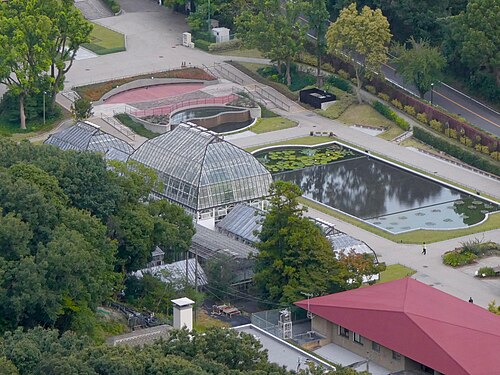
The Tropical Grand Dome (熱帯大ドーム), completed on 10 October 1970, is the heart of the zoo. Rising 15 metres, it is heated with the warmth of Kusatsu's thermal water, which holds the interior at about 23 °C all year round even though the site lies some 1,200 metres above sea level.
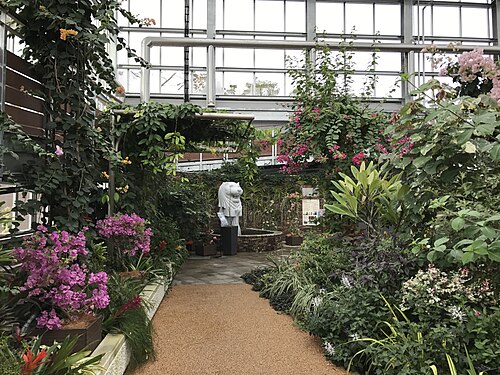
Inside, the dome is laid out as a tiered tropical jungle: dense planting frames spaces arranged by the subtropical and tropical regions of Africa, Asia, Australia and the Americas. The route passes pools for crocodiles and flamingos, tortoise enclosures and reptile sections. Birds and primates once roamed freely under the dome, a practice since abandoned under stricter animal-management rules.
The dome sits within a site of about 15,000 m² that also includes a main building, a resource hall, outdoor enclosures and the animal-encounter building opened in 2024. None of the sources consulted names the architect or the builder, nor do they describe the materials of the dome's envelope.
Plant collections
1 min
The zoo as a whole keeps about 1,000 animals of some 250 species. Reptiles are its strength: with around 120 species, including crocodiles, snakes, lizards and tortoises, the collection is described as the finest in the Kantō region.
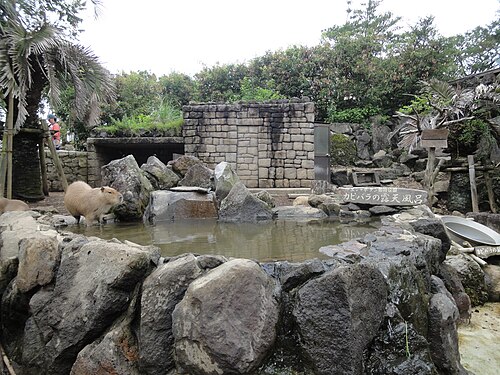
Under the dome, tropical vegetation provides the setting for small primates such as the pygmy marmoset (ピグミーマーモセット), billed as the world's smallest monkey, and ruffed lemurs (エリマキキツネザル), alongside the crocodiles, flamingos and tortoises. Visitors can also feed capybaras, adults and young alike.
Outdoors, Monkey Paradise brings together Japanese macaques that bathe in hot-spring water, and a hand and foot bath with 'beauty fish' rounds off the attractions. In the past the zoo has also shown koalas and other marsupials.
Visiting
1 min
The zoo lies within Kusatsu Onsen, about eight minutes' walk from the Yubatake and roughly twelve minutes from the bus terminal. It bills itself as the highest-altitude zoo in Japan.
With its constant temperature, the dome offers a sharp contrast with the mountain climate, especially in the colder months. After working through its different levels, the natural next step is Monkey Paradise, where the macaques can be watched in their baths. A visit combines easily with a stroll around the Yubatake. Dogs on a lead are admitted throughout the site.
36.62° N, 138.60° E
More greenhouses — Japan
Do you have a good photo of this greenhouse? Suggest it for this page →