Ecological Greenhouse of the Observation Hall, Gunma Insect World (ぐんま昆虫の森 生態温室)
Kiryū (Niisato), Gunma Prefecture
Entry updated on October 5, 2026
- Year
- 2005
- Architect
- Tadao Ando (structure: Kanebako Structural Engineers)
- Style
- Glazed triangulated lattice shell on a reinforced-concrete base
- Dimensions
- Greenhouse ≈1,100 m²; hall 5,084 m²; ≈70 m between the shell's corners
- Status
- Open to the public
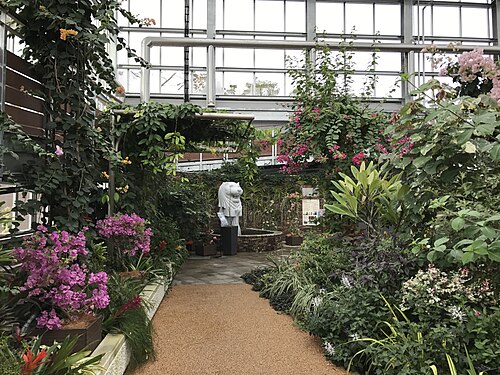
The Insect Observation Hall of Gunma Insect World, a prefectural park devoted to insects that opened in 2005 in Kiryū, was designed by Tadao Ando. Its great glass dome, a triangulated lattice shell cut from a sphere 57.241 m in radius whose three corners stand about 70 m apart, houses an ecological greenhouse of some 1,100 m². The greenhouse recreates the environment of Iriomote Island, with subtropical plants, a waterfall and around 800 butterflies of some forty species flying freely all year round.
Affiliate links — booking through Verrière helps fund our research, at no extra cost to you.
History
1 min
Gunma Insect World (ぐんま昆虫の森) is run by Gunma Prefecture and occupies an estate at Niisato, in the city of Kiryū, of 45 to 48 hectares depending on the source, roughly the size of ten Tokyo Domes. The park was planned around a satoyama landscape, the traditional cultivated countryside of Japan, and an insect observation hall commissioned from Tadao Ando.
The hall was completed in autumn 2004, in September according to Wikipedia and in October according to the structural engineers Kanebako; its cost is put at about 4.4 billion yen. The park opened fully to the public on 1 August 2005, with the entomologist 矢島稔 (Yajima Minoru) as its first director.
The estate also includes an Akagi-type thatched farmhouse, built around 1870 in the Meiji era and covering about 400 m², which was damaged by a lightning fire in August 2001 and then repaired. Between 2022 and 2023 the park carried the name of a sponsor, a local mushroom farm, under a naming-rights agreement that ended on 31 March 2023.
Architecture and engineering
1 min
The observation hall has three storeys above ground and one below, set against the slope, with a total floor area of 5,084 m². Its reinforced-concrete parts, partly in composite steel and concrete, carry a large glass dome whose geometry was engineered by Kanebako Structural Engineers.
The dome is a single-layer lattice shell: a portion of a sphere 57.241 m in radius, trimmed by three great circles, which gives it a triangular plan with corners about 70 m apart. Its grid is made of triangles 4.5 to 5 m along each side, filled with glass. Beneath the shell lies the ecological greenhouse, of about 1,100 m², which reproduces the natural setting of Iriomote Island. OpenStreetMap records the hall as an architectural work by Tadao Ando, partly sunk into the ground, a short walk from the park entrance.
Plant collections
1 min
The greenhouse, which the park also presents as a place to meet insects at close range, holds subtropical vegetation comparable to that of Okinawa, crossed by a waterfall. Around forty species of butterfly, some 800 individuals, fly freely inside. Among them is the ōgomadara (オオゴマダラ), one of the largest butterflies in Japan with a wingspan of 13 to 15 cm, and the tsumamurasakimadara (ツマムラサキマダラ), native to the islands of the south-west of the archipelago.
Across the estate, more than 1,400 insect species and about 80 bird species have been recorded. The insects highlighted include rhinoceros beetles, stag beetles and the ōmurasaki (オオムラサキ), which can be seen from July to early August.
Visiting
1 min
The greenhouse is inside the observation hall, not far from the park's main entrance. It is open all year and makes a warm, bright stop in winter. Allow about three hours to explore the whole estate.
The visit continues outdoors in a satoyama landscape: broadleaf woods, rice fields where dragonflies and fireflies can be watched in June, mulberry fields, a grasshopper meadow, a pond and the thatched farmhouse. Rhinoceros beetles are most often seen from July to mid-August.
36.44° N, 139.25° E
Greenhouses nearby
More greenhouses — Japan
Do you have a good photo of this greenhouse? Suggest it for this page →