Lamune Onsen (ラムネ温泉館)
Taketa, Ōita Prefecture
Sources checked November 2026
- Year
- 2005
- Architect
- Terunobu Fujimori
- Type
- Hot-spring baths (carbonated water)
- Access
- Open to the public (official site, November 2026)
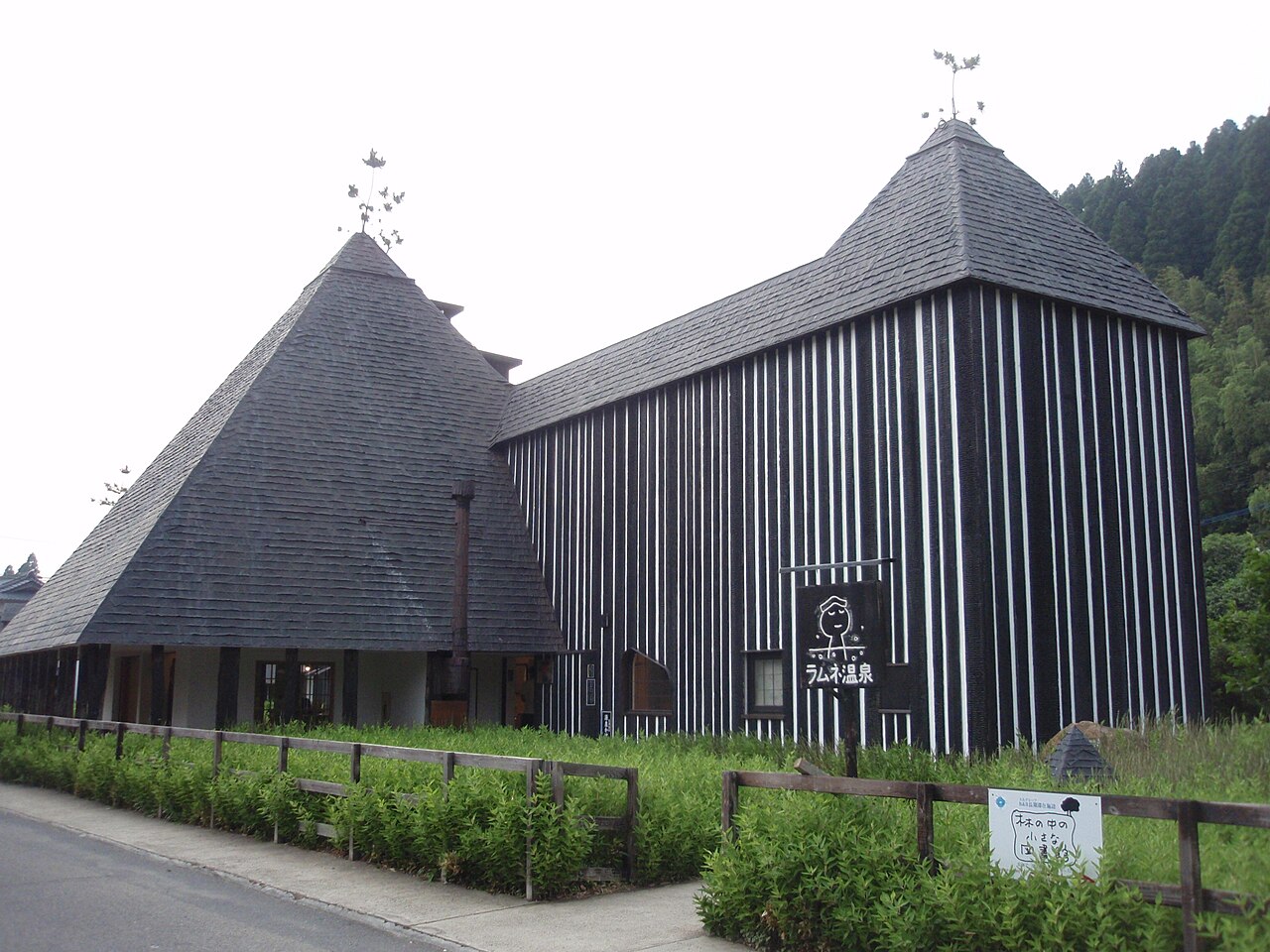
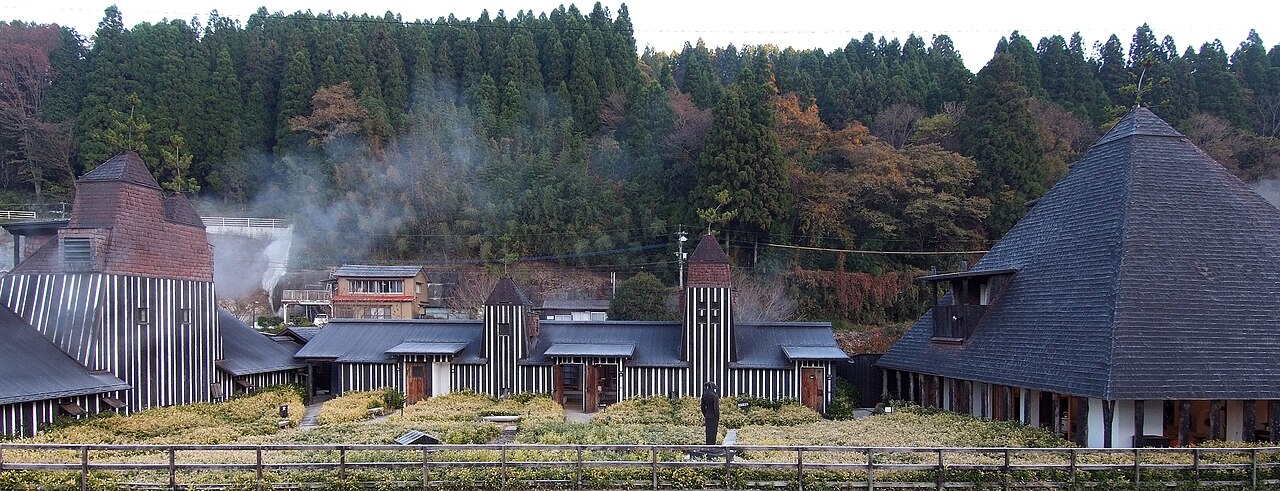
These carbonated-water baths at Nagayu, in the north of the municipality of Taketa, opened in 2005. Terunobu Fujimori designed them with Yoshiaki Irie: walls striped with charred cedar and white lime, a copper roof hand-dented to evoke thatch, and a pine planted at the top. The upper floor of the waiting room holds a museum of works tied to the spa town.
Affiliate links — booking through Verrière helps fund our research, at no extra cost to you.
History
The baths owe their name to a writer, Jirō Osaragi. In a travel account of Ōita Prefecture published in 1934, he describes bathing in the carbonated water of Nagayu: fine bubbles cling all over the body and, even when rubbed off by hand, more keep coming back. "It is like a ramune bath," he writes, after the Japanese fizzy lemonade. Forty years after that account, an establishment called Lamune Onsen opened in a small wooden building.
Terunobu Fujimori came to Nagayu through the writers Shun and Genpei Akasegawa, both devoted to the spa town. It was Katsuji Shutō, who ran a small carbonated-water bathhouse on the spot, who asked him to design the baths; the client was the operating company. The logo and the characters were entrusted to Shinbō Minami, who like Fujimori belongs to the Street Observation Society. The baths opened on 5 August 2005.
Architecture
Terunobu Fujimori designed the baths with Yoshiaki Irie of the IGA Proje'K't office in Kumamoto. The complex has three buildings: a reception building with the waiting room, which carries the museum upstairs; the large-bath building, with one entrance for men and one for women; and the family-bath building, where three baths follow one another like a row of terraced houses.
The outer walls combine cedar boards charred one by one, a traditional technique that makes them last longer, with white lime plaster, giving a black-and-white striped look. The lime set in the gaps absorbs lateral movement, and the black-and-white contrast keeps the building looking bright on rainy days.
The triangular roof is clad in copper, hand-dented to evoke the thatched roofs of old; Fujimori regards copper as a material that goes well with natural ones. A pine is planted at the top of the roof: a symbol of celebration in Japan, the pine is also a symbol of longevity, and it was planted to wish the baths a long prosperity.
The entrance to the large bath, in lime plaster and cave-like, was designed with the nijiriguchi in mind, the small low door of tea rooms.
Use today
Bathers have two waters to choose from. The outdoor bath of the large bath, at 32 °C, is carbonated water; the indoor bath, at 42 °C, is cloudy hydrogen-carbonate water. The large bath also has a sauna, and the three family baths also offer both waters, at 42 and 32 °C. In the courtyard, a fountain lets visitors drink the spring water.
The museum on the upper floor of the waiting room shows works by painters and sculptors tied to Nagayu, calligraphy by Yasunari Kawabata, and letters and photographs from the time these artists visited the spa town. It is free for bathers.
Visiting
The baths are open from 10 a.m. to 10 p.m. and closed on the first Wednesday of the month (the second Wednesday in January and May). The family baths cannot be booked by phone: visitors sign up on site, in order of arrival. Nagayu lies in the north of the municipality of Taketa.
Photos
33.07° N, 131.38° E
Greenhouses nearby
Architecture nearby
By the same architect
Sources (18)
- lamune-onsen.co.jp/
- lamune-onsen.co.jp/fujimori/
- lamune-onsen.co.jp/museum/
- lamune-onsen.co.jp/spa/
- lamune-onsen.co.jp/access/
- edit.pref.oita.jp/news-columns/475/
- data.shinkenchiku.online/projects/articles/SK_2006_01_116-0
- data.shinkenchiku.online/en/projects/articles/SK_2006_01_116-0
- pjcatalog.jp/archives/5591
- iga-arch.com/profile/
- iga-arch.com/ramuneonsen/
- bunganet.tokyo/love11/
- mlit.go.jp/sogoseisaku/kanko/ikiiki2008/stay/pdf/029.pdf
- ja.wikipedia.org/wiki/大佛次郎
- ja.wikipedia.org/wiki/川端康成
- ja.wikipedia.org/wiki/南伸坊
- ja.wikipedia.org/wiki/赤瀬川隼
- ja.wikipedia.org/wiki/赤瀬川原平
Affiliate links — booking through Verrière helps fund our research, at no extra cost to you.