Amazon Waterlily Pavilion
Adelaide Botanic Garden, Adelaide, South Australia
Entry updated on October 5, 2026
- Year
- 2007
- Architect
- Flightpath Architects (structural engineering: Aurecon)
- Style
- Contemporary structural-glass pavilion
- Dimensions
- ≈400 glass panels covering ≈500 m²
- Status
- Open to the public
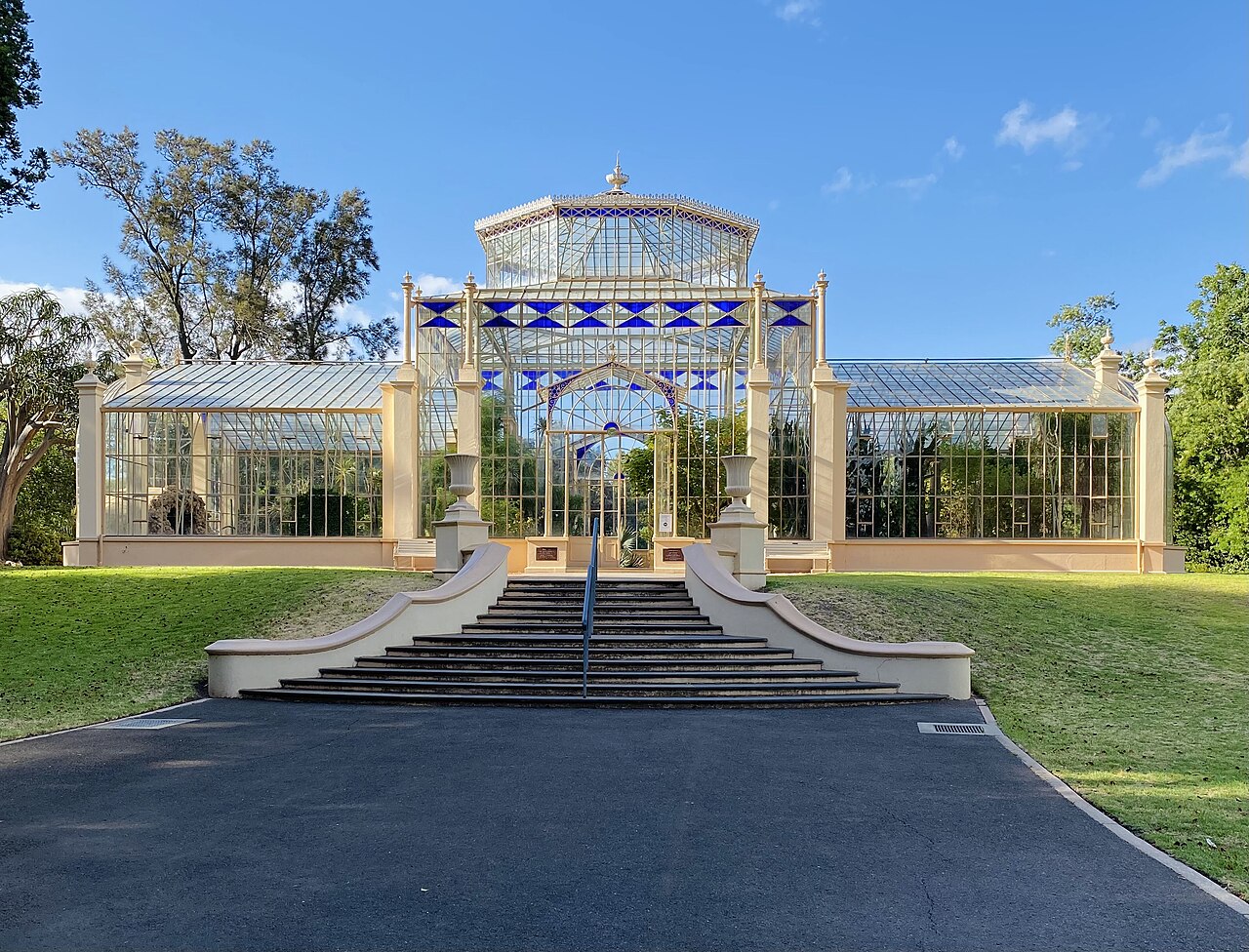
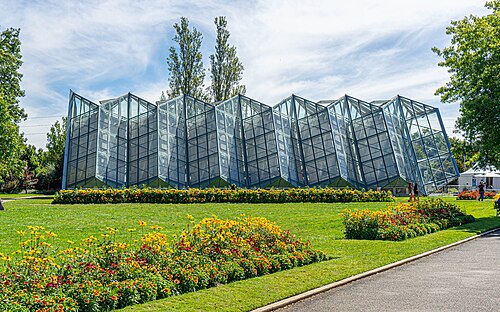
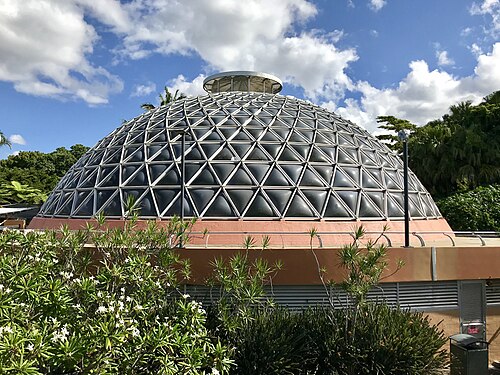
Completed in July 2007 for the 150th anniversary of Adelaide Botanic Garden, this pavilion replaced the Victoria House designed in 1867 by Richard Schomburgk, the garden's second director, for the giant Amazon waterlily. It keeps the original heritage-listed pond beneath an envelope in which glass does most of the structural work: some 400 panels, load-bearing columns and beams of laminated glass, and steelwork patterned on the veins of a Victoria leaf. The waterlily flowers here from September to April, surrounded by bromeliads, orchids and begonias.
Affiliate links — booking through Verrière helps fund our research, at no extra cost to you.
History
1 min
The giant Amazon waterlily, long known as Victoria regia and now as Victoria amazonica, has a special place in Adelaide. Richard Schomburgk, the botanic garden's second director, had himself collected and classified specimens during expeditions to Guyana, and in 1867 he designed the Victoria House, a glasshouse built around a pond for the plant.
The original timber-framed superstructure was replaced in the 1950s by an aluminium structure, which was badly dilapidated by 2005. The decision was then taken to replace it with a contemporary glass pavilion while keeping the original heritage-listed pond at its centre. The project formed part of the garden's 150th anniversary celebrations. The client was DAIS, the state's administrative services department (now DTEI); the design was by Flightpath Architects, with Aurecon as structural engineers, Built Environs as builder and Construction Glazing installing the glass.
Funding came from 2.6 million dollars of South Australian government money, 1.58 million in donations raised by the Gardens 150 campaign and 0.17 million from the garden's Board and Trust Fund. The glass and structural work was finished by mid-June 2007 and the building was handed over in mid-July, on schedule. On 1 January 2008 the waterlily flowered for the first time in its new home.
Architecture and engineering
1 min
Glass does most of the structural work in the pavilion: around 400 panels cover some 500 m², and the load-bearing beams and columns are themselves made of glass. Aurecon's engineers describe it as the first Australian public building to use structural glass as its main supporting material. Walls and roof are of laminated toughened glass; the beams and columns are triple-laminated. Each ply of a beam can carry the service loads on its own until a replacement is fitted; the columns combine a 19 mm core, able to carry those loads, with two protective 10 mm sacrificial layers. Analysis allowed the roof panels to be reduced from 20 mm to 16 mm, and the saving paid for self-cleaning glass.
For reasons of cost, steel provides lateral bracing and carries part of the sloping side canopy, laid out in a pattern that echoes the veins on the underside of the waterlily's leaves. The panels are held by stainless steel patch fittings; at the corners, spherical fixings hold adjacent panes in place when one has to be replaced. Touches of pink on some glass panels, the door handles and parts of the steelwork recall the colour the flower turns after pollination. A gas boiler feeds two heating loops, one in the pond and one around the pavilion, while automatic louvres and back-up exhaust fans cool the air in summer.
Plant collections
1 min
The pavilion is built around a single star plant, Victoria amazonica, which grows wild in the backwaters of the Amazon. Its flowers can reach 40 cm and its pads two metres across; its first flowering in the new building, on 1 January 2008, produced a bloom 30 cm across and 12 cm high, while the largest pad reached 165 cm.
Flowers appear mainly between September and April, and each lasts only about 48 hours. White and scented on the first evening, it draws in beetles and closes over them; it reopens the next evening, now pink or purple, lets the pollen-carrying insects move on, then closes again and sinks beneath the water. Around the pond the planting combines bromeliads, orchids and begonias, and an interpretive gallery explains the plant's form, its biology and its cultural and symbolic significance.
Visiting
1 min
The pavilion stands in Adelaide Botanic Garden, in the heart of the city, among the garden's heritage buildings. About twenty minutes is enough, including the interpretive gallery.
The best period runs from September to April, when the waterlily is in flower; since each bloom lasts only about two days, it can be worth returning a few days apart to follow several flowerings. A visit combines naturally with the garden's two other glasshouses, the Victorian Palm House and the Bicentennial Conservatory, both also featured in this atlas.
34.92° S, 138.61° E
Greenhouses nearby
More greenhouses — Australia

Do you have a good photo of this greenhouse? Suggest it for this page →