Bicentennial Conservatory
Adelaide Botanic Garden

Sources checked September 2026
- Year
- 1989
- Architect
- Guy Maron
- Style
- Curved steel framework
- Dimensions
- 100 × 47 × 27 m
- Status
- Open to the public
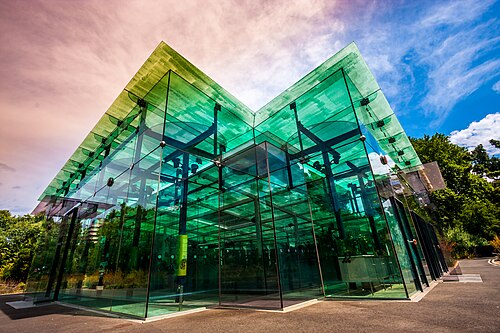
Built for the bicentenary of European colonization in Australia, this glasshouse remains the largest single-span conservatory in the Southern Hemisphere. Its curved steel frame, designed by South Australian architect Guy Maron, shelters a recreated lowland rainforest with species from northern Australia, Papua New Guinea, and the Pacific islands, several of which are now endangered in their native habitats.
Affiliate links — booking through Verrière helps fund our research, at no extra cost to you.
History
The Bicentennial Conservatory was built for the 1988 bicentenary, which marked the arrival of the First Fleet and the beginning of European colonisation in Australia. The commission went to South Australian architect Guy Maron. The Botanic Gardens date it to 1988 or 1989.
The glasshouse was originally heated to support a tropical lowland rainforest. Budget cuts led in early 2012 to the controversial decision to stop heating the building and to remove tropical plants; in April 2012 the separate entry fee was abolished. The building won awards for its design, engineering and landscaping when new, and in 2014 received the Australian Institute of Architects' Jack Cheesman Award for Enduring Architecture, which recognises buildings that have stood the test of time.
Architecture and engineering
The conservatory is 100 metres long, 47 metres wide and 27 metres high, which the Botanic Gardens say makes it the largest single-span conservatory in the Southern Hemisphere: no internal column interrupts the space. Its curving profile has become a familiar Adelaide landmark.
A slender steel frame carries about 2,434 m² of reinforced glass forming the roof, walls and entrance doors alike. Inside, two walkway systems lead visitors through the forest: one at ground level, winding through the understorey, and one raised into the canopy. Both are wheelchair accessible.
Plant collections
The conservatory displays lowland rainforest plants from northern Australia, Papua New Guinea, Indonesia and the Pacific Islands. Many of them are threatened or endangered in the wild, so the collection serves conservation as much as display.
The elevated walkway brings visitors close to the foliage of the taller trees, while the lower path shows the plants of the forest floor. Tropical plants were removed when heating stopped in 2012; the Botanic Gardens' current description nonetheless still presents the building as a rainforest collection.
Visiting
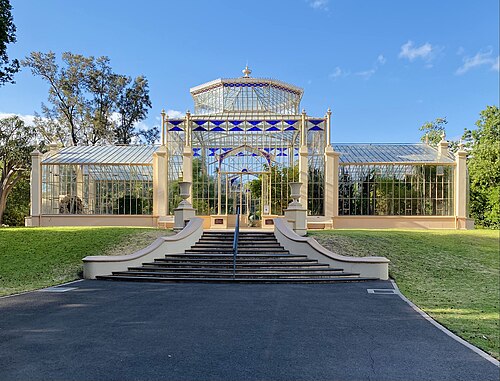
The conservatory stands in the Adelaide Botanic Garden, some 50 hectares on the edge of the city centre. It pairs naturally with the 1877 Palm House, the Amazon Waterlily Pavilion and the Museum of Economic Botany, all within the same garden.
The forest-floor path and the canopy walkway give two successive views of the same forest. During heatwaves in the Australian summer, the garden follows a heat protocol that can close the conservatory early or for the whole day, which is worth bearing in mind for a summer visit.
34.92° S, 138.61° E
Greenhouses nearby
More greenhouses — Australia
Do you have a good photo of this greenhouse? Suggest it for this page →
Affiliate links — booking through Verrière helps fund our research, at no extra cost to you.